

Key takeaways
- Global data center CPU demand is surging as AI and cloud workloads grow, pushing the market to roughly double in size over the next decade.
- New CPUs like Intel Xeon Platinum 8558P are built for cloud-native and AI workloads, and GreenNode plans to offer them so enterprises get high-performance compute without buying hardware.
The market for cloud infrastructure — particularly CPUs and high-performance processors—is emerging as one of the most critical pillars of global technology growth. With the rapid expansion of AI, machine learning, cloud services, and big data applications, demand for powerful, efficient, and flexible CPUs has surged significantly and is expected to continue growing strongly over the next decade.
Market size and growth forecast
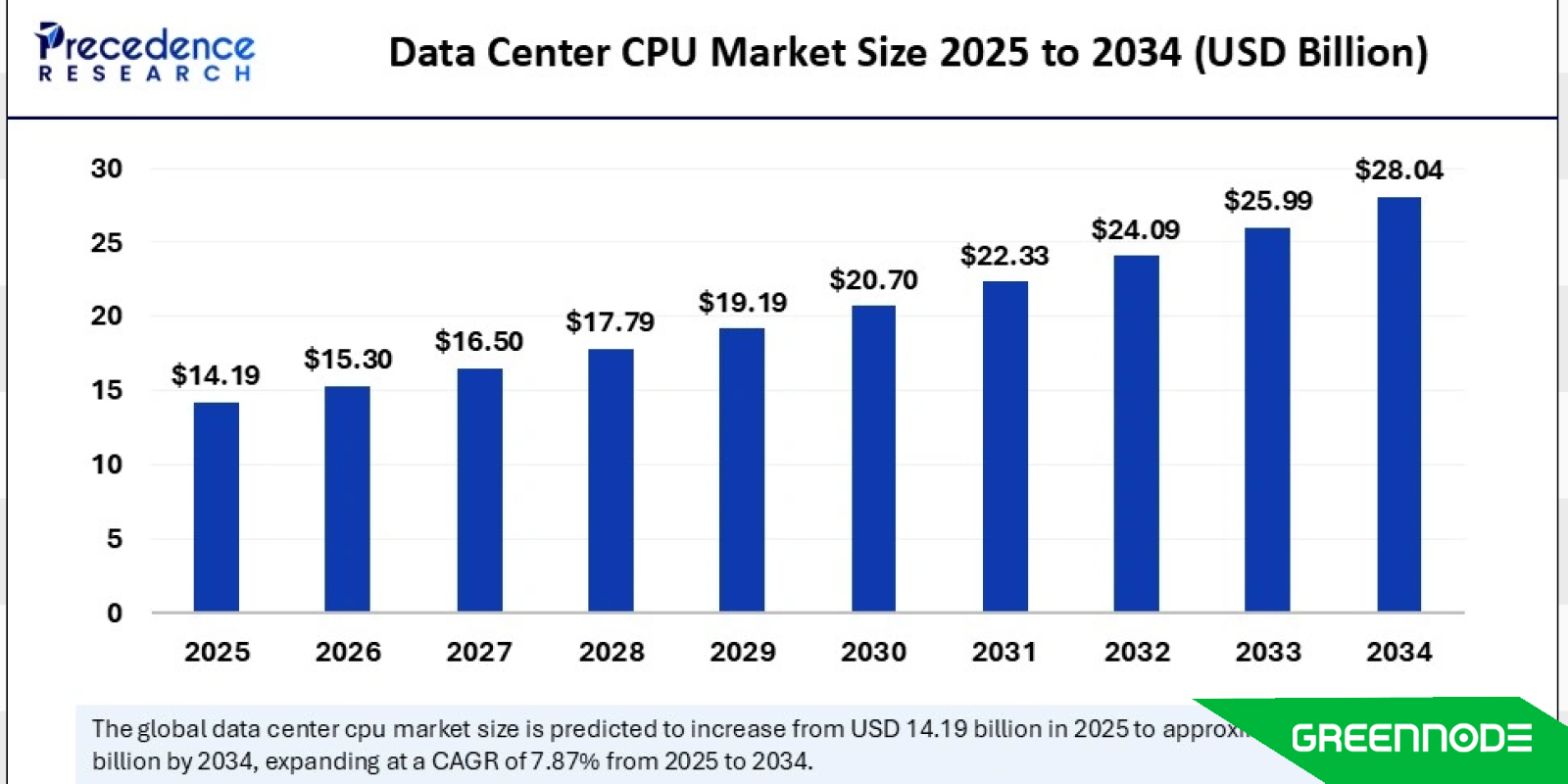
According to the latest report from Precedence Research, the global data center CPU market is valued at approximately USD 14.19 billion in 2025 and is projected to nearly double to around USD 28.04 billion by 2034, representing a compound annual growth rate (CAGR) of about 7.87% during the 2025–2034 period. This growth highlights the sustained demand for high-performance CPUs as cloud computing and AI workloads continue to scale.
Meanwhile, an independent study by Mordor Intelligence also indicates that the CPU segment within the global data center processor market (alongside GPUs, ASICs, etc.) will continue to grow strongly, driven by demand for faster data processing, higher performance, and chip architectures optimized for AI workloads.
Market Growth Drivers
The strong growth of the data center CPU and chip market is being fueled by multiple technology trends occurring in parallel—from the AI wave and cloud adoption to the rapid scaling of computing demand and ongoing innovation in processor architectures.
1. The Rise of AI & Machine Learning
CPUs not only play a central role in system orchestration, but also support complex parallel processing and integrate with accelerators such as GPUs and TPUs to handle AI/ML workloads. The rise of enterprise AI is pushing data centers to upgrade processing components to meet massive compute requirements.
2. Widespread Cloud Adoption
Many enterprises and organizations are migrating workloads to the cloud to take advantage of flexibility, scalability, and cost efficiency. This shift requires CPUs that can handle a wide range of workloads—from data storage and application hosting to AI model deployment.
3. Rapid Growth in Computing Scale
With multi-core server architectures, multitasking CPUs, and support for virtualization and containerization, modern CPU designs are becoming increasingly critical to optimizing server resource utilization while maintaining high performance.
4. Architectural Innovation Trends
Beyond traditional x86 architectures, new approaches such as ARM-based designs and specialized processors are being adopted to optimize performance-per-watt, making them well suited for cloud-native environments and AI workloads.
Market Challenges & Barriers
Despite being strongly driven by AI, cloud computing, and big data, the data center chip and CPU market still faces multiple structural challenges that directly impact both hardware manufacturers and enterprises deploying infrastructure.
- Intense Competition Among Manufacturers
The market is seeing increasingly fierce competition among major players such as Intel, AMD, NVIDIA, ARM, along with emerging chip designers and processor architectures. Competition is no longer limited to raw performance, but extends to energy efficiency, total cost of ownership (TCO), scalability, and optimization for AI workloads. This pressure forces vendors to invest heavily in R&D and continuously innovate architectures, while making chip supply chains and manufacturing processes more complex and costly than ever.
- High Costs and Supply Shortage Risks
Beyond competition, the market is heavily affected by rising production costs and prolonged global chip shortages in recent years. Access to next-generation CPUs and data center chips has become increasingly challenging, especially in developing markets. As a result, enterprises must carefully evaluate long-term infrastructure investment strategies—balancing performance, cost, and hardware availability—while increasingly turning to cloud platforms that offer more stable and flexible supply compared to on-premise infrastructure investments.
The growth of data center CPUs is not only a signal of rising infrastructure demand, but also underscores that investing in powerful, flexible compute infrastructure capable of supporting AI workloads has become mission-critical for cloud providers, SaaS companies, AI-driven enterprises, and organizations undergoing digital transformation.
Even amid intense competition and supply chain constraints, the long-term outlook for this market remains highly positive — reflecting the continued industrialization of data- and AI-driven workloads in the near future.
Ready for Next-Generation Cloud & AI with Intel Xeon Platinum 8558P
Intel Xeon Platinum 8558P is a high-end processor in the 5th Gen Intel Xeon Scalable family, designed for modern data centers, large-scale cloud infrastructure, and high-performance workloads. Positioned in the Platinum tier—the highest level of the Xeon portfolio. This CPU targets enterprises and cloud service providers that require strong performance, high reliability, and long-term scalability.
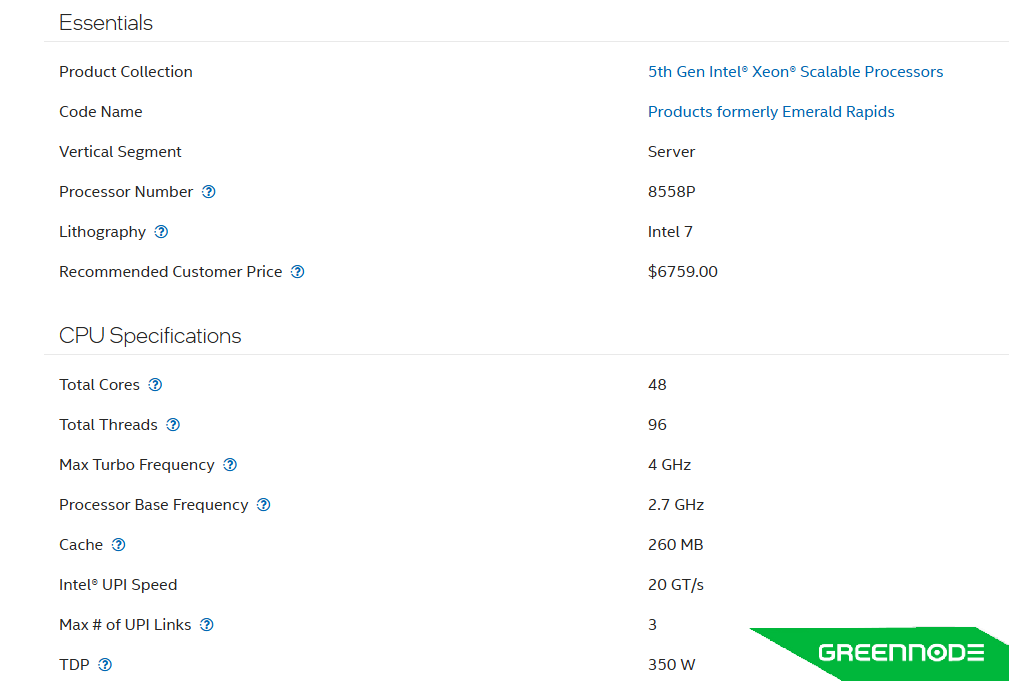
With 48 cores / 96 threads and a 2.7 GHz base frequency, the Xeon Platinum 8558P efficiently handles parallel workloads such as virtualization, containers, microservices, large-scale databases, and AI inference/training, while still delivering strong single-core performance for latency-sensitive applications. Support for DDR5 memory and a large cache increases memory bandwidth, reduces latency, and optimizes overall throughput for big data, real-time analytics, and AI workloads.
Optimized for cloud-native architectures, Intel Xeon Platinum 8558P provides robust support for virtualization, orchestration, and enterprise-grade security, enabling cloud service providers to maintain high SLAs while maximizing infrastructure resource efficiency.
Despite ongoing global hardware supply challenges, GreenNode continues to reinforce its position as a leading innovator among cloud service providers in Vietnam by planning to bring Intel Xeon Platinum 8558P to its cloud infrastructure in early 2026. This enables enterprises to access high-performance compute without investing in physical infrastructure, ensuring readiness for next-generation Cloud and AI workloads.
Register for a consultation with GreenNode to assess your organization’s actual requirements and select the most suitable next-generation CPU configuration for Cloud, AI, and high-performance workloads.
