

Key takeaways
- AI-driven demand and a shift of capacity to HBM have triggered a RAM “supercycle,” with DRAM and NAND flash prices spiking sharply, shortages expected to last into 2026–2028, and data center costs rising across the board.
- Memory demand is now led by AI data centers and cloud services, with additional pressure from 5G/edge, PCs/gaming, smartphones, automotive and IoT, making RAM a volatile, strategic resource rather than a stable line item.
- GreenNode (formerly VNG Cloud) helps enterprises navigate this volatility by shifting workloads to cloud, optimizing DDR4 vs DDR5 adoption, phasing memory upgrades, and designing right-sized, scalable architectures that balance performance, cost, and RAM market risk.
Flash memory has become one of the most in-demand commodities in the technology sector, alongside DRAM, as AI-driven workloads continue to push data storage requirements higher. According to TechPowerUp, SanDisk raised its NAND flash contract prices by approximately 50% in November 2025, reflecting tightening supply–demand conditions.
Following a pattern similar to the sharp rise in DRAM prices - up 172% year over year - the NAND flash market is expected to face comparable upward pressure. In response, several module manufacturers have temporarily suspended shipments to reassess pricing strategies and customer commitments.
Major industry players, including Transcend, Innodisk, and Apacer Technology, are among those pausing deliveries. Transcend, in particular, has suspended new quotes and outgoing deliveries starting November 7 2025, citing the need to evaluate next steps amid ongoing market uncertainty. The company has also indicated that the NAND flash shortage is likely to persist, with prices continuing to rise before eventually stabilizing at more sustainable levels.
AI Boom: Why do data centers need more RAM now?
DRAM is a foundational component of modern IT infrastructure, and this market is inherently cyclical, alternating between periods of oversupply and shortage depending on wafer capacity, manufacturing yields, and demand. After an oversupply phase in 2024, when post-pandemic demand cooled, the market entered a new cycle in 2025, with the explosion of AI and data center demand acting as the key catalyst.
The rapid expansion of large-scale AI models has pushed hyperscalers to deploy servers at an unprecedented pace, driving strong demand for high-bandwidth memory (HBM) used in GPUs and AI accelerators. For instance, AWS has quietly raised prices on its EC2 Capacity Blocks for ML by approximately 15% recently. Because HBM offers significantly higher margins, manufacturers have reallocated wafer capacity from conventional DRAM to HBM, abruptly tightening DRAM supply. As a result, the market has entered a DRAM “supercycle”, characterized by sharp price increases (with many reports indicating multi-fold year-over-year growth) and inventories falling to critically low levels.
The late-2025 crisis differs from previous cycles driven by PCs or smartphones; instead, it is dominated by AI and data center demand and reflects a supply shortage caused by reallocation, rather than organic long-term demand growth. Although memory vendors maintain substantial capital investment budgets, much of this spending is prioritized for HBM and advanced process nodes, making a rapid recovery in DRAM supply difficult. This has significantly increased data center infrastructure costs, forcing enterprises and operators to reassess hardware investment strategies and seek more flexible deployment models to mitigate the risk of cost volatility.
In a nutshell, RAM shortage was triggered by a combination of explosive demand growth and structural supply constraints, including:
- AI-driven demand surge: Rapid expansion of AI data centers has massively increased demand for DRAM, HBM, and LPDDR across CPUs, GPUs, and AI accelerators, pushing memory consumption far beyond historical norms.
- Shift to HBM production: Memory manufacturers have reallocated wafer capacity from conventional DRAM to higher-margin HBM for AI workloads, sharply reducing available DRAM supply.
- Slow capacity expansion: New DRAM fabs require 3–5 years to build, and vendors remain cautious about overinvesting due to concerns over a potential AI demand bubble.
- Intensifying competition for supply: Hyperscalers, governments, and large OEMs are securing long-term contracts and stockpiling memory, further tightening the market.
- Prolonged shortage outlook: Analysts expect the current DRAM shortage cycle to persist into 2026–2028, with supply easing only as new fabs come online.
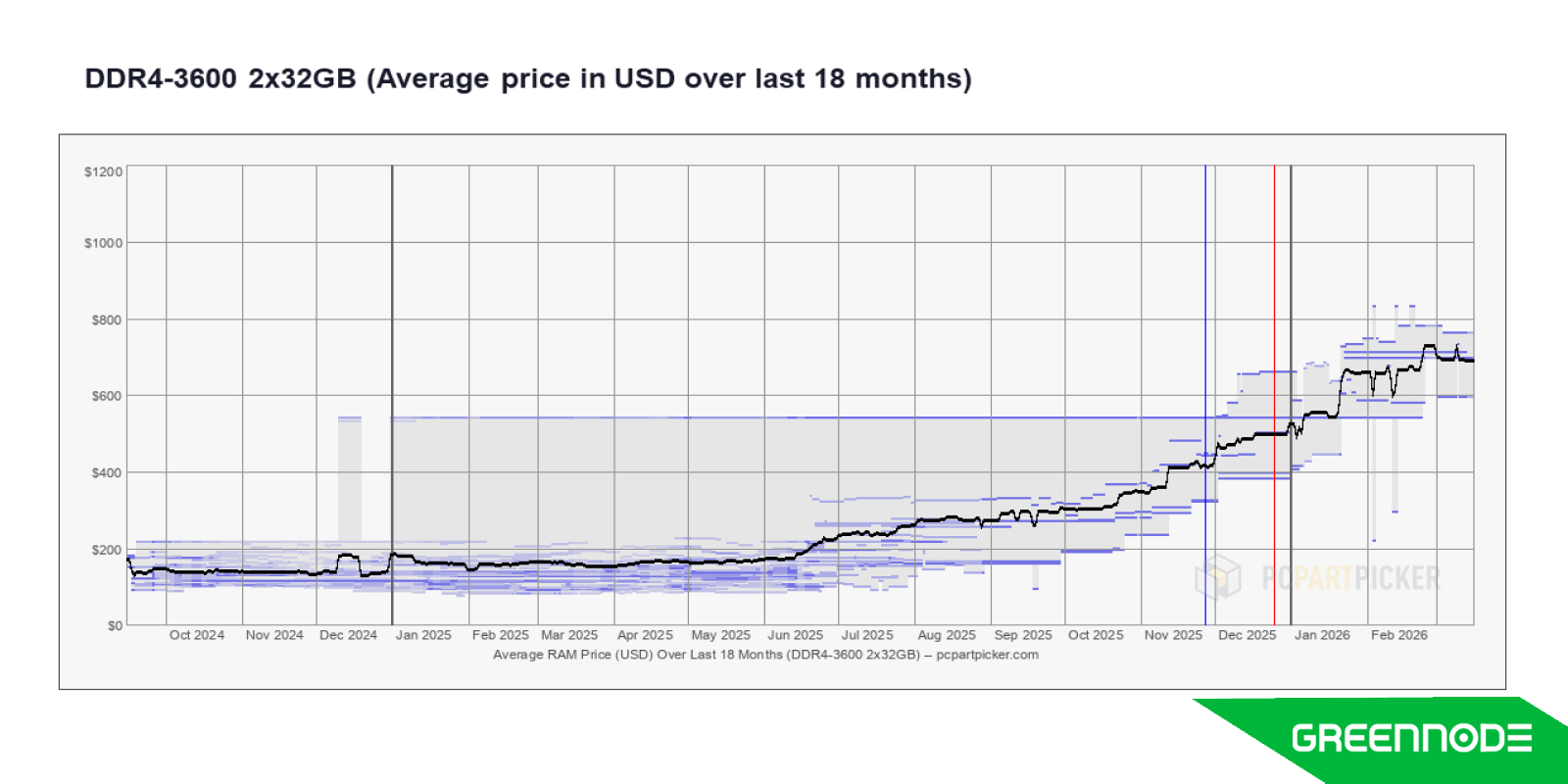
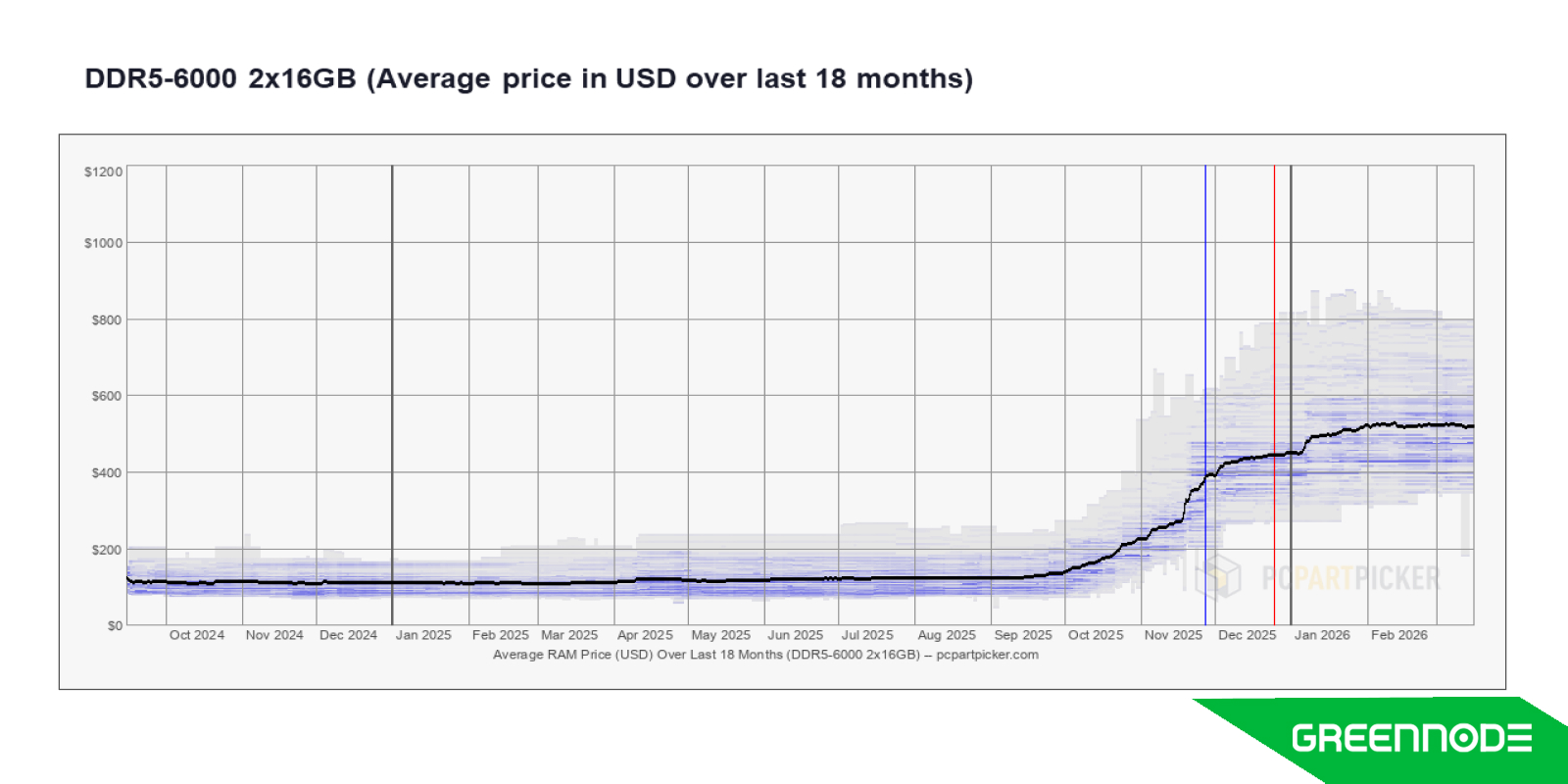
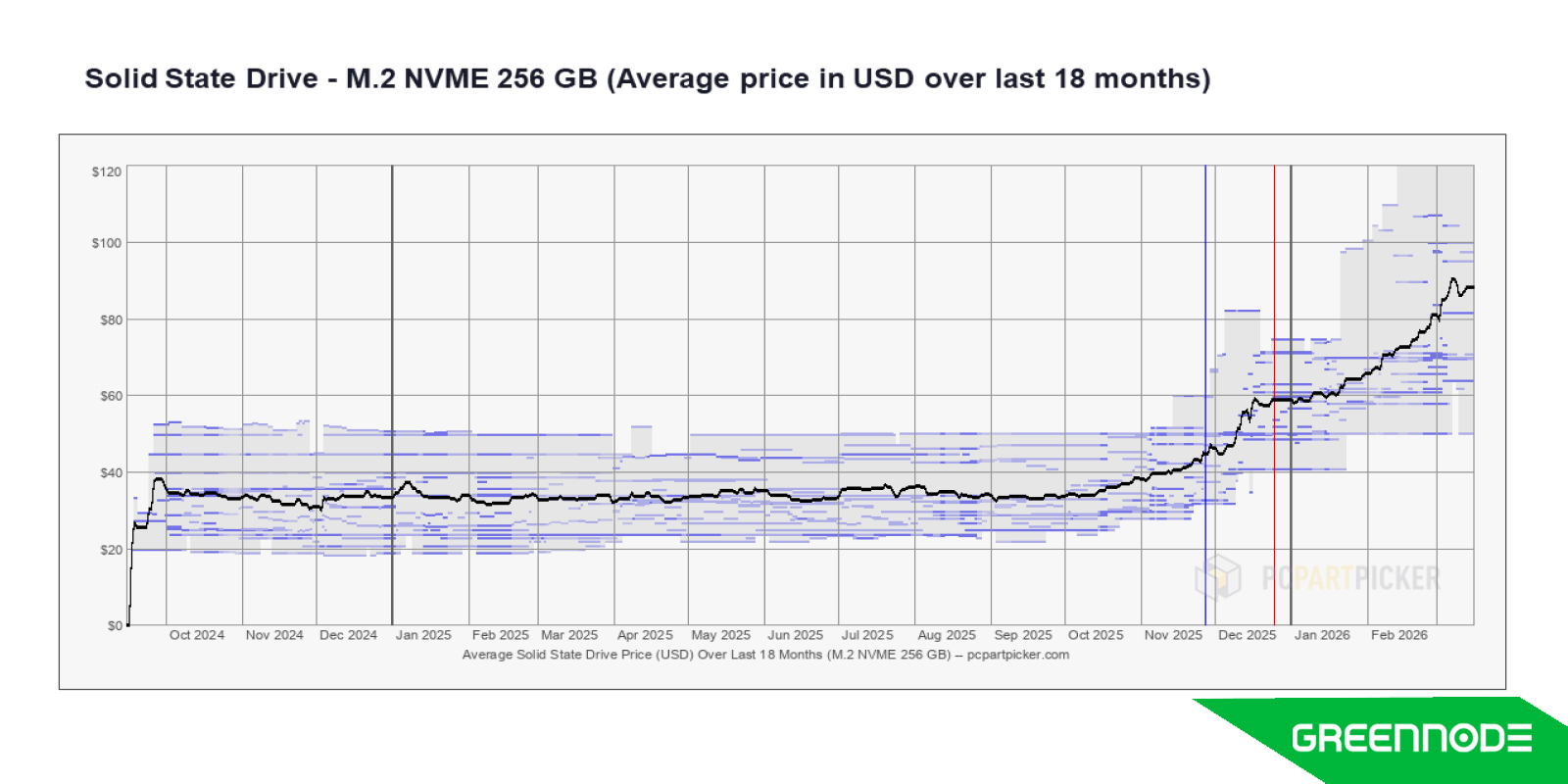
Other benchmarks conducted by PCpartpicker.com to compare the price history of PC parts reveal a much more brutal picture:
RAM Demand Analysis
The surge in memory demand by December 2025 is multi-layered but overwhelmingly driven by AI and data center workloads:
- AI Data Centers (Primary Driver): Large-scale AI training and inference clusters now allocate memory budgets comparable to GPUs. Modern AI servers consume massive amounts of HBM and DDR5, with top-tier GPUs using up to 1TB of HBM each, rapidly draining global memory supply and pushing server DRAM prices sharply higher.
- Cloud & Web Services: AI inference services (e.g. ChatGPT, Bing Chat) combined with hyperscaler growth require vast server fleets, allowing cloud providers to absorb higher memory costs and further intensifying demand.
- Networking & Edge Infrastructure: 5G/6G, edge computing, and next-gen networking equipment require higher memory per unit, adding incremental demand alongside AI growth.
- Consumer PCs & Gaming: While no longer the main driver, PC and gaming markets are impacted by supply tightness, with DRAM prices rising significantly and retail availability shrinking.
- Smartphones, Automotive & IoT: Adoption of LPDDR5X in premium smartphones, along with growing memory needs in automotive, VR/AR, and IoT systems, adds further pressure to an already constrained market.
- Other Electronics: Laptops, smart TVs, routers, game consoles, and other DRAM-dependent devices are facing higher costs and supply delays. As DDR3/4 kits become scarce, some production runs are delayed or more expensive, with OEMs reporting memory procurement as a bottleneck in late 2025.
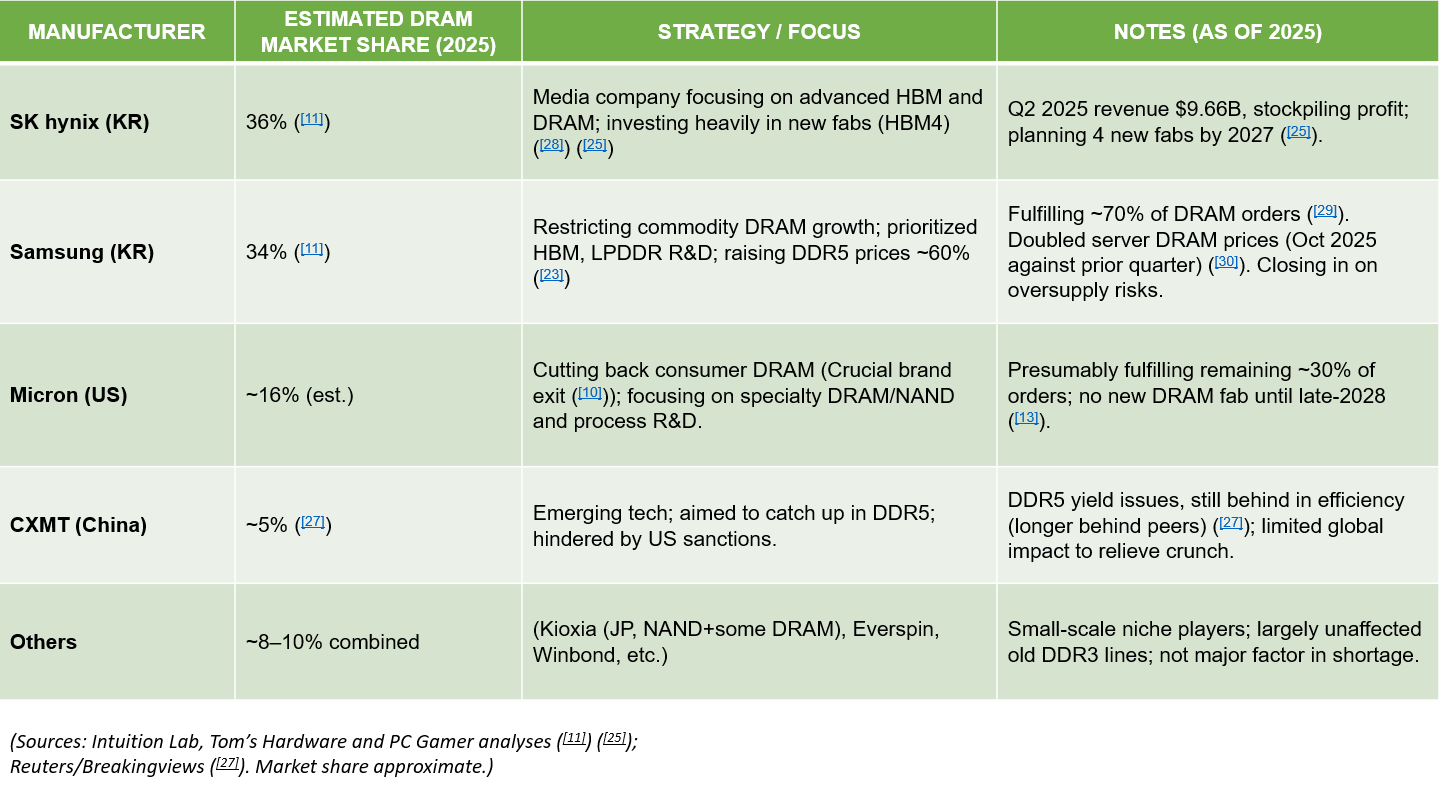
The table below summarizes the major manufacturers, their estimated market share as of Q2 2025, and their strategic positioning (Source: Instuition Lab):
Implications for Your IT Planning
- Migrating from on-premises infrastructure to on-cloud: Moving workloads to a cloud platform like GreenNode* helps enterprises reduce exposure to hardware price volatility while still maintaining stable performance on high-end CPU platforms.
- Plan for price volatility: Memory is no longer a stable cost component. For 2026, RAM should be treated as a variable cost driver, with flexibility built into budgets and infrastructure planning.
- Optimize existing platforms: Where technically feasible, continuing to leverage DDR4-based environments can be a cost-effective option, avoiding premature migration to fully provisioned DDR5 systems.
- Adopt phased capacity growth: Large memory upgrades should be approached in stages—starting with a practical baseline and expanding capacity as workloads, budgets, and market conditions evolve.
- Stage memory-intensive workloads: For virtualization, databases, AI, and in-memory analytics, planning capacity targets (e.g. 128 GB → 256 GB → 512 GB) in phases helps maintain scalability without committing to peak configurations at unfavorable price points.
Read more: Beyond the 50% Surge: Why Server Inflation is the New Enterprise Risk
How GreenNode supports you
As your Cloud Service Provider, GreenNode continuously monitors global memory pricing trends, supply constraints, and market signals. We translate this insight into practical guidance—helping customers choose the right cloud platforms, memory configurations, and deployment timelines to keep projects both technically sound and financially predictable.
Whether you are:
- Extending existing DDR4-based workloads or evaluating a move to DDR5
- Planning a new ERP or database platform and need realistic memory budgeting
- Deploying AI workloads or GPU-based systems and want to avoid over- or under-provisioning
GreenNode can assess your requirements, compare platform options, and design a phased compute strategy that balances performance, scalability, and cost — while mitigating current RAM market risks. Contact us now for free consultancy!
