

Key takeaways
- GreenNode AgentBase is a fully managed platform to deploy and operate AI agents in production, so teams can scale from prototype to thousands of agents without building their own infrastructure, security, or observability stack.
- AgentBase is built from six modular services—Runtime, Access Control, Insight, Context (memory), Gateway, and Tool—that together handle execution, identity/permissions, logging, memory, traffic routing, and tool integration for any agent framework or model.
- Integrated with GreenNode’s AI Cloud and MaaS, AgentBase lets developers plug in powerful LLMs, give agents persistent memory, and manage them via a single control plane instead of babysitting DIY multi‑agent setups.
GreenNode AgentBase is a fully managed infrastructure platform designed to help teams deploy and operate AI agents in production without building the underlying runtime, security, memory, and observability stack from scratch.
AgentBase is currently in Alpha. It is built for early teams that already have an agent prototype—or are close to launching one—and want a faster, more reliable path to production.
Importantly, AgentBase does not replace the framework you already use to build your agent. You can continue developing with tools such as LangGraph, CrewAI, LlamaIndex, or your own internal framework, while AgentBase handles the production layer behind the scenes.
Why AI Agents Stall After the Demo
Getting an AI agent to work in a demo is no longer the hardest part. The real challenge begins when you try to run that same agent for real users, across real workloads, with production-grade reliability and security.
Many teams discover that what worked well for ten users becomes fragile at scale. Sessions reset, latency spikes, integrations break, credentials become difficult to manage, and debugging becomes painfully slow.
Infrastructure does not scale cleanly
It is common for an agent to perform well in a small proof of concept, then struggle once traffic increases. Without autoscaling, session persistence, and isolation, the system becomes unstable under load.
Identity and access become a serious risk
In production, shared API keys and manually managed credentials are not sustainable. Enterprise teams need proper authorization, auditability, and secure access to both internal and external systems.
Integrations become brittle
Every CRM, ERP, database, and internal API adds complexity. If each integration is custom-built and tightly coupled, even a small API change can break the entire workflow.
Observability is often missing
When an agent fails, teams need to know which step caused the issue, what tool was called, how long it took, and what happened inside the reasoning flow. Without that visibility, debugging takes hours or days instead of minutes.
What AgentBase Does
AgentBase is built to close the gap between prototype and production. Instead of asking teams to stitch together runtime orchestration, access control, memory services, API tooling, tracing, and built-in capabilities on their own, it packages these production needs into a single modular platform.
According to GreenNode, AgentBase consists of six core services that can be used independently or together: Runtime, Access Control, Insight, Context, Gateway, and Tool.
1. Runtime
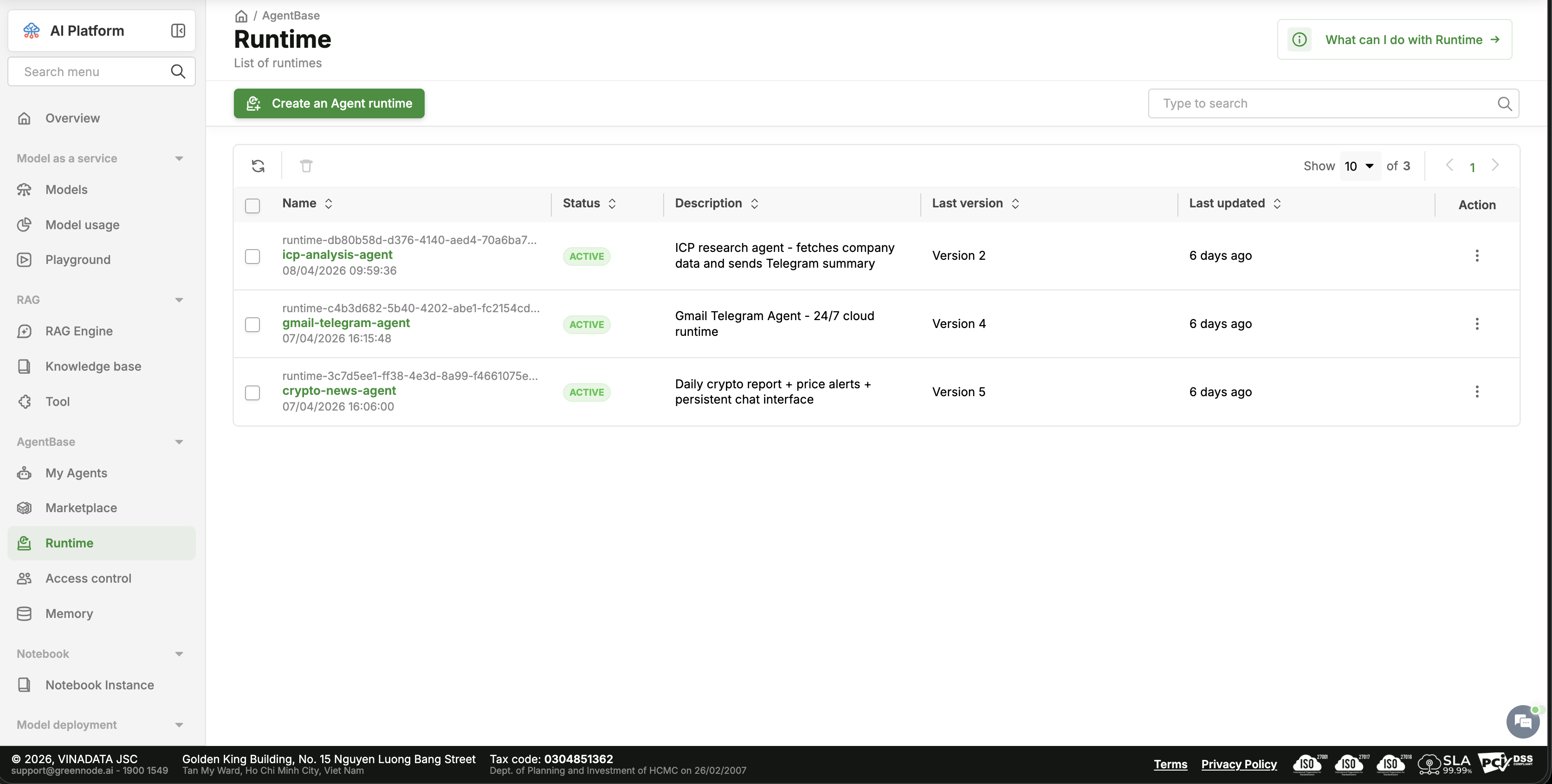
The Runtime module provides a serverless environment for deploying and scaling AI agents in isolated micro-VMs. It supports autoscaling, versioning, and zero-downtime deployment so teams can move faster without maintaining custom runtime infrastructure.
2. Access Control
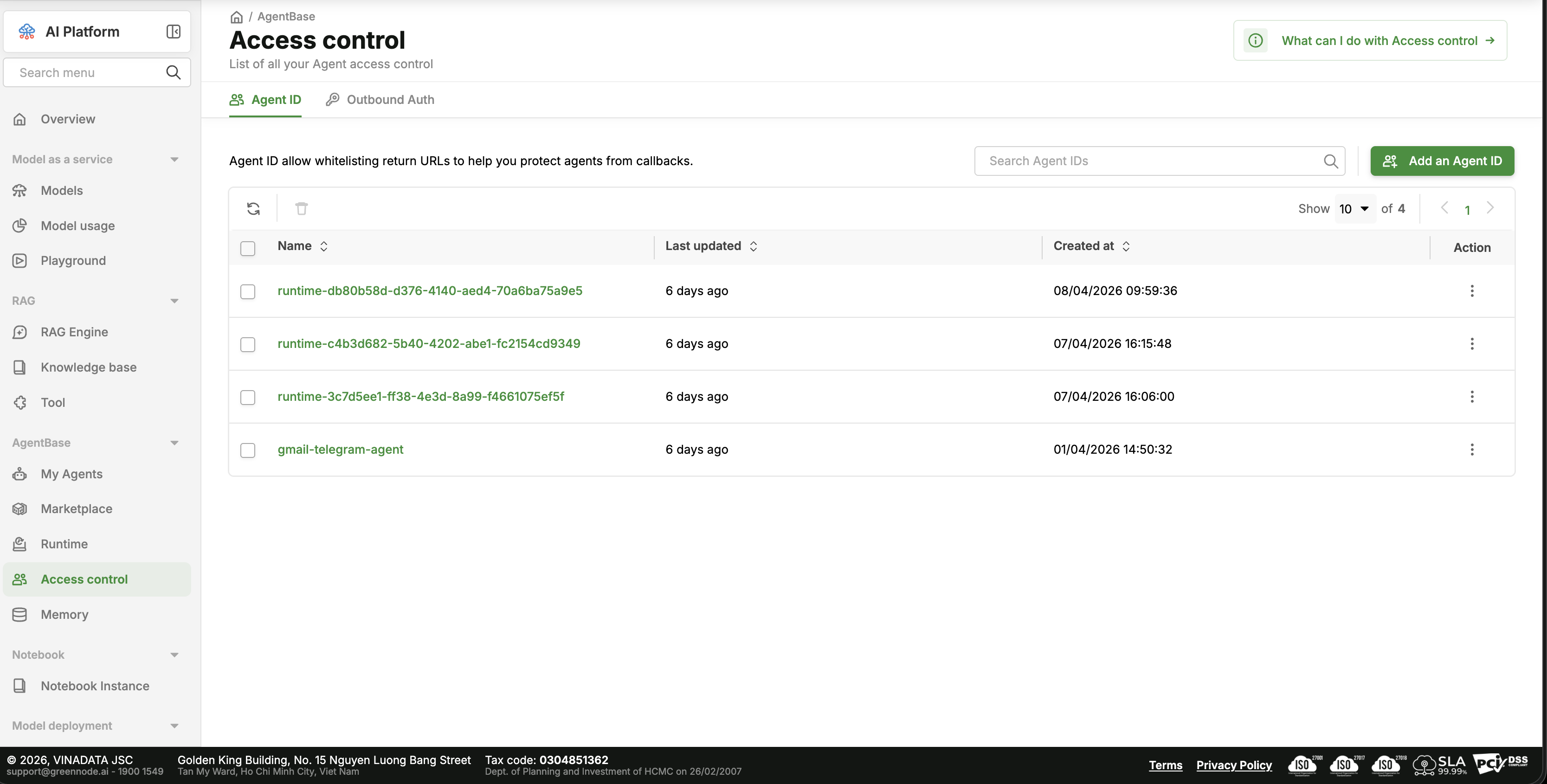
Access Control helps agents authenticate securely with internal and external systems. It supports both user-to-machine and machine-to-machine authorization, integrates with enterprise identity providers, and improves control over credentials and permissions.
3. Memory
The Memory layer gives agents both short-term and long-term memory. That means an agent can preserve conversation state inside a session while also retaining useful long-term information such as user preferences, history, and interaction patterns.
4. Gateway
The Gateway turns existing APIs into agent-ready tools. Instead of rebuilding tool access from scratch, teams can expose current services in a format that agents can discover and use more easily.
5. Insight
Insight provides observability for AI agents in production. Teams can inspect reasoning paths, track latency and token usage, monitor failures, and plug the data into existing observability workflows through standards such as OpenTelemetry.
6. Built-in Tools
AgentBase also includes built-in capabilities for common agent tasks, including RAG-style retrieval, code execution, browser interaction, and MCP-based connectivity. This reduces the amount of custom engineering required for each new deployment.
7. OpenClaw 1-Click Deployment on AgentBase
One of the clearest examples of AgentBase in action is OpenClaw 1-Click deployment. GreenNode documents this as a way to launch a personal AI agent on AgentBase in roughly 40 to 60 seconds, with automatic connection to GreenNode MaaS and no manual infrastructure setup.
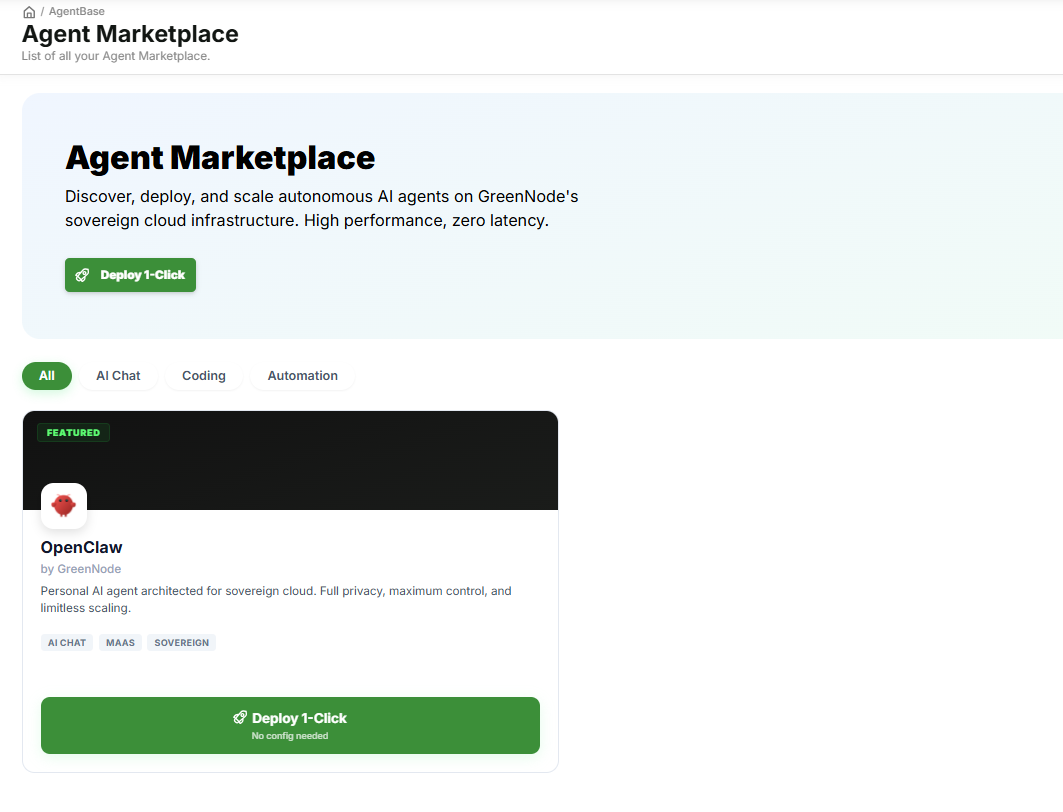
The workflow is intentionally simple: users go to the Agent Marketplace, choose OpenClaw, click the one-click deployment option, and let the platform provision the instance, configure the runtime, and prepare the environment. After that, they can open the OpenClaw dashboard and start using the agent immediately.
This matters because it shows what AgentBase is really trying to achieve: reducing the operational burden of agent deployment so teams can focus on outcomes, not setup. OpenClaw is not just a demo on top of AgentBase—it is a practical example of how production-ready agent infrastructure can be packaged into a much faster, cleaner experience.
People also read: Run OpenClaw on AgentBase Runtime: keep your AI assistant online 24/7
Why This Matters for Production Teams
The value of AgentBase is not just that it hosts an agent. Its real value is that it removes a large amount of production engineering work that usually sits outside the core agent logic.
That means engineering teams can spend more time improving task quality, tool design, workflow orchestration, and business outcomes—instead of building session layers, secret handling, integration middleware, and tracing systems around every project.
With vs. Without AgentBase
| Criteria | With AgentBase | Without AgentBase |
|---|---|---|
| Time to production | Days, with managed runtime and simplified deployment | Weeks to months of manual setup and integration |
| Scalability and reliability | Serverless autoscaling, session persistence, isolated execution | Manual scaling, unstable sessions, higher failure risk |
| Security and IAM | Managed access control, better credential handling, auditability | Shared keys, fragmented permissions, limited control |
| Monitoring and debugging | End-to-end observability, reasoning visibility, structured tracing | Scattered logs, slower diagnosis, limited visibility |
| Agent memory | Managed short-term and long-term context | Custom-built memory stack with more maintenance overhead |
| System integration | APIs can be exposed as agent-ready tools through the Gateway | Custom integrations for each system and workflow |
| Built-in capabilities | Includes retrieval, code execution, browser actions, and MCP connectivity | Each capability must be built and maintained separately |
Who AgentBase Is For
AgentBase is a strong fit for teams that already know how to build agents, but do not want to spend months building the production platform around them.
AI engineering teams
If your team already has a working chatbot, copilot, or workflow agent, AgentBase helps you move from a promising prototype to a production-ready deployment with less infrastructure overhead.
Enterprise IT and digital transformation teams
If you need agents to connect with internal systems such as CRM, ERP, knowledge bases, and proprietary APIs, the value of a managed production layer becomes even more significant.
Software vendors and product teams
If you plan to embed AI agents directly into your product, AgentBase can reduce the cost and complexity of operating those agents at scale.
Example Use Cases
Enterprise chatbot and virtual assistant
Teams can deploy agents that connect directly to internal business systems and knowledge sources. That creates a more useful assistant experience while reducing the amount of manual orchestration required behind the scenes.
Autonomous workflow automation
AgentBase is also suited to multi-step workflows such as approvals, order processing, operations support, and internal process automation. In these environments, the platform’s runtime, gateway, and access control layers become especially valuable.
Embedded AI product features
For software products that need AI search, natural-language actions, or intelligent decision flows, AgentBase provides a more structured path to shipping those capabilities in production.
Why Now Is the Right Time to Get Started - AgentBase GA
AgentBase is now Generally Available, which means your team can move from evaluation to production without waiting. There's no waitlist, no early-access friction — the platform is ready when you are.
For teams already planning an AI agent deployment, this is the right moment to start. You get a production-grade infrastructure stack from day one: identity management, memory, observability, and runtime — all in one platform, backed by GreenNode's direct technical support.
Whether you're running your first agent in production or scaling an existing one, AgentBase is built to meet enterprise teams where they are — with the security, operational simplicity, and governance controls that prototype environments simply can't offer.
If your team is ready to run AI agents in production the right way, GreenNode AgentBase is worth a serious look. Get started on the official product page.
FAQs
Does AgentBase replace frameworks like LangGraph, CrewAI, or LlamaIndex?
No. AgentBase is the production infrastructure layer behind the agent, not the framework used to author the agent itself. Teams can keep building with their preferred framework and use AgentBase to run, secure, observe, and manage the agent in production.
What protocols and standards does AgentBase support?
GreenNode describes AgentBase Runtime as supporting HTTP, MCP, and A2A-style communication patterns, while Insight is designed around observability standards such as OpenTelemetry. This makes the platform easier to integrate into modern agent ecosystems and existing monitoring environments.
How quickly can a team deploy an agent with AgentBase?
The core value proposition is to cut a large amount of setup and infrastructure work out of the path to production. In practical terms, that can mean going from weeks or months of infrastructure setup to a much faster deployment cycle, depending on your architecture and requirements.
Can AgentBase connect to existing enterprise systems?
Yes. The Gateway layer is intended to expose existing APIs as agent-ready tools, and the access layer is designed to work with enterprise identity systems. That makes AgentBase relevant for organizations with complex internal environments.
What does OpenClaw 1-click deployment prove about the platform?
It proves that AgentBase is not only about abstract infrastructure claims. GreenNode shows that a real AI agent can be deployed through the platform in about a minute, with runtime provisioning and model connectivity handled automatically. That is a concrete example of what “deploy fast, forget the infra” looks like in practice.
Who Should Get Started with AgentBase?
AgentBase is built for teams that are ready to move beyond prototypes. If you have an existing agent, a near-term production use case, or a need to embed AI agents into enterprise workflows — this platform is designed for you.
It's especially well-suited for engineering teams that want to ship to production fast, without spending months building identity management, memory, observability, and runtime infrastructure from scratch.
