

Key takeaways
- A standardized runtime for AI agents replaces fragile DIY stacks with a shared execution layer that handles sessions, tools, state, retries, and scaling consistently across all agent workloads.
- This runtime bakes in observability, security, and governance by default—so teams get tracing, policy enforcement, and isolation without rebuilding the same plumbing for every new agent or framework.
- GreenNode AgentBase is now generally available on its AI cloud — giving enterprises a production-ready standardized runtime with built-in identity, memory, and observability to cut operational chaos, cost, and risk at scale.
If you run infrastructure or MLOps today, you’ve probably felt this already: every new “AI agent” your company ships seems to come with its own mini‑platform attached. A different framework, a different queue, a different logging setup - each one “just a small script” until something breaks at 2 a.m.
This isn’t laziness from your teams. It’s a sign that AI agents don’t fit cleanly into the runtime model we built for stateless web services. And if you don’t get ahead of it, you end up with half a dozen DIY stacks that DevOps is forced to babysit.
In this post, we’ll unpack why that happens and why a standardized runtime for AI agents is becoming as important as Kubernetes was for microservices.
The DevOps nightmare of 12 DIY agent stacks
Picture this: you’re on call, and a production “research agent” starts timing out for sales. That agent runs on LangChain, using a custom Celery queue, with logs dumped into a random S3 bucket. Half an hour later, a “support triage agent” built with a different framework shows elevated error rates, but its logs live in a separate Elasticsearch cluster with a totally different schema.
Nothing here is impossible to debug but there’s no single mental model or toolchain you can rely on. Every incident is a scavenger hunt.
How do these DIY stacks happen?
- Someone glues an agent together in a notebook, then wraps it in FastAPI and Docker.
- They add Redis or a message queue for background work.
- They wire in a vector DB, a bit of retry logic, maybe some cron jobs.
- Monitoring and security are “coming in the next sprint.”
Now multiply that pattern across five teams, three languages, and four agent frameworks. You don’t get one AI platform; you get twelve snowflake runtimes.
This approach works fine for the first couple of agents. It collapses once you start talking about dozens, across business units, with real SLAs and compliance requirements.
Why AI agents break traditional runtime assumptions
Part of the trouble is that AI agents don’t behave like the stateless HTTP services our platforms were built around.
A typical microservice is simple: accept a request, hit a database or two, return a response, forget everything. It’s short‑lived, predictable, and easy to scale horizontally by adding more replicas behind a load balancer.
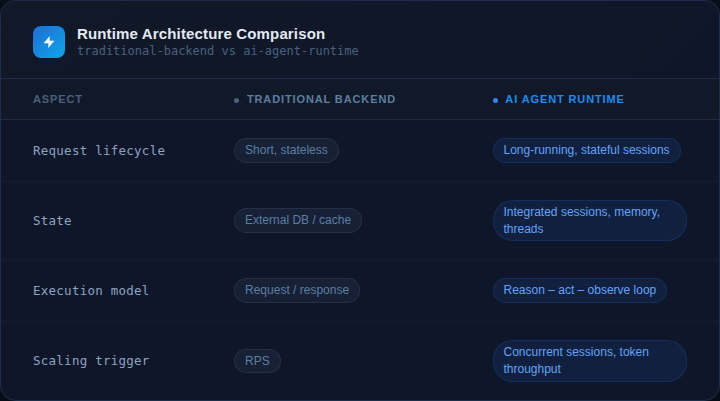
Agents are different in a few important ways:
- They hold conversations and sessions over time.
- They call external tools, run workflows, and wait on humans.
- They can pause, resume, and branch based on non‑deterministic LLM outputs.
Think of an agent as running a long “reason–act–observe” loop:
- Read the user request and existing memory.
- Decide what to do next (LLM reasoning).
- Call tools (APIs, databases, browsers).
- Observe results, update its plan, and continue.
Read more: From Data to Benchmarks: GreenMind becomes Vietnam’s First Reasoning LLM on NVIDIA NIM
That loop might span minutes or hours, involve multiple components, and get interrupted and resumed along the way. It’s much closer to an orchestrated workflow than a single HTTP call.
When you try to force this pattern into a runtime that only understands short‑lived, stateless requests, you get a lot of fragile glue code: custom schedulers, hand‑rolled state machines, ad‑hoc “session stores” bolted onto cache or NoSQL. That’s exactly the kind of bespoke machinery that DevOps ends up maintaining forever.
The hidden cost of letting every team roll its own runtime
From a distance, letting each team build whatever they need can look agile. Up close, the operational cost is brutal.
Some of the biggest pain points we hear from DevOps and platform teams:
- Fragmented observability: Every stack logs differently—JSON here, plaintext there, random fields for latency, cost, and tool usage. Tracing across agent calls is often nonexistent. You can’t get a clean answer to “what is our deflection rate” or “why did this customer’s conversation blow up.”
- Inconsistent deployments and rollbacks: One agent lives in ECS, another in bare EC2, a third in Kubernetes with its own Helm chart. When the security team asks “which agents are still on the old base image,” nobody can say for sure.
- Security and compliance gaps: Some agents run tools in a sandbox; others don’t. API keys and secrets are wired in by hand. Auditors ask for an inventory of what data each agent can touch and how decisions are made, and suddenly every DIY runtime needs emergency work.
- Uncontrolled spend and resource use: Without a shared runtime, it’s hard to see which agents are burning tokens, GPU time, or network calls. You discover cost overruns after the invoice arrives, not while they’re happening.
These problems aren’t unique to you. The broader AgentOps ecosystem exists precisely because operating agents at scale is a different discipline from just building them.
What a standardized runtime for AI agents actually is
A standardized runtime for AI agents is a shared execution layer that all your agents run on, regardless of which framework they’re written in. Think of it as “Kubernetes for agents,” but focused on the things that make agents special.
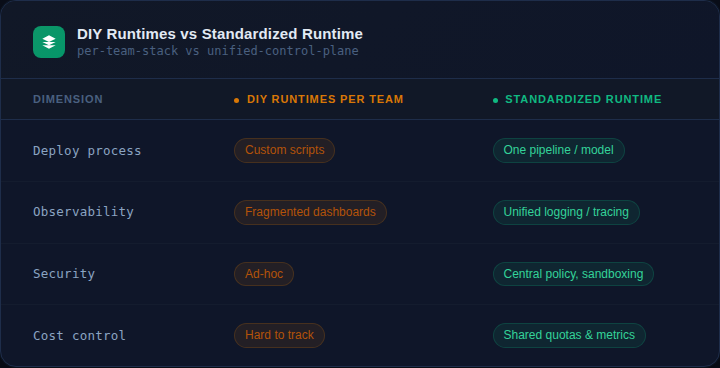
At a high level, such a runtime provides:
- A common lifecycle for agents: Register an agent, deploy a version, route traffic, roll back. No more one‑off deploy scripts per team.
- Built‑in state and session management: The runtime knows how to track conversations, sessions, and workflows so you don’t have to re‑implement that in each repo.
- A robust execution engine for tool calls: Standardized timeouts, retries, circuit breakers, and rate limits for tools, instead of hand‑rolled logic in every project.
- Unified observability: Logs, metrics, and traces for every agent flow, wired into your existing monitoring stack. You get one place to see how agents behave, what they’re costing, and where they fail.
- Central security and policy controls: A single place to define which tools an agent can use, how data is handled, and which safety rules apply at runtime—aligned with emerging standards like runtime safety specs for agents.
Crucially, a standardized runtime doesn’t tell application teams what to build. It just guarantees that once they build an agent, it behaves in ways the platform can reason about, monitor, and secure.
Where a fully managed platform fits into this
Everything we’ve talked about so far points to the same gap: teams are good at building agents, but they don’t want to own yet another custom runtime for each one. This is the gap we’re aiming to close with AgentBase, a fully managed, standardized runtime for AI agents that lets DevOps, MLOps, and platform teams stop stitching together DIY stacks and start running agents on a single, predictable platform.
AgentBase is a production-ready agent control plane and runtime that gives you:
- A standardized runtime that hosts agents built with the frameworks your teams already use — with autoscaling, versioning, and zero-downtime deploys included.
- Centralized identity management for outbound authentication — API keys, delegated keys, and OAuth2 — so tool calls are governed and auditable by default.
- A Memory service for both short-term conversation history and long-term semantic fact storage, so agents don't need to re-fetch or reconstruct context on every turn.
- Built-in observability through runtime logs, CPU and memory metrics, and endpoint-level telemetry across all deployments.
If you're tired of babysitting DIY stacks, AgentBase is ready for your production workloads today.
AgentBase is now generally available. Get started today and run your agents on a standardized, fully managed runtime — no DIY plumbing required.
FAQs
1. Do I really need a new runtime if I already run everything on Kubernetes?
Kubernetes is an excellent base for scheduling containers and keeping them healthy, but it has no built‑in understanding of agent sessions, conversational memory, tool calls, or LLM‑driven workflows. You can absolutely run agents on Kubernetes, and many teams do, yet what happens in practice is that each team quietly rebuilds agent‑specific plumbing inside their own service or operator.
They hand‑roll session tracking, state persistence, safe tool execution, and sometimes even token and cost tracking, all in slightly different ways. A standardized runtime sits on top of Kubernetes and gives you an agent‑aware execution layer that handles these patterns once for everyone. Instead of twelve different approaches to state, retries, and telemetry, you get a single model for how agents live, run, and report back, which is what makes operations and governance manageable at scale.
2. Can I standardize runtimes without rewriting all my existing agents?
In most environments, you can move toward a standardized runtime incrementally, without a big‑bang rewrite. A common starting point is to wrap existing agents behind a thin adapter so the runtime can treat them as workloads it can route to and observe, even if their internal implementation is still “legacy.” From there, you steer new agents onto the standardized runtime by default, so technical debt stops growing, while you selectively refactor older, high‑value or high‑pain agents when it makes sense.
Migration tends to follow the same patterns you already know from other platform shifts: shadow traffic, canary rollouts, and careful rollback paths, but now applied to agent flows rather than just HTTP endpoints. Over time, more of the custom glue logic moves into the runtime, and your teams focus on business logic instead of plumbing.
3. How does a standardized runtime help with security and compliance?
A standardized runtime gives security and compliance teams a single runtime layer where they can see and control what agents are doing, instead of chasing behavior across many DIY stacks. Because all agents run through the same execution engine, you can attach checks and controls around key events such as starting a session, invoking a tool, making a model call, or accessing sensitive data, and you can log those actions in a consistent format that feeds your existing SIEM and audit pipelines.
It also becomes much easier to enforce sandboxing and resource isolation, so one misconfigured agent cannot accidentally overreach or compromise other systems. Emerging runtime safety standards for agents, like AARTS and similar efforts, are designed to live at this layer, which means a single standardized runtime is the natural place to implement them once and apply them to your entire agent portfolio.
4. Is a standardized runtime only useful if we’re building fully autonomous “AGI‑style” agents?
You do not need sci‑fi‑level autonomy to benefit from a standardized runtime. The operational challenges show up as soon as you have a handful of production agents that maintain state, call tools, and matter to the business. Even relatively simple agents, like FAQ assistants, routing bots, internal research helpers, or workflow copilots, create similar needs around session handling, tool orchestration, observability, security, and cost tracking once they move beyond a prototype.
If each of those is deployed on its own mini‑platform, the overhead for DevOps grows linearly with every new agent. When you put them on a shared, agent‑aware runtime, you get one way to see how they behave, what they cost, and how to govern them, and that saves you long before you ever consider building fully autonomous systems.
