

The question that most startup CTOs ask is not "should we use Kubernetes?" but rather "should we self-manage or use a managed service, and which one is actually cheaper when everything is factored in?" The answer depends on a key metric that many overlook during budgeting: the cost of engineering time. This article addresses that directly.
1. What Do Startups Need from Kubernetes Infrastructure?
Kubernetes is not a technology suited for every single stage of growth. However, when a startup surpasses the threshold of roughly 10–15 microservices, or when the team begins to experience friction with manual deployments, Docker Compose is no longer sufficient, and K8s becomes the logical next step.
Startup CTOs generally require 5 specific capabilities from their Kubernetes infrastructure:
- Fast Deployments with Rollback Support: There is nothing worse than deploying at 11 PM with no safe way to roll back. K8s solves this natively using rolling updates and revision history.
- Scaling Based on Real-Time Traffic: Avoid purchasing oversized servers just to handle potential peaks; instead, scale horizontally when needed and scale back down when demand subsides.
- No Single Point of Server Failure: If a single node goes down, the application must stay up. This is a minimum requirement once you have paying customers.
- Clean CI/CD Pipelines: Seamless integration with GitHub Actions, ArgoCD, or GitLab CI without relying on complex, custom scripts.
- Minimal DevOps Time Overhead: This is the exact junction where the choice between self-managed and managed K8s diverges sharply.
2. Self-Managed K8s on VMs: What Is the Actual Engineering Cost?
On paper, hosting Kubernetes yourself on virtual machines looks more cost-effective than a managed service because you only pay for the bare VMs without any platform fees. However, this is where most teams fail to calculate the true cost.
2.1 One-Time Setup Costs
Building a production-ready K8s cluster from scratch using kubeadm or kubespray on bare VMs takes an experienced engineer approximately 3 to 5 working days to properly configure: a highly available (HA) control plane, an etcd cluster, CNI plugins, ingress controllers, cert-manager, a cluster autoscaler, a monitoring stack (Prometheus + Grafana), and a logging pipeline.
With a market-rate salary in Vietnam for such an engineer ranging between 40–60 million VND/month, those 5 days equate to roughly 7–10 million VND spent strictly on the setup phase. If your team lacks production-grade K8s experience, this figure easily doubles due to the steep learning curve.
2.2 Ongoing Operational Costs
This is where the real expenses accumulate. A self-managed cluster demands:
- Kubernetes Version Upgrades: Every minor K8s version release (occurring roughly 3 times a year) must be manually tested and applied , costing 4–8 hours of engineering time per instance.
- etcd Backups and Restores: Without robust automation, you run the constant risk of losing the entire cluster state.
- Node OS Patching: Security patches for the worker node OS require manual rolling updates.
- Incident Response: When the control plane experiences issues at 2 AM, it is your internal team that must troubleshoot it.
- Certificate Rotation: K8s certificates expire annually; if overlooked, the entire cluster will stop functioning.
Real-world estimates from teams running self-managed K8s show that roughly 15–25% of a DevOps engineer's time is entirely consumed by infrastructure-related cluster ops rather than feature development. For a startup with only 5–10 engineers, this represents a significant hidden cost every month.
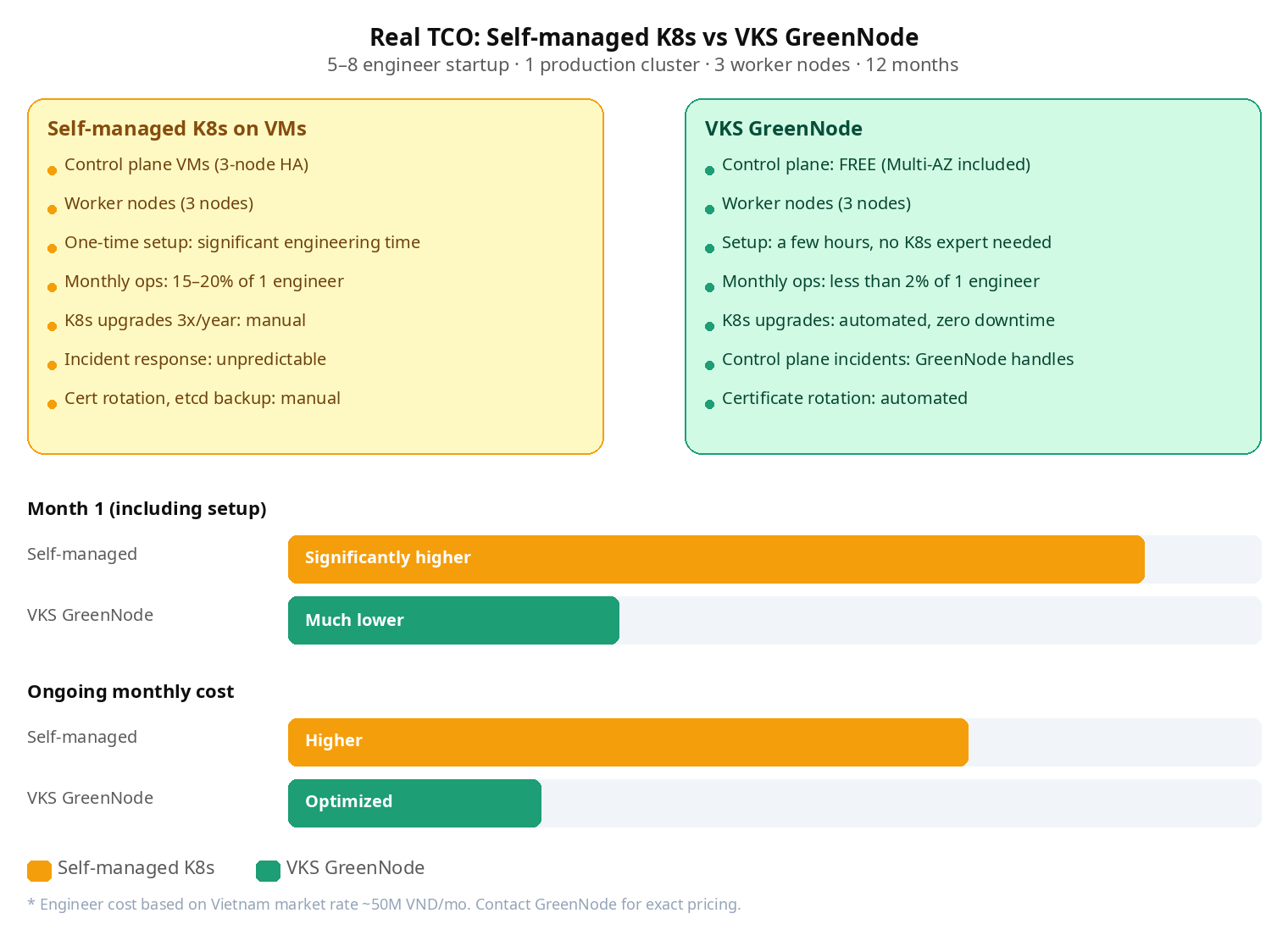
Baseline: Startup with 5–8 engineers, 1 production cluster, 3 worker nodes, over a 12-month period.
2.3 Cost Projections
First Month (Including Setup): Self-managed costs are significantly higher due to engineering time overhead. VKS GreenNode remains much lower.
Standard Months (Post-Setup): Self-managed remains high due to recurring ops burdens , while VKS GreenNode delivers an optimized cost model.
Note: Engineering cost estimations are based on a Vietnamese market average of ~50 million VND/month. Please contact GreenNode for an exact quote.
VKS GreenNode: Managed Control Plane, Auto-Upgrades, and High Availability
VKS (VNG Cloud Kubernetes Service) by GreenNode is a fully managed Kubernetes service hosted locally within Vietnam (Hanoi and Ho Chi Minh City data centers), featuring a control plane entirely managed by GreenNode.
2.4 Heavy Lifting Handled Natively by VKS
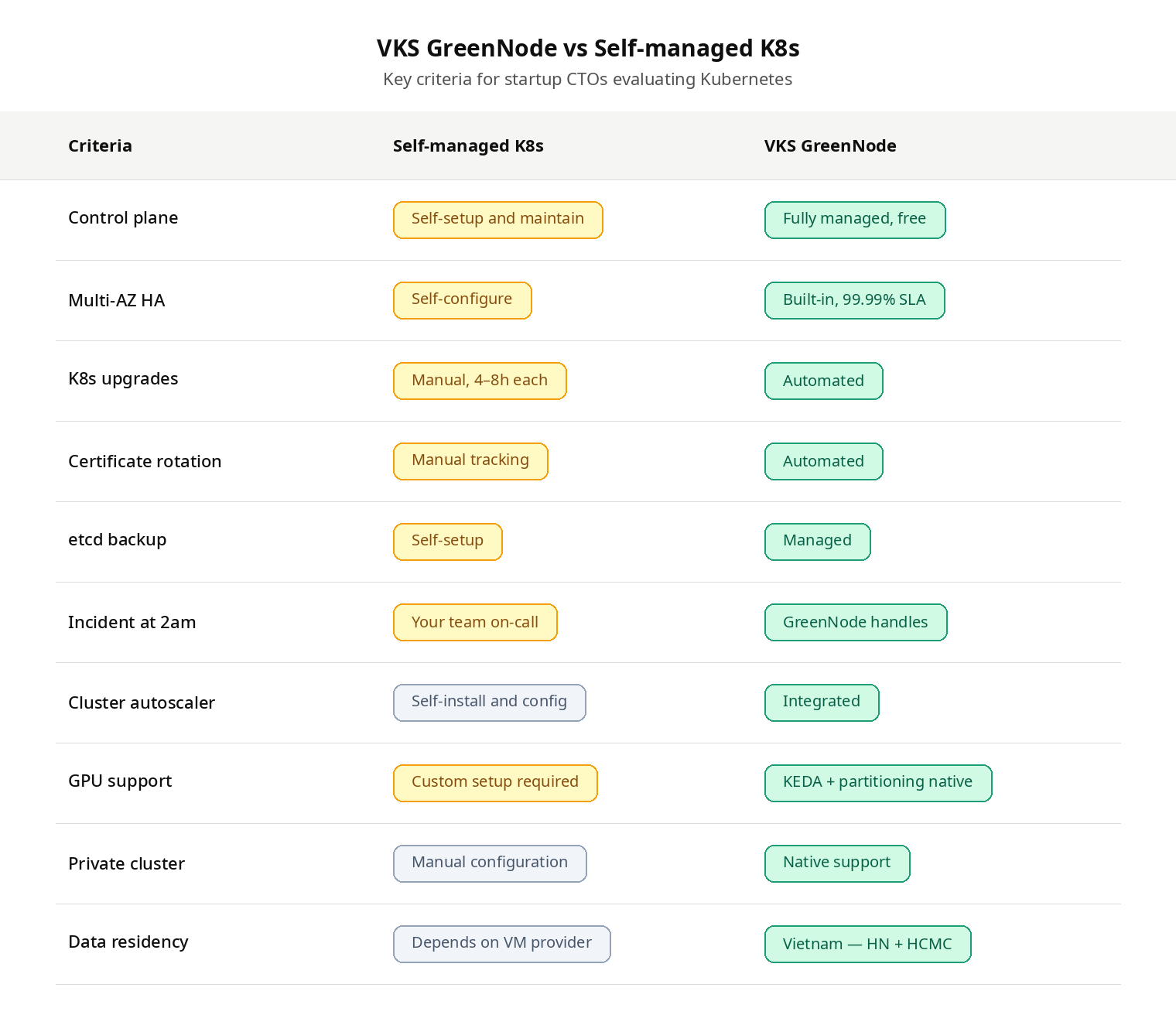
Fully Managed, Free Control Plane: Unlike certain global cloud hyperscalers that charge a separate hourly fee for the cluster control plane, VKS provides a Multi-AZ control plane entirely free of charge. If a single Availability Zone goes down, your control plane remains operational.
- Automated Cluster Upgrades: Simply select your target version (currently supporting versions 1.29 and 1.30), and VKS handles the rolling upgrades automatically with zero downtime for worker nodes , eliminating the need to read extensive changelogs or perform manual environment testing.
- 99.99% SLA for Node Groups: Multi-AZ node groups feature native fault tolerance baked into the architecture out-of-the-box, saving you from complex configuration tasks.
- Integrated Cluster Autoscaler: Automatically provisions or de-provisions worker nodes based on real-time resource demands, eliminating manual infrastructure scaling during traffic spikes.
- IAM Integration and Private Clusters: Secure your infrastructure using local Identity and Access Management (IAM), deploy fully private clusters with no public endpoints, and use IP whitelisting for the API server. This is an essential security posture when serving fintech or enterprise clients.
- GPU Auto-Scaling for AI Workloads: If your startup leverages AI/ML components, VKS natively supports GPU auto-scaling powered by KEDA alongside GPU partitioning (time-slicing and MPS) without requiring you to build custom operators.
- Flexible Networking Options: VKS supports multiple Container Network Interface (CNI) options to meet distinct workload, security, and performance demands , which is crucial for startups handling multi-tenant isolation or strict network policies.
2.5 Total Cost of Ownership (TCO) Analysis
When utilizing VKS, you only pay for the worker nodes (VM instances), networking, and associated storage resources. The control plane itself is free.
Actual Self-Managed Cost= Control Plane VMs + Worker Node VMs + DevOps Engineering Time
When calculating the total overhead, running a self-managed cluster often ends up being more expensive than using a managed service, particularly for smaller engineering teams of fewer than 10 people. Research from the CNCF shows that self-managed clusters hover around an average utilization rate of only 30–50% because teams frequently over-provision resources out of caution. The integrated Cluster Autoscaler in VKS effectively resolves this issue automatically, saving money without requiring manual engineer intervention.
3. Ideal Startup Use Cases for VKS
VKS provides optimal value across four specific startup scenarios:
Scenario 1: Multi-Tenant SaaS Platforms requiring strict isolation. When each customer requires a dedicated namespace equipped with individual resource quotas and isolated network policies, Kubernetes is the natural architectural choice. VKS dramatically minimizes cluster management overhead, allowing your team to focus exclusively on multi-tenancy business logic.
Scenario 2: Small engineering teams without a dedicated DevOps resource. If your backend engineers are pulling double duty as infrastructure operators, a managed K8s service ensures that infrastructure maintenance does not morph into an exhausting full-time second job. Features like a managed control plane, cluster autoscaling, and automated upgrades free up immense development bandwidth.
Scenario 3: Fintech or B2B Enterprise startups with strict compliance needs. When clients audit your security posture and ask where user data resides, answering that your systems "run on fully private clusters within onshore Vietnamese data centers" is a simple, highly persuasive answer compared to explaining convoluted setups on foreign cloud nodes.
Scenario 4: AI/ML startups running heavy GPU workloads. Setting up GPU auto-scaling via KEDA and structural partitioning on a self-managed K8s cluster requires immense engineering effort. VKS offers this functionality completely integrated and ready to go from day one.
4. Migrating from Self-Managed K8s to VKS: Timelines and Risks
For startups currently running self-managed K8s environments who want to know what the transition looks like:
Real-World Migration Timeline
Phase 1 — Audit & Preparation (1-2 Days): Export all active manifests from your current cluster. Review custom resources (CRDs), active operators, unique dependencies, and verify version compatibility between your legacy setup and VKS.
Phase 2 — VKS Cluster Provisioning (A Few Hours): Initialize your new VKS cluster, configure your node pools based on real-time workload needs, and establish your network and private cluster security boundaries.
Phase 3 — Parallel Workload Deployment (1-2 Days): Deploy your entire application stack onto the new VKS cluster and run it in parallel with your legacy cluster for validation and testing.
Phase 4 — Cutover (A Few Hours): Routinely executed outside peak hours, this involves pointing your DNS records or global load balancers to the new VKS cluster endpoint. Keep the old cluster alive as an immediate rollback fallback for 24–48 hours before decommissioning it entirely.
Total Estimated Timeline: 3 to 5 business days for teams already accustomed to working with Kubernetes primitives. Zero downtime can be achieved if your applications are stateless and your core database layers have already been decoupled from the primary cluster.
5.Mitigating Technical Risks
- Stateful Workloads: If you are running active databases directly inside your cluster (which is generally discouraged but common among early-stage startups), you must handle data migration carefully. Recommendation: Migrate your databases over to GreenNode vDB first, then migrate your core K8s application workloads.
- Custom Operators & CRDs: Certain operators have hard dependencies on specific Kubernetes versions. Ensure you cross-reference compatibility metrics prior to pulling the trigger on the migration.
- Persistent Volumes: Storage classes and volume bindings must be reconfigured during migration. VKS supports both block storage and file storage interfaces natively to streamline this step.
Frequently Asked Questions (FAQ)
1. Does VKS natively support Helm and ArgoCD?
Yes. VKS is built on standard, upstream CNCF-certified Kubernetes, making it 100% compatible with the entire ecosystem: Helm, ArgoCD, Flux, Kustomize, and any other standard tooling. There is zero vendor lock-in to custom, proprietary platforms.
2. What happens to my workloads if an underlying GreenNode zone experiences an issue?
VKS features a Multi-AZ control plane, meaning that if an entire data center experiences an outage, the cluster management layer remains online. Any worker nodes sitting in the affected availability zone will have their pods automatically rescheduled onto surviving zones, provided your pods are configured with anti-affinity rules or are utilizing multi-AZ node groups.
3. Can I run a completely private cluster without any public endpoints?
Yes. VKS natively supports fully private clusters where the API server does not expose a public IP address. Access is securely routed through a dedicated VPN tunnel or via a bastion host configured inside your local VPC, satisfying a core compliance requirement for fintech and enterprise platforms.
4. Should an early-stage startup with only 3–5 engineers use Kubernetes?
It depends entirely on the architectural complexity of your application. If you are running fewer than 10 services with predictable traffic patterns, Docker Compose or a few standalone virtual machines are usually more than enough. However, if your architecture already uses microservices, has multiple teams deploying independently, or runs AI/ML workloads with dedicated GPU requirements, Kubernetes provides instant structural value. VKS drastically lowers the barrier to entry because it removes the need to hire a full-time infrastructure specialist to manage the cluster.
5. How long does it take to migrate from AWS EKS or Google GKE over to VKS?
For a standard cluster without highly complex stateful workloads, migration typically takes 3 to 5 business days. GreenNode provides dedicated technical support teams to assist you throughout the entire migration process if needed.
Conclusion: When to Self-Manage vs. When to Choose VKS
Self-managing K8s on bare VMs makes sense if:
- You already employ dedicated platform engineers with production-grade K8s experience, your workloads demand unique kernel modifications that a managed service cannot support, or you are constructing a massive internal infrastructure platform spanning multiple large-scale corporate teams.
- Choosing VKS GreenNode is the smarter choice if: Your engineering team has fewer than 10 people, you do not have dedicated engineers to handle routine K8s ops, you need to go from zero to production-ready in hours rather than weeks, you require strict domestic data residency inside Vietnam, or you are running AI/GPU workloads that demand automated scaling.
- The fundamental question is not "is a managed service more expensive than a raw VM?" The real question is: "How much is your engineering time worth, and do you want your team spending that time on infrastructure maintenance or on building core features that grow your business?"
Built intentionally for startup CTOs who want to run robust production Kubernetes clusters without allowing infrastructure ops to swallow up their engineering team's focus
