

Key takeaways
- Deploying AI agents in production without governance is a security liability — autonomous agents need verified identities, least-privilege access, and defined action boundaries to prevent unintended data exposure or runaway behavior.
- A solid AI agent governance framework covers three layers: identity (who the agent is), access control (what it can touch), and auditability (a full trace of what it did, when, and why).
- Platforms like GreenNode AgentBase operationalize governance by design — so enterprise teams can ship agentic workflows with the oversight controls regulators and security teams actually require.
When AI agents don’t just answer questions but start calling APIs, querying databases, writing logs, queuing messages, and automatically executing workflows in your production systems, the question is no longer “should we use AI?” but rather: “Who is actually controlling these agents, with what permissions, and under which policies?”
Gartner predicts that by the end of 2026, 40% of AI-enabled enterprise applications will embed task-specific AI agents to handle specialized tasks across business processes. At that rollout speed, most of the risk does not come from the AI models themselves, but from governance gaps: no clear identity for agents, weak technical boundaries, and missing audit trails you can actually rely on.
A Cisco/Splunk CISO report surveying 650 CISOs worldwide shows that 86% are concerned that autonomous AI will expand their attack surface, and 82% worry that persistent intrusion techniques will become more sophisticated and harder to contain — while only 13% of IT leaders feel confident their organizations have a strong enough control framework to manage AI agents in real-world environments. That gap is exactly where risk accumulates — and where CISOs, IT Directors, and operations teams need to get ahead of the curve.
Identity-less agent sprawl is your biggest risk
Most organizations still deploy AI agents with a “just another SaaS tool” mindset: reusing existing user accounts, sharing machine credentials, and not creating a dedicated identity for each agent instance. That may be fast in the early days, but it quickly leads to agent sprawl as more teams and use cases come online.
The core issue is that the organization no longer has a centralized inventory that clearly shows which agents are running, which team owns them, what permissions they have, and which systems they are wired into. Without a trustworthy, up-to-date list of agents, it’s almost impossible to enforce consistent controls downstream.
The consequences are very real: an agent granted read access to your CRM can end up touching your billing system through shared integrations; an agent originally built to automate email can accidentally trigger financial workflows. In many cases, teams cannot even say exactly what an agent did, under which scope, or where its logs are stored.
According to the original source, 47% of CISOs and CIOs have already seen AI agents behave unexpectedly or perform actions that were not authorized in a production environment. That means these risks are not theoretical “future problems” — they are already showing up in real systems today.
Three essential governance layers for every AI agent fleet
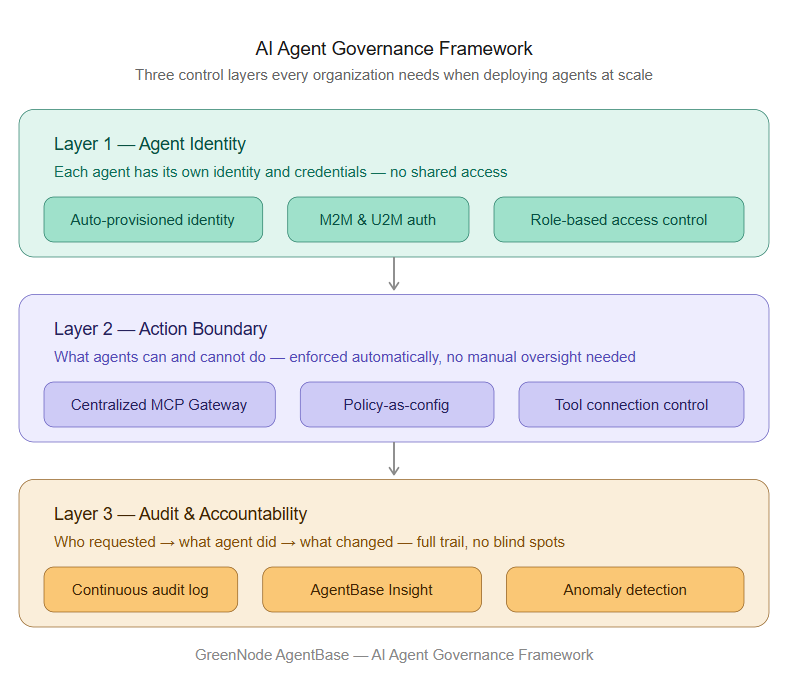
To govern an AI agent fleet at enterprise scale, your governance framework needs to be built around three core layers: Agent Identity, Action Boundary, and Audit & Accountability. These are the foundational control planes that let security, platform, and compliance teams work off the same governance model.
- Agent Identity: every agent is a distinct digital identity with its own lifecycle and isolated credentials.
- Action Boundary: each agent is technically constrained to only perform actions within its declared scope.
- Audit & Accountability: every action leaves a complete trail that can be traced, investigated, and used for compliance.
These three layers are not just a theoretical framework. They are the minimum baseline you need if you want to scale AI agents without giving up control over your production environment.
Layer 1: Agent Identity – every agent must have its own digital identity
An agent is not a user, and it should not be treated as just another background job. The underlying IAM framework for enterprises needs to evolve so that AI agents are handled as “priority digital identities”, because their execution speed and blast radius can far exceed that of a human operator.
Every agent in the fleet should have an independent identity with a clear identifier, rich metadata, and isolated credentials. That prevents scenarios where multiple agents share the same token, reuse the same secret, or all run under a single integration account.
From a technical standpoint, an agent’s identity needs to support both machine-to-machine authentication and user-to-machine delegation. That way, when an agent takes action on behalf of a user, the organization can still see who initiated the original request and which agent actually executed the action.
When an agent is compromised, this model lets the security team revoke exactly that agent’s identity, rotate the relevant credentials, or isolate the affected runtime without having to bring down the entire system. That is very hard to achieve if the organization relied on shared credentials or lumped many agents under the same account from day one.
On GreenNode AgentBase, each agent runtime is automatically provisioned with its own independent identity. At the same time, RBAC provides fine-grained control over who can create, edit, publish, or simply view specific agents, based on roles like admin, developer, and viewer.
Layer 2: Action Boundary – defining what agents can and cannot do
If Agent Identity answers the “who” question, Action Boundary answers “what can they do?”. This is the policy-as-configuration layer, where policies stop living only in documents and slide decks and are instead encoded as technical controls that can be enforced automatically.
At this layer, organizations need to define which tools a given agent can call, which APIs it can access, which routes and methods it can use, and which parameters are allowed. Boundaries can also include rate limits, quotas, context rules, and environment-based restrictions across dev, staging, and production.
The AgentBase MCP Gateway acts as a centralized gateway for all MCP servers across the organization. Instead of each agent connecting directly to tools or external services, all requests are funneled through the gateway, where policies are applied, access is controlled, and traffic is routed according to the defined boundaries.
In short, instead of every agent managing its own credentials, connections, and logs in its own way, you route all of that connectivity through a single control point. This is a much more realistic and sustainable approach for production environments, especially once the number of agents starts growing rapidly across multiple teams and workflows.
Layer 3: Audit & Accountability – full trails with no blind spots
Governance has very limited value without auditability. In enterprise environments, you need an immutable audit trail that records the complete chain of agent actions — from the initial request and applied context, through the tools called and parameters used, all the way to the final changes on downstream systems.
This layer helps answer three critical questions: who or what initiated the request, which agent executed the action, and what was the final outcome? It forms the foundation for incident response, internal reviews, compliance audits, and post-incident analysis.
AgentBase Insight provides continuous audit logging and combines it with runtime metrics to detect anomalous agent behavior before it escalates into a major incident. This is especially important given that agents can execute many steps back-to-back at machine speed.
With sufficient visibility, SOC and SRE teams can trace backwards from an action to its request source, from the request source to the identity, and from the identity to the policy that was in effect at execution time. That’s what turns governance from “policy on paper” into a practical ability to investigate and control what agents are doing.
You don’t need to block AI — you need to govern it
The difference between an organization that simply blocks AI and one that safely unlocks AI’s potential is the governance layer. If all you do is prohibit usage, business teams will still find ways to adopt AI through SaaS tools, shadow IT, or workflows that sit outside your formal control.
In contrast, when you build governance into the infrastructure itself, AI agents can be brought into production in a controlled way. That’s how organizations capture the speed and leverage of agentic AI while still maintaining their security baseline and meeting compliance obligations.
AgentBase is designed as a built-in supervision and control layer — a governance plane that exists from day one: identities are provisioned automatically, RBAC is configured early, the MCP Gateway enforces connectivity policies, and Insight keeps logs and visibility flowing throughout the entire lifecycle of each agent.
Where should enterprises start?
If your organization is deploying or planning to deploy AI agents at scale, there are three questions you should answer as early as possible. These are the foundational questions to assess your governance readiness.
Do you have a complete list of agents currently running?
You need clear visibility into which agents are running in development, testing, and production; which teams own them; what permissions they have; and which tools or services they are allowed to call. If you don’t yet have a centralized inventory, that’s the first gap you need to close.
Do you have any boundaries that are actually enforced?
What you need is not just policy documents and internal guidelines, but real technical controls that stop agents from exceeding their allowed scope — for example via connectivity gateways, policy engines, and role-based access configured consistently across environments.
When something goes wrong, can you trace the entire flow?
Your organization should be able to follow the full chain from user request, to agent actions, to the final system changes. Without that end-to-end traceability, it’s very hard to investigate incidents accurately or assign accountability.
If the answer to any of these questions is still “not sure”, that’s your starting point for a serious AI agent governance program. GreenNode AgentBase is designed as the underlying infrastructure to help enterprises deploy and govern agents through three control layers: Identity, Action Boundaries, and Audit & Accountability.
