

Key Takeaways
- Most SMEs don't choose multi-cloud, they end up there. One team picks AWS, another tries GCP, and nobody cleans up after. Multi-cloud and hybrid cloud are two different things, and mixing them up is where the wrong architecture decisions start.
- Complexity doesn't add up when you bring in a second cloud, it multiplies. Egress fees, duplicate IaC, duplicate CI/CD pipelines, and the hardest part: engineers who are genuinely competent on both platforms are hard to find. These hidden costs usually eat up whatever you saved on compute.
- Multi-cloud only pays off in 4 specific situations: mandatory compliance requiring in-country data storage (Vietnam's Data Law 2024, PDPL 2025), genuinely independent workloads with minimal data transfer between them, disaster recovery with a real RTO under 15 minutes, or a contractual requirement from an enterprise customer. Outside these four, a single well-run cloud provider is still the better bet.
Running on AWS and thinking about adding another cloud provider? You're not alone. According to Gartner, most companies end up multi-cloud by accident before they ever have a strategy for it, through acquisitions, different teams picking different tools, or a trial that never got cleaned up.
But "accidentally multi-cloud" and "strategically multi-cloud" are two very different things when it comes to cost, complexity, and outcomes.
This piece isn't trying to talk you into either direction. The goal is to help you answer a practical question: given your team's current size and resources, is multi-cloud the right move, or is it over-engineering you don't need yet?
1. What is multi-cloud, and how is it different from hybrid cloud?
These two terms get used interchangeably a lot, but they mean different things, and that confusion is often where the wrong decision starts.
Multi-cloud means using services from two or more public cloud providers for the same type of workload. For example: your app runs on AWS, your AI workload runs on GreenNode because the GPUs are cheaper and the data needs to stay in Vietnam, and your CDN runs on Cloudflare. All public cloud, just different vendors.
Hybrid cloud means combining on-premise (or private cloud) infrastructure with public cloud. For example: your critical database runs on physical servers in your office, and your web app runs on public cloud. The focus of hybrid cloud is connecting on-premise infrastructure with the cloud, not necessarily using multiple cloud providers.
Quick comparison:
| Multi-cloud | Hybrid cloud | |
| Number of providers | ≥ 2 public cloud | 1+ public cloud + on-premise/private |
| What it solves | Avoiding lock-in, best-of-breed | Connecting legacy infrastructure with cloud |
| Complexity | High | Medium to high |
| Right fit for SMEs? | Conditionally | Usually a better fit |
In practice, a lot of Vietnamese SMEs are actually running hybrid cloud (in-house servers plus a few cloud services) but calling it multi-cloud. Getting the label right matters, because it points you toward the right solution for the actual problem you have.
2. Why Vietnamese SMEs actually consider multi-cloud
Skip the textbook reasoning about "avoiding vendor lock-in" and "best-of-breed selection." The real reasons SMEs in Vietnam look at multi-cloud are a lot more concrete:
Reason 1: Compliance and data sovereignty. Vietnam's Data Law 2024 (effective July 2025) and the Personal Data Protection Law 2025 (PDPL, effective January 2026) require certain categories of important data to be processed on domestic infrastructure. If you're running everything on AWS Singapore, this is the trigger that forces you to look at a local provider, not because multi-cloud sounds appealing, but because the law requires it.
Reason 2: GPU costs for AI workloads. Startups and tech SMEs are shipping more AI features every quarter. GPUs on AWS or GCP cost noticeably more than what some local or specialized GPU cloud providers charge. Running AI training or inference on a separate provider while keeping the main app where it already lives is a fairly common pattern now.
Reason 3: Latency for local users. AWS Singapore has higher latency than a data center in Hanoi or Ho Chi Minh City for users based in Vietnam. If you're running a consumer app or SaaS with a large domestic user base, adding a CDN or workload on a local cloud makes sense.
Reason 4: Disaster recovery and redundancy. Some teams want to avoid being fully dependent on one provider, so if that provider has a prolonged incident, there's somewhere to fail over to. It's a legitimate reason, but the actual need for it is often overestimated.
Reason 5: Teams picking tools independently. The most common pattern in practice: marketing runs a SaaS tool on Azure, engineering builds on AWS, data team tries BigQuery on GCP. This isn't strategy, it's entropy.
3. The real cost: complexity, spend, and the skills gap
Before you commit to multi-cloud, it's worth looking honestly at what you're actually signing up for.
3.1 Complexity doesn't add up, it multiplies
With one cloud provider, you learn one console, one IAM system, one billing dashboard, one networking model, one support channel.
With two, it's not double the effort, it's several times more, because now you're also managing the differences between the two environments. AWS and GreenNode don't share the same networking model. IAM policies differ. Debugging a network issue looks different. Reading the bill looks different.
Every incident forces your engineers to context-switch between two environments instead of debugging on one system they actually know well.
3.2 Operating costs are usually underestimated
The obvious costs are licensing, compute, and storage. The hidden costs are usually where it hurts:
Data egress fees: moving data between two cloud providers is typically billed as outbound bandwidth by the sending provider. For workloads with heavy data transfer, this can add up fast.
Engineering time: maintaining two sets of IaC, two CI/CD pipelines, two monitoring stacks. For a small team, that's a meaningful chunk of time not spent on the product.
Tooling: multi-cloud management tools (Terraform, cross-cloud monitoring, cost management) all come with their own licensing costs and learning curve.
Training: engineers need to be genuinely competent on both platforms, not just familiar enough to get by.
3.3 The skills gap is a real problem in Vietnam right now
A shortage of experienced cloud engineers is one of the biggest constraints for SMEs in Vietnam today. Finding a strong AWS engineer is already hard. Finding someone strong on AWS and a second platform, capable of designing cross-cloud architecture, is significantly harder.
If your engineering team is already stretched, adding a second cloud provider means more surface area for things to go wrong, without adding more people to handle it.
4. When does multi-cloud actually make sense?
Here's the honest version: these are the four situations where multi-cloud delivers real ROI, not just theoretical benefits.
Case 1: Compliance forces workload separation. Vietnam's Data Law 2024 and PDPL 2025 require part of your data to sit on domestic infrastructure, but you have other workloads that don't fall under this requirement and are already running well on international cloud. This is the strongest case for multi-cloud, not to avoid lock-in, but because the law requires geographic separation.
Case 2: Workloads that are genuinely independent. One provider has better-priced H100s for AI training, another is better suited for web serving. If the two workloads don't need to talk to each other much and can run independently, the added complexity is manageable. The test: if the two workloads need to transfer data regularly, egress fees and latency will erode whatever cost advantage you were chasing.
Case 3: Disaster recovery with a genuinely low RTO. If downtime costs you real money by the minute (payment platforms, trading systems) and you need an RTO under 15 minutes, multi-cloud DR can be justified. But run the numbers honestly: the cost of maintaining a hot standby on a second provider versus the actual probability and duration of an outage on your primary. For most SMEs, a provider with a solid SLA and a proper backup strategy is enough.
Case 4: An enterprise customer requires it. Some enterprise customers have policies that prohibit vendors from depending entirely on one cloud provider. If that's a condition for winning the contract, that's a clear business case, no further debate needed.
5. When is one cloud provider enough, and actually better?
Here's the answer a lot of multi-cloud content avoids saying outright: for most SMEs in Vietnam at their current stage, one well-run cloud provider is still the better choice.
Here's why, specifically:
You're building, not optimizing yet. The growth stage calls for fast deploys, fast iteration, fast debugging. A familiar environment lets your team do all of this quicker. Multi-cloud optimizes for resilience and flexibility, which matter more once you're mature, and that's not where you are yet.
Teams under 10 engineers. Every hour an engineer spends managing infrastructure is an hour not spent on the product. Multi-cloud multiplies that cost significantly.
Workloads too small to offset egress costs. If data transfer between providers costs more than what you're saving on compute, you're losing money, not gaining an edge.
No one on the team has cross-cloud experience yet. Rolling out multi-cloud without someone who genuinely understands both platforms usually creates architecture debt, temporary decisions become permanent, and fixing them later costs double the effort.
Self-check: are you actually ready for multi-cloud?
- At least one engineer with real hands-on experience on both platforms
- A workload that's genuinely a better fit for the second provider, not just "worth trying"
- Data transfer between providers isn't a daily operation
- You have the bandwidth to maintain two sets of IaC, monitoring, and CI/CD
- A clear business case: compliance, cost, or a contract requirement
Checked fewer than 3 out of 5? A single, well-run cloud provider is the right call for now.
6. If you're going multi-cloud anyway: which pattern fits SMEs in Vietnam?
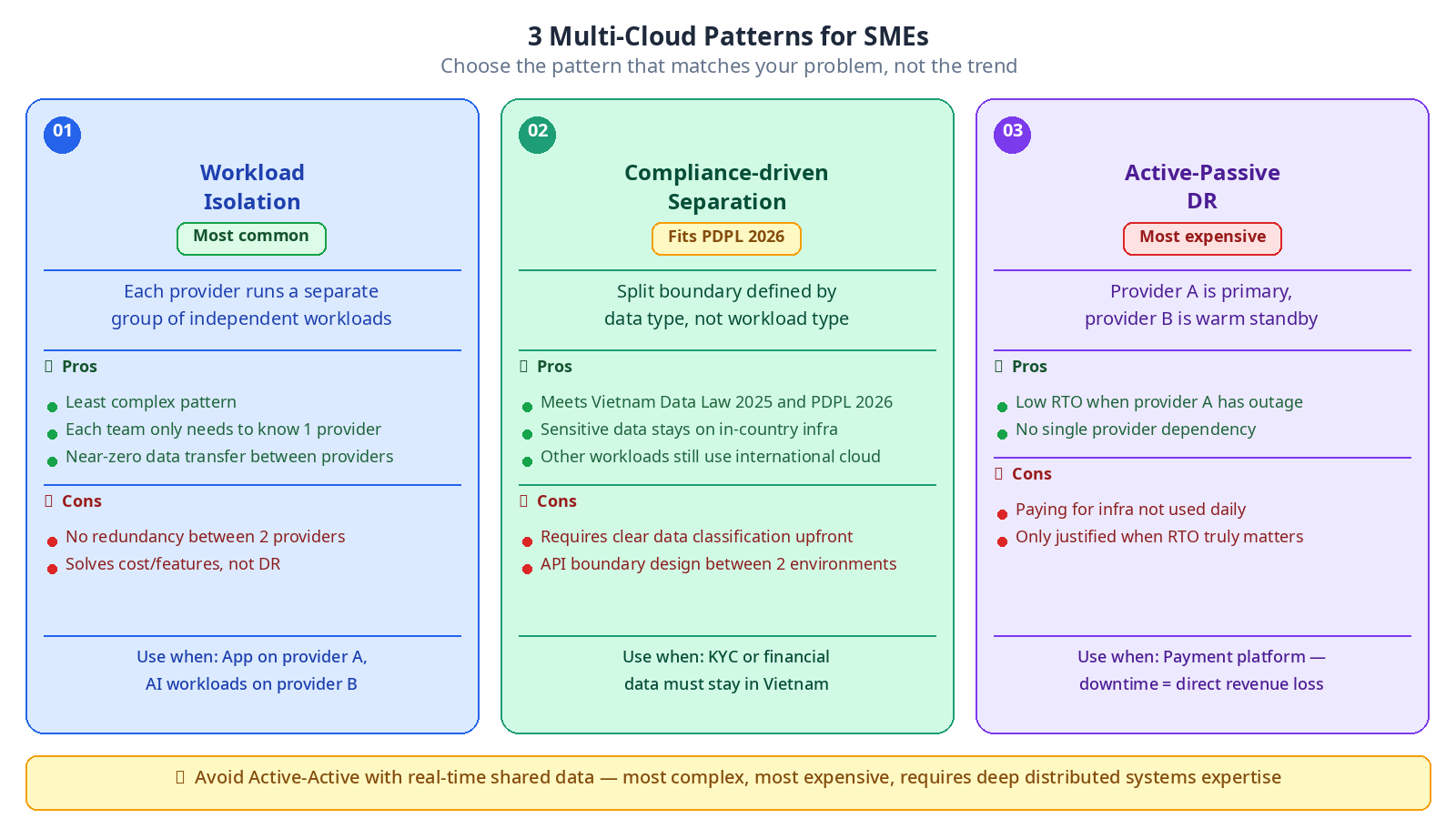
If you've made it past the checklist above, here are the three patterns that are realistic and manageable for SMEs.
Pattern 1: Workload isolation (the most common)
Each cloud provider runs a distinct group of workloads, operating almost independently, with no regular data flow between them.
Example: production app and database on Provider A. AI training and model serving on Provider B with better GPUs. The two sides communicate over API with acceptable latency, no need for real-time sync.
This is the least complex pattern, because each provider operates like a silo. Team A knows Provider A, Team B knows Provider B, and neither needs deep knowledge of the other.
Pattern 2: Compliance-driven separation
Workloads handling important data (as defined under Vietnam's Data Law 2024) run on the domestic provider. Non-sensitive workloads (static assets, build pipelines, dev environments) run on international cloud.
The boundary here is defined by data type, not workload type. Data flow needs to be designed carefully so sensitive data never "leaks" over to the foreign provider, this is the hardest part of this pattern to get right.
Pattern 3: Active-passive DR
Provider A is primary and runs all of production. Provider B is a warm standby, with data synced on a regular cycle. If Provider A has a prolonged outage, you fail over to Provider B.
This is the simplest day-to-day to operate, but also the most expensive, because you're paying for infrastructure that sits mostly idle. Only worth it if your RTO requirement is genuinely low and the business case is clear.
Pattern to avoid: active-active with data shared in real time across both providers. This is the most complex architecture, the most expensive in egress and latency, and it demands distributed systems expertise that most SMEs don't have yet.
7. GreenNode combined with international cloud: the hybrid model more SMEs are choosing
This is a specific pattern that a growing number of SMEs and startups in Vietnam are adopting, not because it's theoretically optimal, but because it solves two real problems at once.
Problem 1: Compliance. Vietnamese user data, financial information, and important data need to sit on domestic infrastructure under Data Law 2024 and PDPL 2025.
Problem 2: Ecosystem and tooling. Some managed services, marketplaces, or third-party integrations only exist on international hyperscalers and are hard to replicate on a domestic provider.
8. How workloads get split in this model
On GreenNode (domestic, Vietnam):
- Workloads processing personal data of Vietnamese users
- Production databases holding customer information
- AI/ML workloads on GPU (H100 at competitive pricing, no cross-border transfer for important data)
- Backup and DR for important data
- Workloads that need low latency for users in Vietnam
On international cloud:
- Workloads that don't touch sensitive data (static content, build pipelines, dev environments)
- Managed services that the domestic provider doesn't yet offer or hasn't matured
- Global CDN edge nodes (non-sensitive data)
- Offsite disaster recovery, where required
What needs careful design:
Clear data classification before you build. Every data type needs to be classified: does it qualify as "important data" under Data Law 2024? If so, it can only be processed on GreenNode. Skip this step and you'll discover the compliance risk after the architecture is already built, which is a much more expensive fix.
A clear API boundary between the two environments. Services on international cloud shouldn't have direct access to databases holding important data on GreenNode. All communication should go through an API, with full authentication and logging.
Centralized monitoring. Even with workloads split across two providers, you need one dashboard, not two separate consoles to check every time there's an incident.
This model isn't for everyone. It fits when you already have workloads running well on international cloud and just need to add a compliance layer for the important data, not a full migration.
Conclusion: multi-cloud is a tool, not a destination
Multi-cloud is a real trend, but it's a trend for enterprises with large engineering teams and the resources to manage the complexity. For most SMEs in Vietnam at their current stage, one well-run cloud provider is still the better choice for overall ROI.
The right question isn't "should we go multi-cloud." It's: "what specific problem do we actually have, and is multi-cloud the cheapest way to solve it?"
If the problem is compliance, the answer is usually adding one domestic provider for the important data, that's multi-cloud with intent, not multi-cloud for its own sake.
If the problem is vendor lock-in, the answer is usually writing code to best practices (12-factor apps, container-first, IaC) so it's portable, not necessarily running on two providers today.
If the problem is cost, check your current bill and optimize it before adding another provider.
