

One of the biggest barriers to deploying AI is how hard it is to predict and control usage costs. Unlike software bought on a fixed license, AI cost is variable: the more API calls and AI workloads you run, the higher the bill – and it often grows in unpredictable ways. Without the ability to track token consumption in real time, businesses can easily face unexpected charges that only surface once the invoice arrives.
This article explains why AI costs are hard to control as you scale, how tokens drive usage cost, and how GreenNode MaaS's real-time token tracking gives businesses clear visibility into usage, budget control, and transparent cost optimization.
Why Are AI Costs So Hard to Control as You Scale?
During testing or a pilot, AI costs are usually small and easy to overlook. The problem only shows up as you scale: more use cases, more users, more teams calling the model. At that point cost doesn't grow linearly – it can spike quickly, for several reasons:
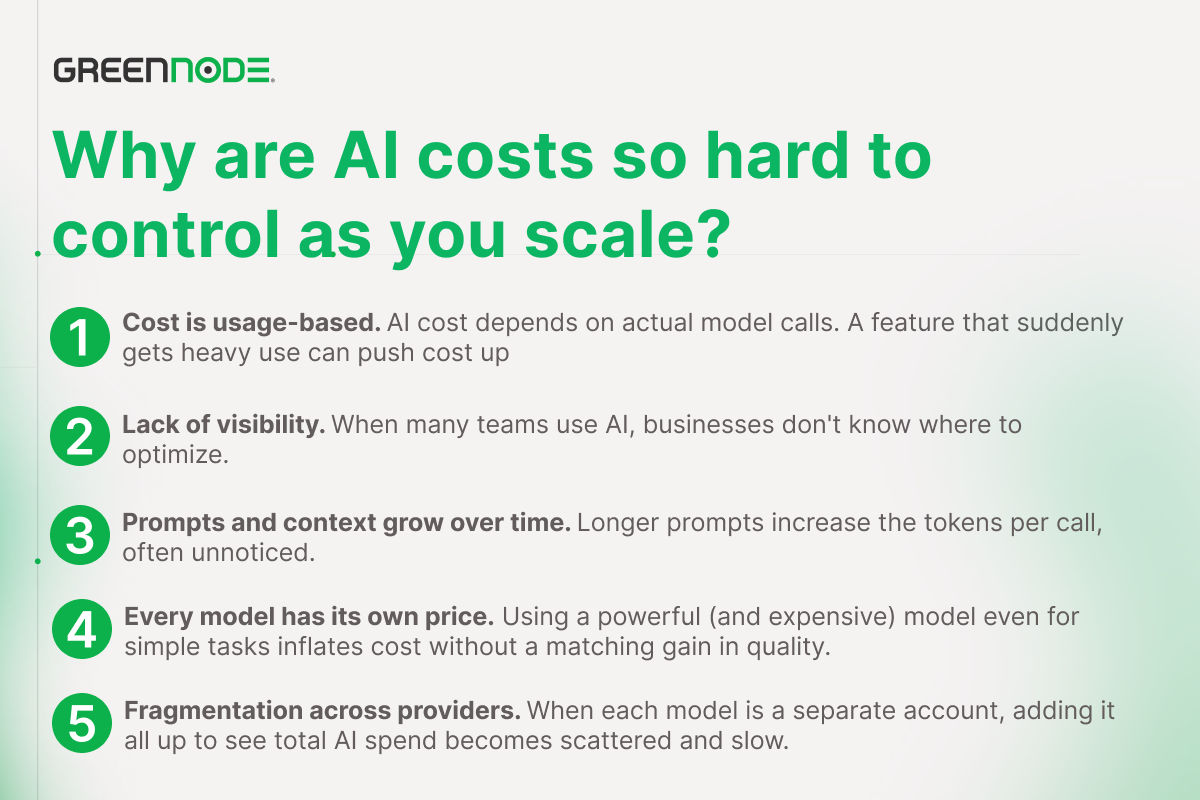
- Cost is usage-based. Unlike a fixed annual software license, AI cost depends on actual model calls. A feature that suddenly gets heavy use can push cost up significantly in just a few days.
- Lack of visibility. When many teams use AI, businesses often don't know which use case, team, or model consumes the most – so they don't know where to optimize.
- Prompts and context grow over time. Longer prompts, more attached documents (RAG), and retained conversation history all increase the tokens per call, often unnoticed.
- Every model has its own price. Using a powerful (and expensive) model even for simple tasks inflates cost without a matching gain in quality.
- Fragmentation across providers. When each model is a separate account and a separate invoice, adding it all up to see total AI spend becomes scattered and slow.
The familiar result is "bill shock" – an end-of-period invoice far higher than expected, with no data to explain why. For leadership, that's a real risk: hard to budget for AI, hard to forecast, and hard to make scaling decisions.
How Do Tokens Affect the Cost of Using AI?
For most language models, the token is the billing unit. Tokens are small pieces of text (an English word is typically about 1–2 tokens; accented Vietnamese usually costs more tokens for the same length). Each model call is billed on the total number of tokens, in two parts:
- Input tokens: everything you send to the model – the user's question, the system prompt, attached documents, conversation history.
- Output tokens: the content the model generates in response.
So the same feature can cost very differently per call, depending on:
- Prompt and context length. The longer the prompt and the more documents you pack in (RAG), the more input tokens.
- Conversation history. The more prior turns a chatbot keeps, the more old tokens each new turn carries.
- Output length. Asking the model to write long, detailed answers costs more output tokens.
- Model type. Large models, reasoning models, and multimodal processing usually carry a higher per-token price.
In other words, AI cost is tokens times unit price, compounded over thousands or millions of calls. To control cost, a business first has to see its tokens: how many, where, and for what. That's why real-time token tracking is the foundation of any AI cost-management effort.
How Does GreenNode MaaS Track Tokens and Cost in Real Time?
GreenNode MaaS controls cost at two moments: predicting before you call – from each model's published specs on the portal – and tracking during the run with real-time token tracking. These two layers map directly onto the token-driving factors described above.
Before the call: read each model's "token appetite" on the portal
Every model on the GreenNode MaaS portal publishes the specs that directly determine the token count – and therefore the cost – of each request. Instead of guessing, your engineers check these fields before integrating, mapping each cost factor to a concrete spec:
| Portal spec | What it means | How it relates to cost / capacity |
|---|---|---|
| Modalities | The input–output data types the model supports (text, image, video, voice…) | Multimodal processing usually costs more tokens than plain text |
| Max input | Maximum tokens allowed for the input part of a request | Caps input cost per call; helps budget for prompt + RAG documents |
| Max output | Maximum tokens the model generates for one response | Caps the output-token portion – usually priced higher than input |
| Context length | Total tokens the model handles in one turn (input + history) | The larger the window, the more room to pack tokens → higher potential cost per turn |
| Default TPM | Maximum tokens processed per minute (tokens per minute) | Forecast throughput and how cost scales as load rises |
| Default RPM | Maximum requests per minute (requests per minute) | Capacity planning; avoid bottlenecks when many users call at once |
For example, a model on the portal may show: Max input 1M tokens, Max output 128K tokens, Context length 1,000,000 tokens, Default TPM 2,000,000, Default RPM 10 (the default account-level limit is 10 RPM and 14,400 requests/day, shared across all models – the exact figures vary by model, so check the portal directly).
As a result, from the design stage your team can already estimate: how many input and output tokens a worst-case "heavy" request would cost, whether the context window is enough for the task (e.g. summarizing long documents, RAG), and whether per-minute throughput meets your expected user load – all before a single unit of cost is incurred.
During the run: track tokens and cost in real time
The platform is built on transparent pay-per-token pricing: you pay only for the tokens you actually use, with no fixed subscription and no hidden fees. More importantly, it lets you track and control AI usage in real time for both text and voice, giving full visibility into usage and cost – eliminating billing guesswork:
- Real-time token and cost tracking. Businesses see token consumption and cost updating continuously, instead of waiting until the end of the period. Unusual usage trends (a use case suddenly "eating" tokens, hitting the TPM ceiling…) are caught early, while there's still time to act.
- Cross-check against the specs you read on the portal. Because you already know each model's max input/output and TPM ceilings, you can compare actual consumption against the original estimate – and spot immediately when a request balloons beyond expectations.
- Transparent, no hidden fees. A clear token mechanism for each call means cost is always traceable to where it came from – no surprise surcharges.
- Estimate cost from the testing stage. Right in the no-code Playground, you see each model's per-token cost while testing, so you can compare and budget before going to production.
- One API, one place to manage cost. Because every model shares one unified API, AI spend across many models is consolidated in one place to track – instead of scattered across multiple accounts and provider invoices.
- Tied to model choice and deployment region. Businesses see whether each model is self-hosted or third-party and choose the right deployment region – controlling both cost and data sovereignty on the same platform.
For leadership, this turns AI cost from a number you "only learn at month-end" into a metric you can estimate ahead of time (from the model specs), track continuously at run time, and put into the budget like any other operating expense.
How Do You Optimize AI Cost Without Sacrificing Quality?
Controlling cost doesn't mean using less AI – it means using it in the right place, at the right level. Once you can see your tokens, you can optimize along a few practical lines:
- Match the model to the workload. Use small, fast, cheap models for simple, high-volume tasks; reserve powerful models for the ones that truly need them. (See also: how to choose the right AI model for each use case.)
- Trim prompts and context. Cut the excess in prompts, include only the documents a question actually needs, and cap conversation history at a reasonable level – every token saved multiplies across calls.
- Control output length. Set response-length limits for tasks that don't need long answers.
- Test and measure before scaling. Use the Playground to measure cost on real data before switching a feature on for all users, avoiding surprises at scale.
- Monitor regularly against real usage. Watch real-time token data to see which use cases are growing fast, then adjust the model or prompt in time instead of waiting for the invoice.
The key point: optimizing AI cost is a continuous, data-driven process, not a one-time cut. Real-time token tracking is the data source that makes that process possible.
When Should a Business Use Real-Time Token Tracking?
Real-time token tracking is especially valuable when:
- You're scaling AI across many use cases and teams, and need to know where cost comes from to allocate and optimize.
- Leadership needs to budget for AI and wants a cost metric it can track and forecast for financial planning.
- You use several different models and want spend consolidated in one place rather than added up manually across providers.
- You're moving from pilot to production, when real traffic starts to rise and the risk of "bill shock" becomes significant.
- You're in a cost- and compliance-sensitive industry – finance, banking, insurance – where every expense must be transparent and traceable.
If your business is putting AI into real operations and starting to worry about cost at scale, real-time token tracking is the tool to scale with confidence – seeing every dollar spent on AI, optimizing continuously, and deciding on solid ground.
If you'd like an overview of this AI delivery model first, see What Is Model as a Service (MaaS).
Contact GreenNode for a consultation on Model as a Service and see how real-time AI cost tracking would work for your business.

Frequently Asked Questions
What is a token, and why does it determine AI cost?
A token is a small unit of text that a language model processes. The cost of each model call is billed on the total input and output tokens, times the model's unit price. So controlling AI cost really means controlling token consumption.
How does GreenNode MaaS charge for usage?
On a pay-per-token basis: you pay only for the tokens actually used, transparently per call, with no fixed subscription and no hidden fees.
What does real-time token tracking mean?
It's the ability to see token consumption and cost updating continuously as they happen, instead of waiting until the end of the period. This helps catch unusual usage early and control the budget proactively.
How do I reduce AI cost without reducing quality?
Match the model to each workload, trim prompts and context, cap output length when it isn't needed, and measure cost on real data in the Playground before scaling. Real-time token tracking provides the data to optimize continuously.
