

Key Takeaways
- The biggest barrier to shipping AI is usually not the idea, but scarce AI/ML talent, expensive GPU infrastructure, and complex model operations (MLOps).
- MaaS handles model training, hosting, operation, and scaling for you; your business simply calls an API.
- As a result, your existing software team can integrate AI in days – without hiring dedicated ML engineers or investing in GPUs.
- With GreenNode MaaS, you also control the deployment region and keep data within the region you choose.
Almost every company today has a list of AI ideas: a customer-support chatbot, a product recommendation tool, an internal document assistant. Ideas are not the bottleneck. What keeps most of them stuck on paper is the next question: "Who will build it, and with what?"
The familiar answer is always the same: hire an AI/ML team, invest in GPU infrastructure, and stand up a model operations pipeline. But that answer is costly in both money and time, and for most businesses it's an investment far beyond their actual need. This article looks at why bringing AI into a product remains hard, and how the Model as a Service (MaaS) approach – specifically GreenNode MaaS – shortens the path from idea to product without a dedicated AI team.
Why Is Bringing AI Into a Product Still So Hard?
The gap between "we want AI" and "AI running in our product" usually comes down to four barriers.
Scarce and expensive AI/ML talent. ML and AI engineers are hard to hire and costly, and they are fiercely contested by large tech companies. Building a full AI team just to add a few features is uneconomical for most businesses, especially in retail and traditional industries.
Costly, hard-to-provision GPU infrastructure. Training or self-hosting models requires high-performance GPUs – expensive, hard to procure at the right time, and costly to maintain even when the system is idle.
Model operations (MLOps) as a long-term burden. Getting a model into production is only the first step. After that come serving, latency optimization, load balancing, monitoring, and version updates – specialized work that is never really "done."
Time and risk. Building in-house can take months to go from idea to product. In that window, market needs can shift, and the business carries the risk of a large investment in an unproven direction.
The key point: for most businesses, these barriers do not sit in the part that creates value (the features customers see), but in the underlying infrastructure. And that is exactly the part MaaS was built to remove.
The Complex Parts MaaS Already Handles
Model as a Service delivers AI as a service: the provider deploys and operates pre-trained models, and businesses access them through an API. In other words, MaaS takes on all of the hardest parts above:
- Model training and hosting: handled by the provider; no training data or research team required on your side.
- GPU infrastructure and scaling: GPUs are provisioned and auto-scaled with traffic; no more buying ahead and paying for idle capacity.
- Serving and inference optimization: load balancing, latency tuning, and availability.
- Model updates and versioning: you always have access to newer models without upgrading anything yourself.
- Monitoring and governance: on GreenNode, real-time tracking of token usage, cost, and model activity is built in, so you don't have to build a separate governance layer.
The result is a completely different division of labor: your business focuses only on the part close to the product – choosing the right model, designing prompts, handling the output – instead of the infrastructure customers never see.
Build AI Applications With an API Instead of GPU Infrastructure
From a delivery standpoint, the biggest change is this: instead of an infrastructure project, integrating AI becomes a familiar programming task. Your team just needs an API key and a few lines of code to call a model – exactly how they already integrate a payment gateway or a maps service.
This means your existing software team – developers and backend engineers – is already capable of bringing AI into the product, with no need to hire ML engineers. Before writing the first line of code, they can even test and compare models on a no-code playground to pick the right tool for the job. (For a hands-on walkthrough, see our guide on integrating AI models through APIs; and if you want the underlying concept, see What Is Model as a Service.)
Specifically, with GreenNode MaaS, businesses get:
- A unified API to a catalog of leading models, with the ability to switch models without rewriting your entire codebase.
- Pay-per-token pricing – you pay for actual usage instead of investing upfront in infrastructure.
- High-performance NVIDIA GPU infrastructure located in Vietnam and the region, with availability zones in Hanoi, Ho Chi Minh City, and Bangkok for low latency.
- Data sovereignty control – you can see where each model runs and choose the deployment region; data does not leave the region you select, with per-tenant isolation and a commitment not to use customer data for training.
For a Head of Product or CTO, this translates into something very concrete: getting AI into the product without opening a new cost center for talent and infrastructure.
Use Cases You Can Deploy Quickly
Without an AI team, businesses can still start right away with use cases that deliver clear value:
- Customer-support chatbots and virtual assistants: answer FAQs, assist with orders, reduce load on call centers (retail, services, all industries).
- Smart product search and recommendations: semantic search and personalized suggestions that lift conversion (retail, e-commerce).
- Automated content and product descriptions: generate descriptions, titles, and marketing copy at scale (retail, marketing).
- Document summarization and processing: summarize contracts, emails, and reports; extract information from documents (all industries, operations).
- Customer feedback and review analysis: aggregate sentiment and surface issues from reviews and comments (retail, services).
- Internal knowledge assistant (RAG): question-answering over internal documents so staff find information faster (tech, enterprise).
- Internal coding assistant: help engineering teams write and review code faster (tech).
What they share: each can start with a single API call to a ready-to-use model, be tested in days, and scale gradually once it proves valuable – instead of a multi-month AI project.
Getting Started With GreenNode MaaS
Going from an idea to a working AI feature doesn't have to start with hiring an AI team or investing in GPUs. With GreenNode MaaS, businesses can start by validating quickly across four steps:
- Try it on the playground first: compare models and evaluate results against your own use case, with no code.
- Get an API key and integrate: your existing team calls the model with just a few lines of code through a unified API.
- Run a usage-based trial: with pay-per-token, you start with almost no fixed cost and pay only for what you actually use.
- Scale when ready: the system auto-scales with traffic, and data stays in the region you chose.
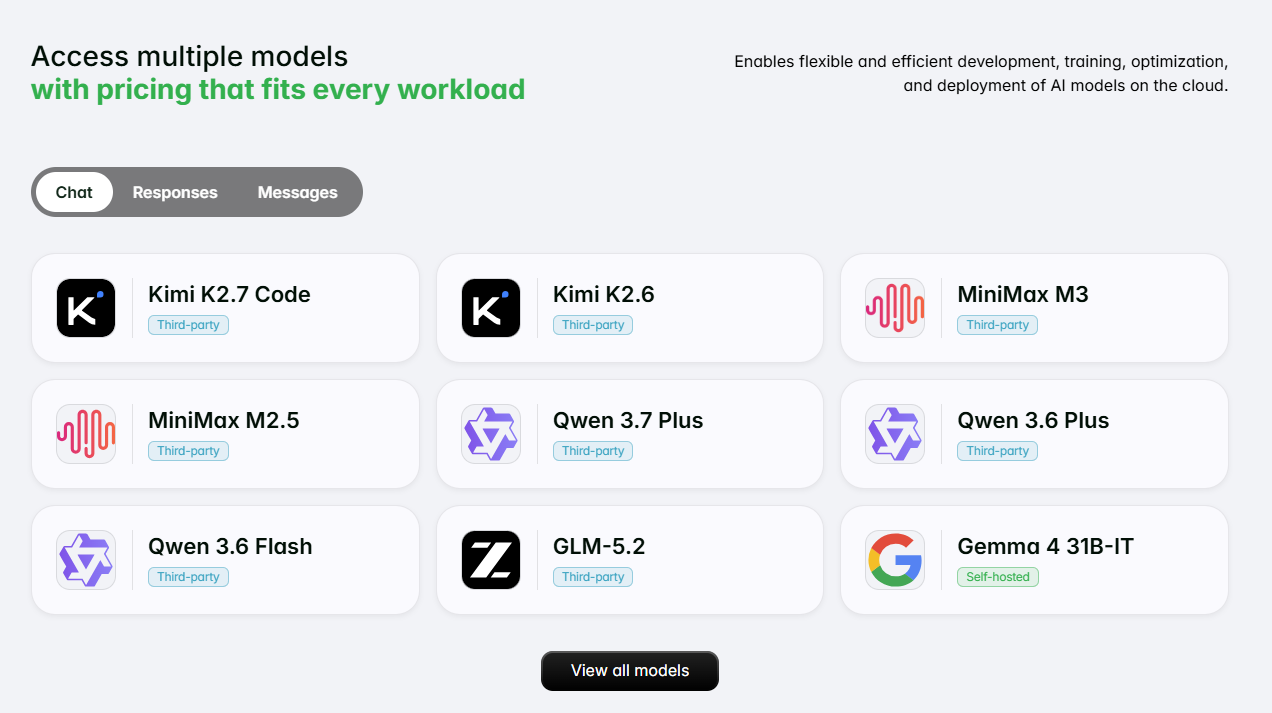
But scalability only truly matters when it comes with control over your data – especially as Vietnam's regulatory framework grows stricter. That's why GreenNode MaaS currently offers two types of models:
- Self-hosted: models that GreenNode deploys and operates directly on its own infrastructure.
- Third-party: models provided and operated by GreenNode's official partners.
This classification brings transparency about the source of each model and how it is operated. On the Portal, businesses can see clearly which models are self-hosted by GreenNode and which are provided by partners, giving them a firmer basis to choose models that fit their data residency and governance requirements.
If your business has AI ideas but no dedicated AI team – or doesn't want to build one yet – MaaS is the fastest, lowest-risk way to validate and deploy.
Explore GreenNode Model as a Service to start bringing AI into your product with a single API.
Frequently Asked Questions
Do I need an ML engineer to deploy AI?
No. With MaaS, the provider handles model training and operation. Your existing developer/backend team can integrate AI through an API without hiring dedicated ML engineers or building an MLOps team.
How does pricing work to get started?
Most commonly it's pay-per-token: you pay only for the tokens actually processed, with no upfront infrastructure investment. This lets you experiment early with almost zero fixed cost.
Is our business data safe?
With GreenNode MaaS, you choose the deployment region and keep data within it, with per-tenant isolation and a commitment not to use customer data to train models – important for industries with strict compliance requirements.
