

Key Takeaways
- When deploying AI, the question is not only which model to use, but also where the data is processed (inference).
- Data Sovereignty refers to the control and legal framework governing data, including where data is stored and processed — an increasingly important consideration as AI and data governance requirements evolve in Vietnam.
- AI Law 134/2025 and the Personal Data Protection Law 91/2025 introduce new requirements around AI governance and cross-border data transfers, particularly for BFSI and foreign businesses.
- GreenNode MaaS enables businesses to use modern AI models with inference served from Vietnam, while providing transparency into where models are hosted and helping businesses control their data processing region.
When businesses integrate AI, most of the attention tends to focus on one question: “Which model should we use?”
But in the context of Data Sovereignty, there is another question that is just as important and often overlooked: “Where is your data actually being processed?”
Every time a business calls an AI model, the input data, which may include customer records, transaction information, or proprietary source code, is sent to wherever that model is actually running. And that location may be outside Vietnam.
With today's AI models, getting an answer often means sending input data outside the country to where the model is hosted, and then receiving the result back. In some cases, this can unintentionally become a cross-border data transfer.
As Data Sovereignty becomes increasingly important, where AI inference takes place is no longer just a technical detail. It is becoming an important business and compliance consideration.
This article focuses on that specific issue, and how GreenNode MaaS helps businesses process data in Vietnam while still using modern AI models.
Data Sovereignty and Vietnam's AI Regulatory Framework: What Businesses Need to Know
Data Sovereignty is the principle that data is subject to the laws and regulations of the country where it is stored and processed.
When data belonging to users in Vietnam is processed on servers in another country, it may become subject to that country's laws and regulations and potentially fall outside the direct control of the business.
This issue is becoming increasingly important as more sensitive data flows through AI systems, Vietnam's regulatory framework continues to evolve, and demonstrating where data is processed becomes part of the vendor evaluation process - particularly for financial institutions, banks, and foreign businesses.
From a regulatory perspective, two key laws are particularly relevant: AI Law 134/2025 and the Personal Data Protection Law 91/2025.
AI Law 134/2025, effective March 1, 2026, takes a risk-based approach. High-risk AI, including applications in banking and finance, is subject to stricter requirements, while foreign providers are required to appoint a legal representative in Vietnam.
However, the AI Law itself does not directly require data to be stored domestically. Requirements concerning cross-border transfers of personal data, including the preparation of a Transfer Impact Assessment (TIA) and potential penalties of up to 5% of the previous year's revenue, come from the Personal Data Protection Law 91/2025, effective January 1, 2026, together with the Cybersecurity Law.
GreenNode has previously published a detailed analysis of this regulatory framework and the key considerations for businesses. In this article, we focus on one specific aspect that is often overlooked when deploying AI: inference location.
Why Should Data Processing Location Be a Criterion When Choosing an AI Platform?
Businesses should start by challenging a common misconception:
Myth: “If I want to use the most powerful models (GPT, Claude, Gemini, etc.), I have to accept sending my data overseas.”
Reality: What matters is not where the model comes from, but where inference, the process through which the model processes your data, takes place. The same model family can still be served from infrastructure located domestically.
What Is AI Inference?
Inference is the process through which an AI model receives input data and generates an output. This is the point at which your data is actually “read” and processed by an external system.
If the inference endpoint is hosted overseas, every API call means that data leaves Vietnam. If the endpoint is hosted domestically, the data can be processed within Vietnam. For this reason, inference location should be evaluated alongside model performance and pricing when selecting an AI platform.
Businesses should ask any AI provider three key questions:
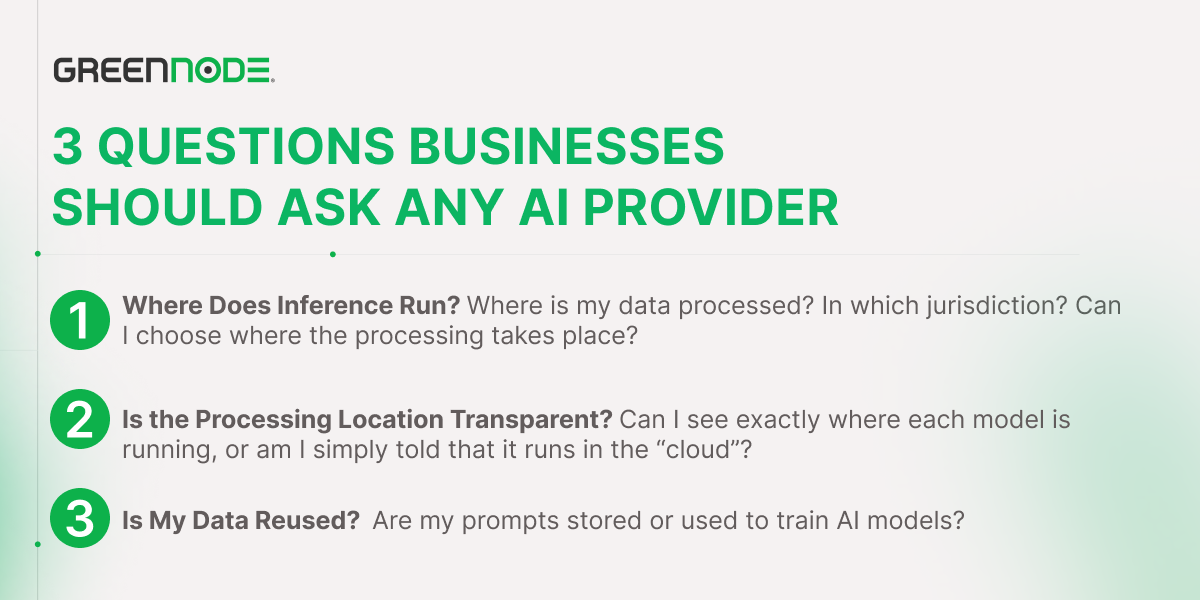
1. Where Does Inference Run? Where is my data processed? In which jurisdiction? Can I choose where the processing takes place?
2. Is the Processing Location Transparent? Can I see exactly where each model is running, or am I simply told that it runs in the “cloud”?
3. Is My Data Reused? Are my prompts stored or used to train AI models?
A platform that provides clear answers to these three questions enables businesses to use modern AI while maintaining greater control over compliance risks - rather than having to choose between the two.
How Does GreenNode Model as a Service Enable AI Inference in Vietnam?
GreenNode MaaS is designed to help businesses avoid choosing between “powerful models” and “keeping data domestic.”
The platform provides access to leading AI models through a unified API, with inference served from infrastructure located in Vietnam and the region.
Specifically, GreenNode MaaS addresses data sovereignty through the following mechanisms:
Inference in Vietnam on NVIDIA GPU Infrastructure
AI models are served from availability zones in Hanoi, Ho Chi Minh City, and Bangkok, helping keep data processing within the region while maintaining low latency.
Transparency Into Where Models Run
Through the Transparency Portal, businesses can see whether each model is self-hosted by GreenNode, running directly on GreenNode infrastructure, or provided by an official partner.
This gives businesses a clearer basis for selecting models based on data residency and governance requirements.
Choose Your Deployment Region
Businesses can choose where their data is processed, helping ensure that data remains within the selected region.
Per-Tenant Isolation and No Training on Customer Data
Customer prompts and data are isolated through per-tenant isolation and are not used to train models.
GreenNode MaaS also provides guardrails and PII masking to help protect sensitive information.
Built-In Governance and Monitoring
Businesses can monitor usage, costs, and model activity in real time, supporting audit requirements in highly regulated industries.
In other words, businesses can use the modern AI models they need while keeping inference within Vietnam and their data under control.
This makes GreenNode MaaS a suitable platform for engineering, security, and business leadership teams across banking and finance, technology, and foreign businesses operating in Vietnam.

Learn more about GreenNode Model as a Service
Frequently Asked Questions
What Is Data Sovereignty?
Data Sovereignty is the principle that data is subject to the laws and regulations of the country where it is stored and processed.
In the context of AI, this means that the location where a model processes data (inference), determines the legal framework that applies to that data.
Does Using Powerful International AI Models Require Businesses to Send Data Overseas?
Not necessarily.
The key consideration is not where the model comes from, but where inference takes place.
With a platform that provides domestic inference, such as GreenNode MaaS, businesses can use modern AI models while keeping data processing within Vietnam.
Does AI Law 134/2025 Require Data to Remain in Vietnam?
AI Law 134/2025 focuses on risk-based AI governance and does not directly require data to be stored domestically.
Requirements concerning data storage and the cross-border transfer of personal data primarily come from the Personal Data Protection Law 91/2025 and the Cybersecurity Law.
Why Is Inference Location Important for BFSI and Foreign Businesses?
Financial and banking data is highly sensitive and associated with higher levels of risk, while foreign businesses may face additional obligations, such as appointing a legal representative in Vietnam.
Keeping AI inference within Vietnam can help reduce the risks associated with cross-border data transfers and make it easier to demonstrate compliance.
