

Many retail chains are using chatbots to automatically handle most customer support requests, forecasting systems to optimize inventory working capital, and recommendation engines to boost conversion rates. But if a customer files a complaint asking: "What is my data being used for, and who is viewing it?"which team in the organization can answer within 5 minutes?
This is no longer a question solely for IT or Cybersecurity, nor is it just a marketing issue. Since Personal Data Protection Law No. 91/2025/QH15, Decree 356/2025/ND-CP, Law on Artificial Intelligence No. 134/2025/QH15 (effective March 1, 2026), alongside E-commerce Law 2025 (No. 122/2025/QH15) and Decree 248/2026/ND-CP officially tightened compliance boundaries, protecting retail customer data has become a C-level imperative: the CEO, CIO, CMO, and COO share joint responsibility moving beyond leaving it for the "technical team to handle alone."
This article shares key insights into the risks to consider when deploying AI into retail operations from customer care and personalization to forecasting and operational optimization along with reference questions for retail enterprises.
1. Customer Data in Retail Is Fragmented Across Multiple Systems and Vendors
In an omnichannel retail chain, customer data rarely resides in a single database. Data is generated and stored sparsely across multiple touchpoints:
- In-store POS systems: Store transaction records, payment methods, purchase timestamps, and direct PII (phone numbers, customer names).
- E-commerce platforms and Mobile Apps: Track browsing history, cart abandonment behavior, device telemetry, IP addresses, and geolocation.
- Customer Relationship Management (CRM) and Customer Data Platforms (CDP): Integrate segmentation data, loyalty rewards points, and customer service interaction history.
- Third-party Marketing Automation & Customer Support Platforms: Manage email lists, phone numbers for targeted ad campaigns, and chat logs via Zalo OA or Facebook Messenger.
When enterprises deploy AI solutions (e.g., RAG models for product lookups or AI Recommendation Engines for customer data personalization), these data flows are instantly passed onto new technical components: Vector Databases (Vector DBs), Large Language Models (LLMs), and GPU compute infrastructure.
If these AI components are operated by multiple SaaS or Cloud vendors without unified governance policies, retail enterprises face a "compliance blind spot": transaction data resides in one place, AI query logs sit in another, and vector embedding backups reside on third-party infrastructure. This fragmentation makes data deletion or proving compliance based on customer consent extremely complex.
2. Without Data Flow Visibility, You Cannot Commit to Customers
A privacy commitment on a website is only as valid as the enterprise's actual visibility into where its data flows. Mapping data flows is therefore not a step to be taken "after an incident occurs," but a prerequisite before deploying any AI model into commercial operations.
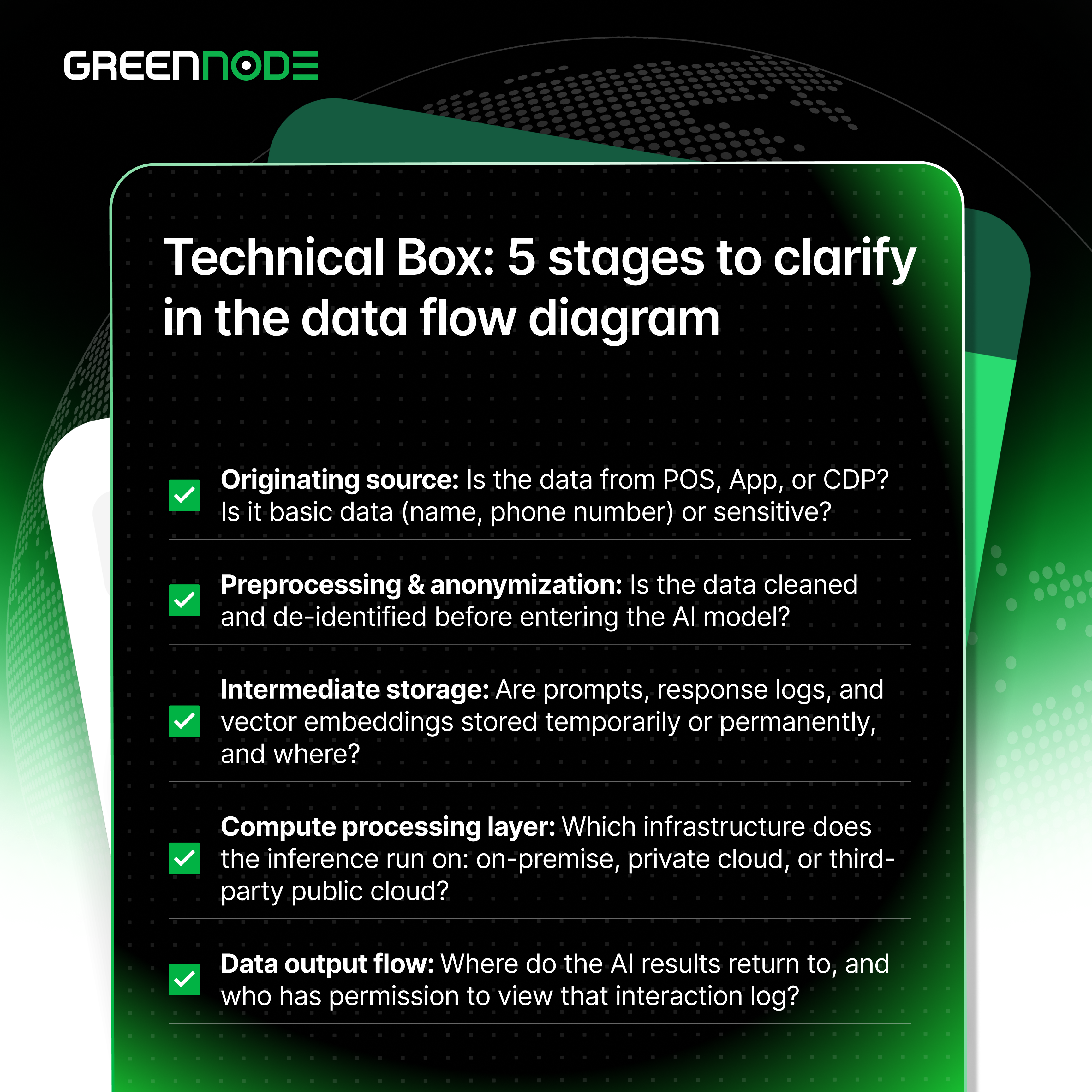
Technical Callout: 5 Stages to Clarify in a Data Flow Map
- Source of Origin: Is data coming from POS, Mobile App, or CDP? Is it basic data (full name, phone number) or sensitive data (location, financial data)?
- Preprocessing & Anonymization: Is data cleaned and de-identified before entering the AI model?
- Intermediate Storage: Are prompts, response logs, and vector embeddings stored temporarily or permanently, and where?
- Compute Processing Layer: On which infrastructure does inference run—on-premise, private cloud, or third-party public cloud?
- Data Output Flow: Where are AI outputs delivered, and who has authorization to view those interaction logs?
(Refer to the article on AI Governance Framework and Tiered AI Stack for Enterprises for detailed guidance on architecting tiered AI safety.)
By clearly decoupling the Data Plane from the Control Plane, executive leadership can instantly identify in the event of an incident or customer request who within the organization (or which partner) bears responsibility at every link in the chain.
3. Seasonal Infrastructure Capacity Requirements and Key Terms to Align Before Peak Seasons
The retail industry is heavily driven by seasonality. During peak shopping events like 11.11, 12.12, Black Friday, or Lunar New Year, system traffic and AI inference workloads can surge 5 to 10 times compared to normal business days.
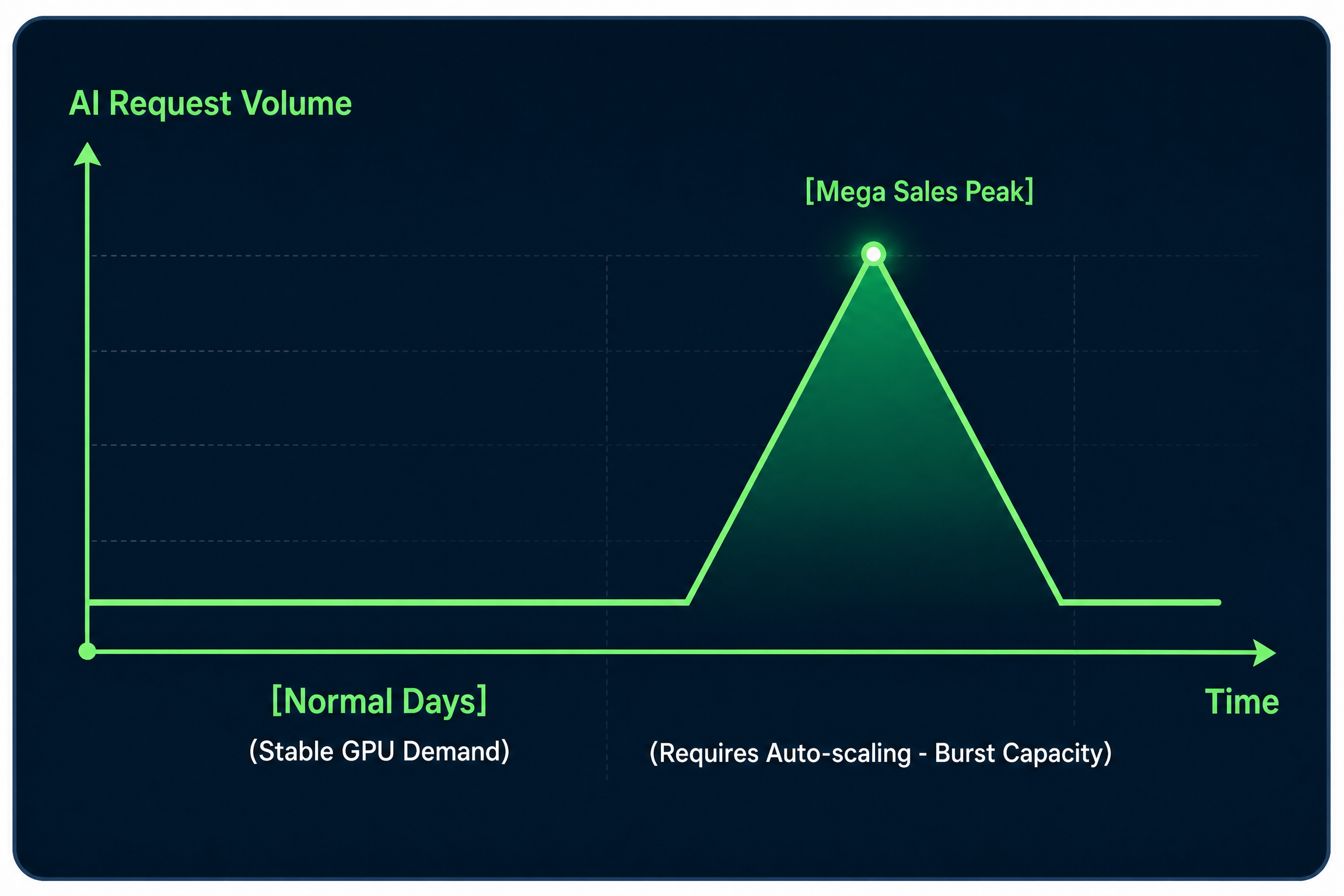
This volatile demand poses major challenges for AI compute infrastructure:
- Risk of Inference Bottlenecks: If Cloud infrastructure lacks auto-scaling capabilities for GPU resources, critical features like real-time product recommendations or customer support chatbots will experience outages, directly impacting revenue.
- Risk of Data Exposure in Shared Environments: When infrastructure auto-scales in a multi-tenant Cloud environment during traffic peaks, insufficient tenant isolation mechanisms can lead to cross-tenant data leaks between competing retail brands.
Therefore, prior to peak sales events, retail enterprises must align on core technical terms with their AI Cloud provider:
- Guaranteed Compute Scaling Capacity: Ensuring immediate provisioning of GPU clusters (e.g., NVIDIA L40S, H100) without disrupting processing pipelines.
- Hardware-level Environment Isolation: Guaranteeing that shopping data and query logs remain stored and processed within isolated virtualized environments during high-load periods.
- Flexible Cost Structure: Enabling pay-as-you-go scaling to optimize operational infrastructure costs outside of peak seasons.
See the Sovereign Cloud Vetting Ebook for Enterprises for a detailed vendor evaluation rubric.
4. Model Retraining Cycles and Permissible Data Scope
Retail consumer trends shift weekly and seasonally. An AI customer data personalization model that isn't updated with fresh data will rapidly decline in accuracy. Consequently, fine-tuning or re-training models is an imperative requirement.
Legally, however, feeding customer data into model training pipelines requires strict adherence to customer consent conditions:
- Validity of Consent: A customer's consent for a retail chain to "use information to suggest orders" does not equate to permission to "use personal data to train a vendor's shared AI model."
- Data Minimization Principle: All Personally Identifiable Information (PII) like names, phone numbers, addresses, and card details must be fully stripped and anonymized before entering training datasets. Only pure behavioral metrics (view history, purchase frequency, basket value) should be retained.
- Training Data Lifecycle Management: Enterprises must establish explicit retention and deletion cycles for training data. When a customer withdraws consent, the system must feature automated procedures to purge the corresponding data from subsequent training sets.
To establish a standardized consent management workflow aligned with the new legal framework, refer to the Consent Governance Framework for AI and Big Data article.
5. Access Control Internal to the Organization and Across the Partner Ecosystem
An average retail chain collaborates with dozens of external partners: marketing consultancies, e-commerce operators, SaaS vendors, logistics providers, and ad agencies. When implementing AI, information security risks often stem from overly permissive access rights or a lack of auditability.
To ensure retail customer data protection, access governance strategies must adhere to three core principles:
- Principle of Least Privilege (RBAC & ABAC): Store sales staff should only access customer data necessary for the active transaction; marketing teams operate solely on aggregated segment data; external AI consultants must never have direct access to raw PII databases.
- Data Masking & Anonymization: For testing tasks or third-party API integrations, all customer PII must be automatically masked (e.g., displaying 090****123 or substituting real names with pseudonymous IDs) at the API Gateway layer before data leaves the internal network.
- Verifiable Auditability: Every data export operation, prompt submission containing customer data to an AI model, or analytical report extraction must be logged into an immutable system Audit Log. The system should automatically flag anomalous, high-volume data exfiltrations.
6. Technical Safeguards Against Unauthorized Cross-Border Data Transfer
Under Decree 356/2025/ND-CP, transferring personal data of Vietnamese citizens abroad or storing it on infrastructure outside Vietnamese territory is strictly regulated. Retail enterprises (as Data Controllers) are required to complete a Cross-Border Data Transfer Impact Assessment (DPIA/CTIA Form 10) and notify the Ministry of Public Security.
To ensure retail customer data is not accidentally transferred abroad during AI operations, enterprises must audit four infrastructure conditions:
- Data Center Residency: Ensure that source databases, vector databases, and GPU compute servers are hosted exclusively within Data Centers located in Vietnam.
- Control Plane Localization: Many international Cloud providers guarantee data storage in Vietnam, yet their Management Consoles and system logs run on servers hosted overseas. Legally, this still constitutes a cross-border data transfer.
- Customer-Managed Encryption Keys (CMEK): The retail enterprise must directly own and manage its encryption keys. The Cloud infrastructure provider must not have any capability to decrypt customer data under any circumstances.
- Sub-processor Boundaries: Contracts must explicitly commit that the AI solution provider cannot transfer customer data to any unvetted third party outside the list of Sub-processors explicitly approved by the retail enterprise in writing.
7. 7-Eleven Vietnam: Operating Nearly 1,500 Online Stores with Zero Downtime
Operating on a 24/7 model, 7-Eleven Vietnam a leading global convenience store brand with over 150 physical stores and nearly 1,500 online storefronts faced the challenge of running seamless omnichannel operations without revenue-impacting outages, all while maintaining compliance in transaction and payment data processing. Since 2020, 7-Eleven deployed vServer, vStorage, and Backup solutions in a hybrid model on GreenNode's infrastructure for core workloads (POS, order processing, customer data synchronization), keeping data processing and storage strictly within domestic borders.
Results (2020–2024): The infrastructure achieved a 99.9% SLA, maintaining continuous operations during peak seasons; order cancellation rates on GrabMart dropped below 4.5%; order processing time was reduced to under 3 minutes; and the entire ecosystem of nearly 1,500 online storefronts was managed by an IT team of just 2 people.
GreenNode and 7-Eleven recently signed a strategic Memorandum of Understanding (MoU), laying the groundwork for their next phase of AI adoption on the same infrastructure platform already proven for stability and compliance over the past six years.

GreenNode Solution Pillars for Retail Enterprises
Building on a field-proven infrastructure foundation demonstrated through real-world case studies like 7-Eleven Vietnam and ACFC, GreenNode empowers retail enterprises to build robust AI capabilities across three core pillars:
High-Performance In-Country GPU Infrastructure: Purpose-built GPU Cloud infrastructure (NVIDIA L40S, H100, H200, RTX 6000) automatically scales compute capacity in real time during Mega Sales events, ensuring smooth, uninterrupted AI personalization experiences. Compute nodes, storage layers, control planes, and audit logging reside entirely within domestic Vietnamese data centers, ensuring zero data egress beyond national borders during operation.
Isolated AI Platform: Enables retail enterprises to establish dedicated model fine-tuning environments and host Private Vector Databases on dedicated infrastructure. Model weights and customer data remain under the absolute ownership of the enterprise, preventing data leakage or unauthorized use for training competitor models.
Governance Built-in: Native integration with Customer-Managed Encryption Keys (CMEK), multi-tiered IAM access controls down to the API endpoint level, and the vMonitor system for instant audit log extraction to satisfy regulatory compliance checks.
Explore the detailed 7-Eleven and GreenNode case study
Conclusion:
Applying AI in retail offers a massive competitive edge in operational speed and personalized customer experiences. However, that advantage is only sustainable when built upon a secure, compliant infrastructure foundation.
By proactively mapping data flows, enforcing strict customer data consent mechanisms, and selecting scalable domestic AI Cloud infrastructure, retail enterprises can confidently accelerate their digital transformation journey without incurring compliance or legal liabilities.
