

This May, GreenNode continued to expand its production infrastructure capabilities with four notable updates: vDB PostgreSQL Cluster, ACL for Load Balancer, more flexible LB Autoscale after deployment, and self-configurable VKS Auto Healing on the Portal.
For teams running real systems on the cloud, the challenge is not simply having more features. It is about reducing downtime, improving access control, scaling resources more flexibly, and cutting down manual operational work. These four updates directly address those needs, making them well suited for a monthly digest aimed at enterprise customers and technical teams.
vDB PostgreSQL Cluster: better readiness for production workloads
GreenNode has launched vDB PostgreSQL Cluster on the Portal together with a 90-day free trial program for the first 30 users. This is a meaningful upgrade for businesses that need PostgreSQL deployments with higher availability, stronger scalability, and a simpler cloud management experience.
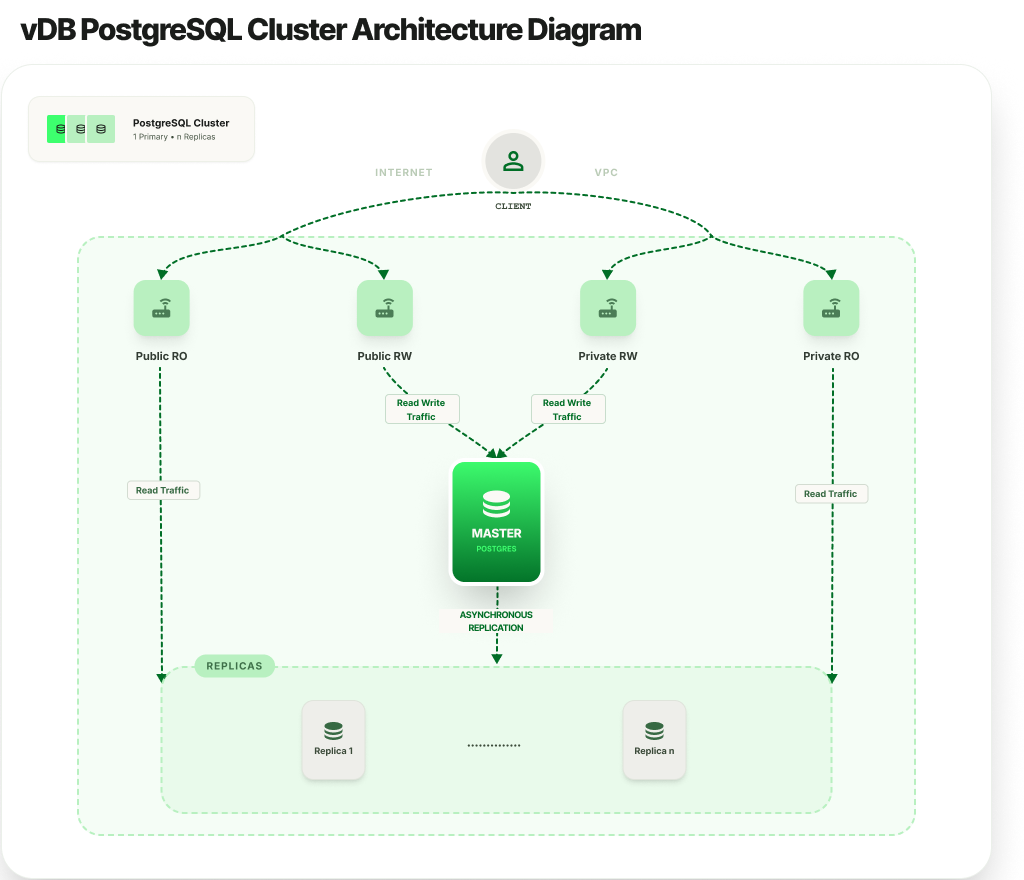
From an architectural perspective, PostgreSQL Cluster follows a one-writer, multiple-reader model, supports multi-node auto-failover, enables independent read and write scaling, and includes integrated backup in HCM and HAN. It also supports pgvector, TimescaleDB, and PostGIS, making it especially relevant for AI, analytics, and geospatial workloads.
Who is PostgreSQL Cluster for?
- Businesses that need High Availability for production databases.
- Applications with heavy read workloads that need to separate traffic between write and read nodes.
- Teams building AI or analytics workloads on PostgreSQL.
ACL for Load Balancer: more granular access control
ACL for Load Balancer is a comprehensive upgrade from the previous Allowed CIDR mechanism. In addition to defining permitted IP ranges, ACL also introduces Dropped CIDRs for proactive blocking and Default Actions when no rule matches.
This change allows businesses to build more flexible access policies for different deployment environments, including public services, internal systems, office networks, corporate VPNs, and partner integration flows. Instead of relying on simple whitelisting, operations teams can now apply clearer and more practical traffic policies directly at the load balancing layer.
LB Autoscale: more flexibility after deployment
Another important update is that vLB now allows users to modify Auto Scaling settings after creation through the Configure AutoScale feature on the detail page. This is a major improvement because several parameters previously had to be fixed at the time of provisioning.
The three editable parameters are Min size, Max size, and Availability Zone. As a result, businesses can adjust scaling boundaries and deployment zones based on new requirements without recreating the Load Balancer, helping operations teams respond more effectively to changing traffic patterns.
VKS Auto Healing: more proactive Kubernetes cluster recovery
VKS now supports Auto Healing configuration directly at the cluster level on the Portal. Users can proactively control unhealthy-node detection thresholds, safe replacement limits, and self-healing behavior that fits different workload types.
A notable point is that this mechanism includes cluster protection, automatically stopping replacements when the number of failed nodes exceeds a defined threshold in order to avoid broader impact. The configuration is also applied immediately without requiring a cluster or node restart, which helps reduce operational risk and keep Kubernetes environments more stable.
Tech docs updates
PostgreSQL Cluster - Overview
ACL (Access Control List) - Config IP whitelist to Load Balancer
Auto Scaling - vLB new version
VKS - Release notes
Frequently Asked Questions
What are the benefits of PostgreSQL Cluster?
This solution improves database availability, supports more scalable read and write patterns, and adds backup and failover capabilities to reduce the risk of service interruption.
How is ACL different from a traditional IP whitelist?
ACL goes beyond a list of allowed IPs by adding proactive blocking and configurable default actions, making access policy management more flexible.
How does the updated LB Autoscale help operations?
It allows teams to change Min size, Max size, and Availability Zone after deployment, making infrastructure adjustments more flexible without recreating the service.
