

Key takeaways
- GPU cloud by the hour lets Vietnamese AI startups validate ideas, control burn rate, and scale without buying expensive on‑prem GPU servers.
- A sovereign high‑performance AI cloud platform like GreenNode gives access to a wide range of NVIDIA GPUs, fast networking, and ready‑to‑use environments so teams can focus on model and product.
- Flexible pricing and optimized GPU allocation make it possible to start training from just a few dollars per hour instead of investing millions of USD into AI infrastructure.
Most AI startups in Vietnam are currently spending more than necessary on GPU cloud infrastructure—not necessarily because they chose the wrong provider, but because they have not yet identified the key questions to ask before signing a contract.
The market is evolving rapidly. According to data from Introl.com (December 2025), H100 rental prices fell from around USD 8 per hour to USD 2.85–3.50 per hour, a 64% decline from their peak. In other words, access to high-performance GPU infrastructure for AI model training has never been more affordable. Still, the listed hourly rate tells only part of the story.
Why AI Startups Should Rent GPU Cloud Instead of Buying Hardware
Purchasing a physical server equipped with 8x NVIDIA H100 80GB GPUs can cost more than VND 2 billion, not including electricity, cooling, maintenance, and the opportunity cost of underutilized hardware. On-demand GPU cloud eliminates that upfront capital expense entirely.
For startups in the R&D or model fine-tuning stage, the pay-as-you-go model is even more practical: turn GPUs on when needed, shut them down as soon as the job is done, and pay nothing extra. According to RunPod’s 2025 analysis, using cloud GPUs for a 4x A100 setup can save more than USD 124,000 (roughly VND 3 billion) compared with buying and operating equivalent on-premise infrastructure over the same period. Hourly access to high-performance GPU compute also allows smaller teams to experiment with more model architectures within the same budget.
Just as importantly, renting GPU cloud infrastructure allows AI teams to focus on training and fine-tuning models instead of spending time managing physical hardware.
Understanding the Total Cost of GPU Cloud
The price listed on a provider’s pricing page is usually just the starting point. Here are several additional costs that many startups overlook when comparing options:
Data egress fees. When large datasets are uploaded and checkpoints are exported, data transfer charges can add 20–40% to the monthly bill for providers that charge for egress. Many international platforms do not make this explicit in their advertised pricing.
Storage costs. LLM training requires high-speed NVMe storage to feed data fast enough to keep GPUs busy. If storage is located separately from compute, I/O latency can leave GPUs waiting instead of computing—while you continue paying for both.
Idle GPU time. This is one of the fastest ways to burn through a budget. Forgetting to shut down instances after a job finishes, or lacking an auto-shutdown mechanism, can waste millions of VND per week without creating any real value.
Latency and data center location. If your dataset is in Vietnam but your GPUs are running in an overseas region, data transfer speed can slow down every training epoch. At larger model sizes, an extra 20% in training time can easily translate into hundreds of dollars in added cost.
Which GPU Fits Which Workload?
Not every AI model needs an H100. Choosing the right GPU for the right workload is often the most effective way to optimize cost.
| Workload | Recommended GPU | Why |
|---|---|---|
| Fine-tuning smaller models (<7B parameters) | A40, L40S | 48GB VRAM at a significantly lower cost than H100 |
| Pre-training or fine-tuning larger LLMs (13B–70B+) | H100 80GB | Strong FP8/BF16 performance, plus NVLink and InfiniBand support |
| Production inference | A40, L40S | Stable throughput without requiring extremely high memory bandwidth |
| Distributed multi-node training | H100 + InfiniBand | Can reduce training time by 30–40% compared with single-node setups |
The right configuration also depends on your stage of development. You can refer to this comparison of H100 and H200 to determine which GPU best fits your specific workload.
GreenNode — NVIDIA Preferred Partner in Asia
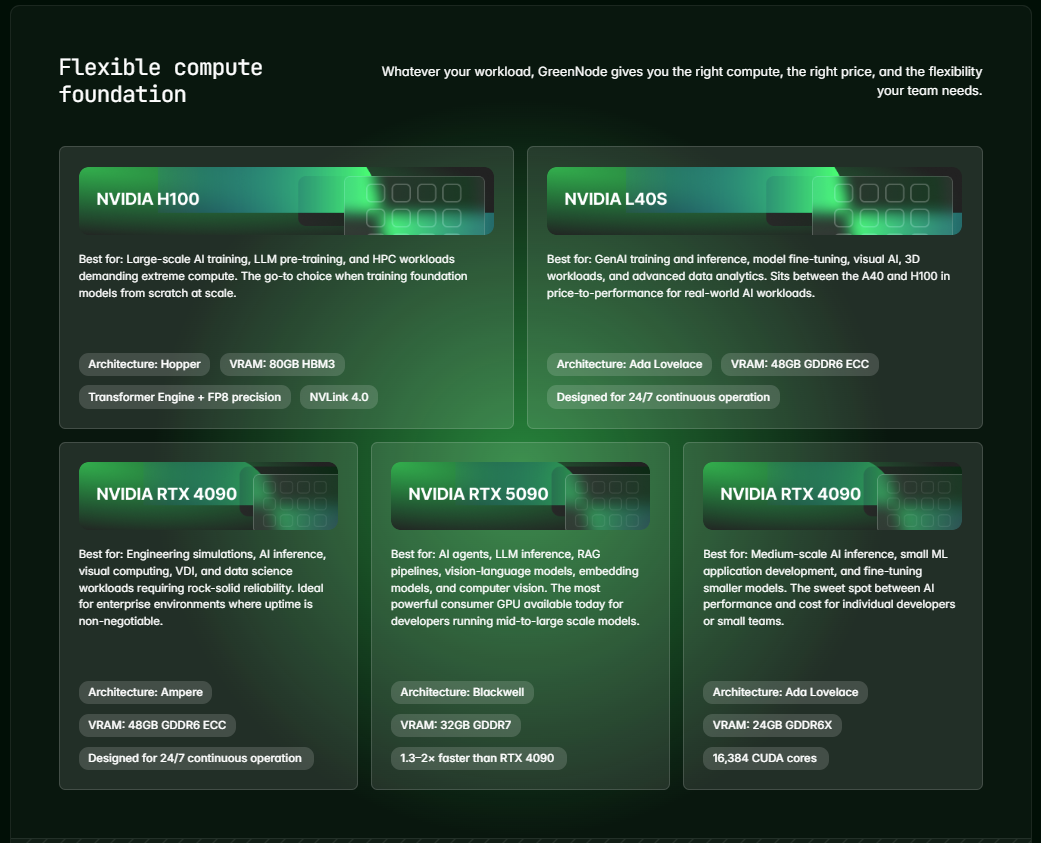
Since May 2024, GreenNode has officially been recognized as an NVIDIA Preferred Partner (NCP) in Asia, making it one of the few regional providers to earn this certification. Thousands of NVIDIA H100 Tensor Core GPUs have been deployed across data centers in Hanoi and Thailand, in coordination with ST Telemedia Global Data Centres.
In March 2026, GreenNode launched the HAN-1B Availability Zone in Hanoi, expanding AI GPU capacity for Northern Vietnam. The platform now operates across six availability zones in Hanoi, Ho Chi Minh City, and Bangkok, with a 3.2 Tbps InfiniBand network connecting nodes across the infrastructure.
On-demand H100 pricing starts at USD 2.69 per GPU per hour (updated August 2025), putting GreenNode in direct competition with international GPU-focused platforms—while offering the added advantage of infrastructure located in Vietnam and Thailand. That regional presence matters when comparing it with foreign platforms that have no local footprint.
If you want a better sense of real-world H100 performance in AI/ML benchmarks, this article on H100 performance in the MLPerf benchmark can help you evaluate the right configuration more accurately.
Why Data Center Location Matters for Vietnamese Startups
This is one area where international platforms have a hard time matching GreenNode.
Vietnamese user data—from financial transactions to customer information—is increasingly subject to local requirements around data storage and processing. Uploading datasets to an overseas cloud for training not only creates compliance risk, but also raises immediate questions around data sovereignty once a startup begins working with enterprise clients or financial institutions.
GreenNode’s domestic infrastructure allows training data to remain within Vietnam’s borders throughout the model training process—something many enterprises now consider a requirement rather than an option. For more context, see this overview of cloud compliance requirements in Vietnam.
AI in Southeast Asia: Opportunity and Infrastructure Gaps
According to a report by Kearney, more than 80% of businesses in Southeast Asia are still in the early stages of AI adoption. Some 83% allocate less than 0.5% of revenue to integrating AI into operations. The biggest barrier is not a lack of ideas—it is the lack of infrastructure capable of turning those ideas into production systems.
Access to regional GPU cloud helps startups overcome that barrier without waiting for large budgets or relying on international hyperscalers that are not optimized for local data and latency conditions. That is also why the AIaaS ecosystem for startups is expanding quickly across the region.
From GPU Access to a Complete AI Platform
GreenNode offers more than just GPUs. That distinction becomes important when startups begin thinking beyond the initial model training phase and plan for a longer AI roadmap.
GreenNode’s AI Platform covers the full model lifecycle—from training and fine-tuning to deployment and model management at scale—within a unified interface. Teams do not need to build an MLOps pipeline from scratch.
Model as a Service (MaaS) provides access to more than 20 ready-to-use AI models via API, which is useful when teams need fast integration without training their own models. For teams building Vietnamese-language models, GreenMind—a 34-billion-parameter LLM developed on GreenNode’s H100 infrastructure—shows that high-quality Vietnamese reasoning models can be built on regional infrastructure.
For teams ready to get started, this guide to fine-tuning LLaMA 3 on GreenNode offers a practical starting point with setup steps and sample commands.
Lessons from Real Startups: Accelerating AI Deployment with GreenNode
SotaTek brought Sotabox.ai into production in just 30 days by leveraging GreenNode’s infrastructure, including vDB, Kafka, and VKS, reducing DevOps costs by 30% in the process. Meanwhile, Neyu—a telesales startup operating more than 1,000 agents across seven countries—was able to scale faster thanks to the deployment speed enabled by regional infrastructure.
What both companies had in common was not the question, “Where can we find the cheapest GPU?” The more important question was: which infrastructure enables us to launch faster, minimize compliance risk, and scale confidently once the model has proven its business value?
Affordable GPU cloud is a necessary starting point. But for AI startups to move fast and grow sustainably, they need more than that: regional infrastructure, low latency, support for data sovereignty requirements, and 24/7 technical support in Vietnamese. Those are the factors that make the real difference over time.
View GPU cloud pricing and configurations or contact the GreenNode team for workload-specific guidance.
