

Key takeaways
- Policy-as-Code turns security, compliance, and access rules for AI agents into executable code, enabling consistent, real‑time guardrails instead of fragile manual processes.
- Embedding Policy-as-Code into AI agent infrastructure (via tools like OPA/Rego, GitOps, PDP/PEP patterns) lets organizations block unsafe actions before execution and keep a full audit trail of every decision.
- As agentic AI scales across data, APIs, and cloud resources, Policy-as-Code becomes critical to harden infrastructure, reduce risk, and keep autonomous agents fast but governed under clear enterprise policies.
If you’re already running AI agents in production, you’ve probably felt the gap between “this is incredibly powerful” and “I really hope this thing doesn’t do something we didn’t intend.” Hardening your AI agent infrastructure is about closing that gap with a clear security baseline and turning your guardrails into policy-as-code instead of hopeful documentation.
Why AI Agents Need a Different Security Playbook
From chatbots to autonomous agents with real permissions
The first wave of LLM adoption looked like simple chatbots answering questions over internal docs or FAQs. Today’s AI agents are very different: they can call APIs, write tickets, change configurations, orchestrate workflows, and act on behalf of users in production systems.
That means each agent is less like a passive model and more like a junior engineer, SRE, or operations analyst who never sleeps and can execute actions at machine speed.
New risk surface: actions, tools, and shadow agents
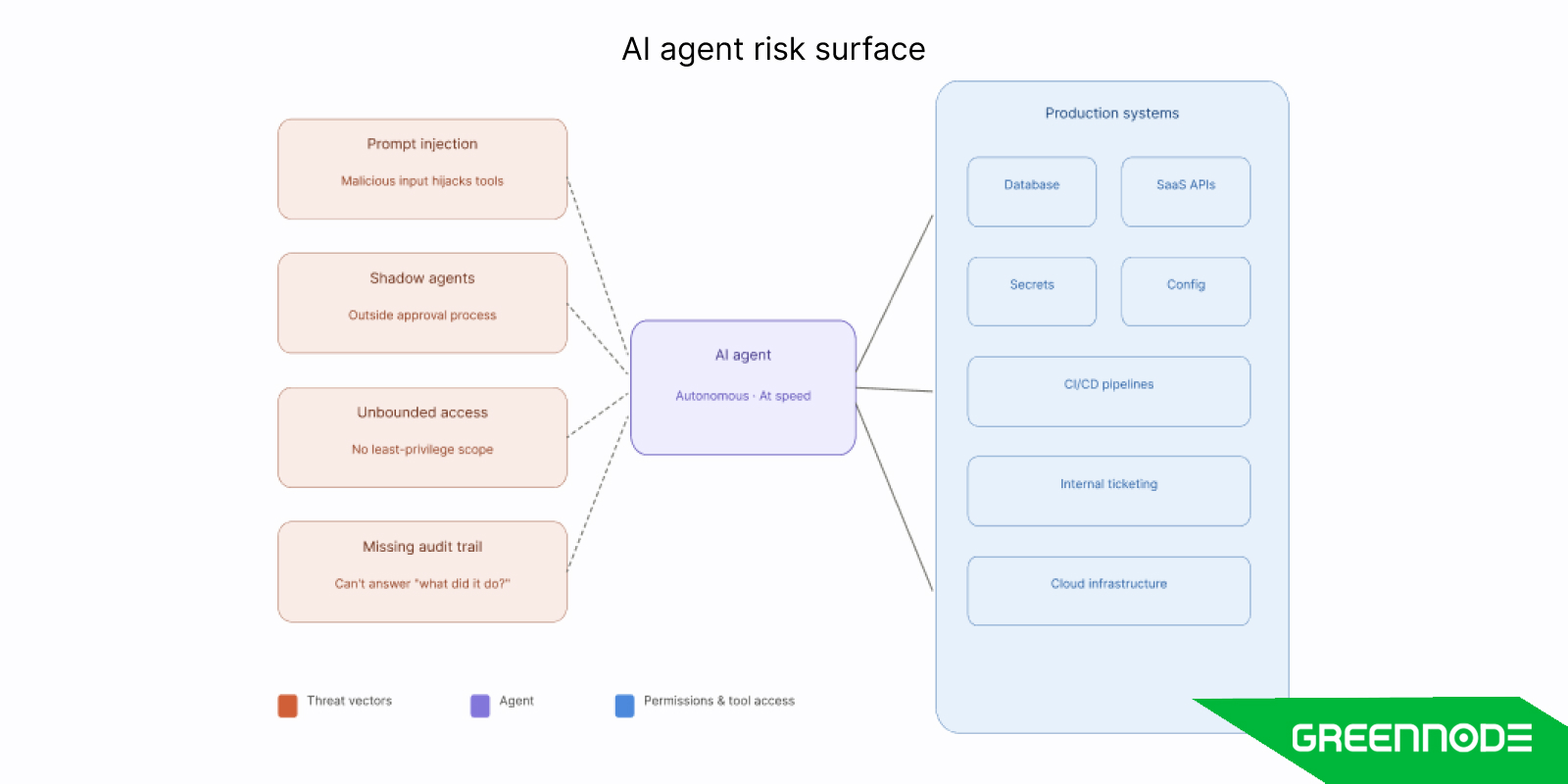
This shift introduces a risk surface that traditional app security doesn’t fully cover. Common issues include:
- Prompt and tool injection, where input data convinces the agent to call tools in unexpected ways.
- Shadow agents, built and run outside official platforms or approval processes.
- Unbounded tool access, where an agent can reach production databases, secrets, or SaaS systems without strong controls.
If you don’t treat agents as first‑class identities with explicit permissions and containment, they quickly become a powerful new path to data loss and production incidents.
People also read: Key Notes for Businesses under Decree 13/2023/ND-CP on Personal Data Protection
Establishing a Practical Security Baseline for AI Agents
You can’t jump straight into fancy governance if the foundations aren’t there; you need a practical baseline before scaling agent adoption.
Infrastructure basics you cannot skip
At the infrastructure layer, AI agents should look like any other internet‑facing, high‑value application. That usually includes:
- API gateways in front of agent endpoints, with authentication, rate limiting, and request inspection.
- Network segmentation and micro‑segmentation to isolate agent runtimes from critical systems unless explicitly allowed.
- Hardened containers or serverless runtimes, patched base images, and minimal OS surfaces.
- Basic cloud posture management (CSPM/CNAPP) so agents aren’t running on misconfigured infrastructure.
If an attacker can pivot from an agent’s pod or container into your broader network, the rest of the discussion is mooted.
Secrets, identity, and least privilege
Next, each agent needs a unique, well‑governed identity rather than a shared API key. Good baselines include:
- Assign a dedicated identity (service principal/service account) per agent, not per team.
- Use short‑lived tokens and automatic rotation, avoid static long‑lived keys.
- Enforce least‑privilege scopes for every tool, API, and data source the agent can reach.
Think of it as standard IAM done seriously, but for agents instead of humans.
Role-based access control: govern who builds and operates agents
Security baselines for AI agents often focus on what agents can do, but overlook who can deploy and manage them. Without centralized role governance, you end up with sprawl: developers with production deploy rights, analysts running agents against live customer data, and no clear ownership when something goes wrong.
A practical baseline assigns clear roles — who can create agents, who can approve tool configurations, who can access logs — and enforces them centrally rather than relying on team-level conventions. This maps directly to standard RBAC patterns, applied to your agent platform rather than just your cloud IAM.
GreenNode AgentBase introduced Member & Permissions management as a platform-level control, letting organizations define and enforce these roles centrally instead of managing them across individual team setups.
Observability and audit: every agent action leaves a trace
Because agents are autonomous, you must be able to answer “what did it do?” at any time. A minimal baseline:
- Log every tool call, including inputs, outputs (with redaction where needed), and identity.
- Track access to sensitive data (databases, storage buckets, internal APIs).
- Stream logs to your SIEM/SOAR so security teams can monitor patterns and investigate incidents.
- Maintain clear ownership: who is on call for a misbehaving agent.
NIST’s recent initiative on AI agents explicitly calls out identity, action logging, and containment boundaries as core governance pillars, which align directly with this baseline.
Where the Baseline Breaks: Gaps You Cannot Fix with Manual Controls
Even if you have a solid baseline, two problems remain: policies live in documents and approvals don’t scale.
Policies in docs, not in systems
Most enterprises already have some form of AI usage policy: which data can be used, where agents can run, and when humans must approve actions. The problem is that these rules often exist only in PDFs, Confluence pages, or slide decks.
You might say “agents must not access production customer tables,” but nothing programmatically enforces that constraint when an engineer adds a new tool or updates a workflow.
Human review bottlenecks and inconsistent approvals
When every new agent or change requires manual security review, friction goes up and consistency goes down. As adoption grows—some reports show more than 80% of technical teams already running agents while only ~14% have full security approvals—this gap widens.
Security teams get stuck in ticket hell, and developers start bypassing the process just to move work forward. That is exactly where policy-as-code becomes useful.
Policy-as-Code for AI Agents: Core Concepts
Policy-as-code (PaC) turns your governance and security rules into executable code that systems can evaluate automatically, instead of relying on human memory or manual checklists.
What policy-as-code means in an agentic context
In the context of AI agents, PaC means encoding rules like:
- Which agents can run in which environments.
- What data an agent can access, and under what conditions.
- Which actions always require human approval (for example, financial trades or production config changes).
These rules are expressed in a machine‑readable language (such as Rego or Cedar) and evaluated whenever an agent is deployed or tries to perform an action.
The result is proactive enforcement instead of reactive “post‑incident” investigations.
Policy decision and enforcement points for agents
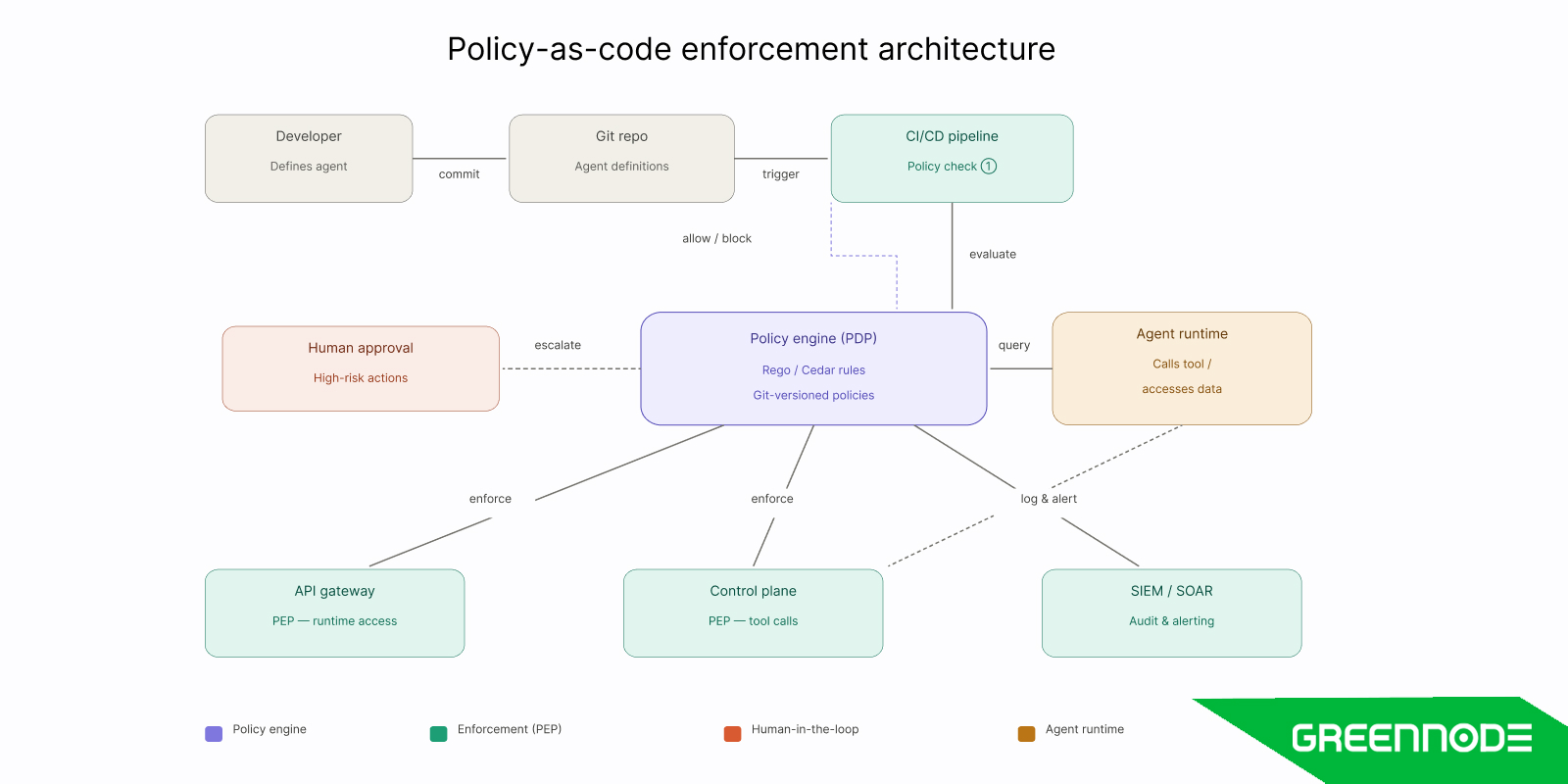
Most PaC architectures separate policy decision points (PDPs) from policy enforcement points (PEPs). For AI agents, you can place PEPs at key chokepoints:
- CI/CD and GitOps: block risky changes to agent workflows or infrastructure-as-code before deploy.
- Agent platform / control plane: check policies before routing tool calls or action requests.
- API gateways and service meshes: enforce runtime access policies on data and tools.
Kyndryl, for example, positions PaC as a central enforcement layer for agentic AI workflows across regulated environments.
Example policies you actually want
You don’t need hundreds of policies to start; a handful of high‑impact rules goes a long way. Examples:
- Environment boundary: “Agents running in ‘staging’ cannot call tools tagged ‘prod’.”
- Data residency: “Agents serving EU users must only query data in EU regions.”
- Human‑in‑the‑loop: “Any action that creates or modifies financial records requires human approval.”
- Containment: “Agents may not execute shell commands or write to specific directories on the host.”
Under the hood, these become small, testable policy modules stored in Git and evaluated by a PaC engine.
The hidden cost and visibility problem
Beyond the policy enforcement gap, scaling agent adoption introduces two practical blind spots that manual controls cannot solve.
The first is shadow agents — models and workflows built outside the official platform, often because the approval process is too slow or the tooling too unfamiliar. These agents are invisible to your security team, have no governed identities, and frequently use shared API keys or personal credentials.
The second is cost and resource sprawl. As agent usage grows across teams, MaaS consumption and runtime costs become difficult to attribute. Without per-team budget visibility and alerting, organizations often discover overruns only at billing time — too late to act.
Policy-as-code can address the first problem by making unofficial deployments technically impossible. Budget controls and usage dashboards address the second. Both need to be engineered into the platform, not bolted on afterward.
How to Apply Policy-as-Code to Your AI Agent Stack
Once you understand the core ideas, the next step is integrating PaC into the parts of your stack that matter most: agents, tools, and data.
Agents and tools: identity and access policies
Start by encoding rules around who an agent is and which tools it can use.
Typical policies:
- “Agent X may only act on behalf of users in group Y.”
- “Agent X can call ticketing tool T with read/write scope, but can only read from observability tool O.”
- “Tools tagged ‘high‑risk’ (for example, database admin) require approval for each write operation.”
In practice, these policies are evaluated either when a new agent definition is merged (CI/CD) or at runtime when a tool call is about to execute in the control plane.
Data access, locality, and dangerous actions
Data security is one of the biggest concerns for AI agents. Good PaC coverage includes:
- Data classification rules: which datasets can be accessed by which agent types.
- Residency and locality: ensuring agents do not route regulated data outside allowed regions.
- PII and secrets protection: preventing agents from reading .env files, SSH keys, or raw credential stores.
- Command blocklists, file‑system restrictions, and network egress controls for agents with system access.
These policies help close the “we know agents shouldn’t do that, but we can’t technically stop it” gap that many enterprises report.
Wiring PaC into your control plane or platform
Most organizations will manage dozens of agents over time, so centralizing governance through a control plane or agent platform is essential. Conceptually, the flow looks like:
- Developer or ML engineer defines/updates an agent (tools, prompts, workflows) and commits to Git.
- CI/CD runs policy checks on the definition and infrastructure before deploying.
- At runtime, when the agent tries to call a tool or access data, the control plane queries the policy engine and either allows, denies, or requires human approval.
This keeps governance close to where agents operate instead of scattered across scripts and teams.
MCP Gateway as a practical enforcement layer
One of the most effective places to enforce policy in modern agentic stacks is at the MCP (Model Context Protocol) connection layer — the point where agents connect to tools, data sources, and external services.
Rather than enforcing policies separately at each tool integration, an MCP Gateway centralizes connection management and becomes a natural policy enforcement point (PEP): every tool call from every agent passes through it, making it straightforward to apply rules like:
"Only agents with identity tag production-approved may connect to tools in the prod namespace."
"All MCP connections must be logged with full input/output traces."
"Connections to external SaaS tools require explicit approval for first-time use."
This aligns with the PDP/PEP architecture described earlier, but makes the enforcement point concrete and operational rather than theoretical. GreenNode's MCP Policy feature in AgentBase applies this pattern directly — defining connection policies that govern which MCP servers agents can reach and under what conditions.
30–60–90 Day Plan to Secure and Govern Your AI Agents
You don’t need a multi‑year programme to make progress; a simple 30–60–90 day roadmap can get you from ad‑hoc security to policy‑driven enforcement.
Days 0–30: inventory and baseline
In the first month, focus on visibility and hygiene.
- Inventory all agents, tools, and data they touch, including any shadow agents you can discover.
- Ensure every agent has a unique identity and is behind an authenticated, rate‑limited endpoint.
- Turn on logging for tool calls and sensitive data access, streaming to your central SIEM.
This gives you the map you need to govern effectively.
Days 31–60: codify the first critical policies
Next, work with security and compliance stakeholders to translate top‑risk concerns into code.
Examples of a first batch:
- Agents cannot access production databases unless their identity is explicitly whitelisted.
- Certain actions (payments, account closures, system configuration changes) always require human approval.
- Agents serving regulated regions must only query data within approved zones.
- Implement and test these policies in your policy engine, then wire them into at least one enforcement point (for example, CI/CD).
Days 61–90: expand coverage and automate checks
In the final phase, you shift from pilots to a sustainable operating model.
- Expand policy coverage to more agents, tools, and environments based on your inventory and incident history.
- Integrate policy checks into all relevant deployment paths (GitOps, CI/CD, platform‑level runtime checks).
- Define metrics such as policy violations prevented, time‑to‑approve changes, and reduced manual reviews.
By the end of 90 days, you should have moved from “please follow the policy” to “the system enforces the policy by default.
FAQs
1.What’s the minimum-security baseline I need before scaling AI agents?
At a minimum, you need unique identities for each agent, hardened and segmented infrastructure, and full logging of agent actions against sensitive systems. Without that, you cannot safely investigate or contain issues if something goes wrong.
2. How is policy-as-code different from traditional security reviews for AI?
Traditional reviews rely on humans to interpret policies and sign off on every change, which does not scale beyond a few agents. Policy-as-code encodes the same rules in machine‑readable form, so systems can automatically allow, block, or flag actions before they execute.
3. Which tools can I use to implement policy-as-code for agents today?
Common choices include Open Policy Agent (OPA) with Rego, Cedar‑based engines, and policy frameworks integrated into CI/CD and GitOps platforms. Many organizations embed these in their agent platforms or API gateways to enforce rules at runtime.
4. Can I adopt policy-as-code if my agents are already in production?
Yes; start by inventorying existing agents and codifying a small set of “must not break” rules, then add PaC checks into your current pipelines and platforms. Over time, migrate manual checks and tribal knowledge into policies while tracking reductions in incidents and review effort.
5. How does MCP Gateway fit into a policy-as-code architecture?
An MCP Gateway acts as a centralized enforcement point (PEP) between your agents and their tools. Instead of defining access rules at each individual integration, you express policies once — which agents can connect to which servers, under what conditions — and the gateway evaluates them in real time for every connection attempt. This makes it one of the most practical first places to implement policy-as-code for teams already using MCP-compatible tooling.
