

By 2026, global data creation is projected to reach 230–240 zettabytes — a near 32% surge in a single year. (Source: Storage in Big Data Market Size & Growth Report 2035). Behind that staggering figure are thousands of AI pipelines running continuously: training large language models (LLMs), processing medical imaging, analyzing real-time IoT telemetry, and forecasting retail demand. All of them share one critical bottleneck: storage infrastructure.
The question CTOs, Data Engineers, and IT Managers are asking with growing urgency: “What storage architecture can sustain a large-scale AI pipeline without blowing up the infrastructure budget?”
The answer, increasingly validated across enterprise deployments, is Object Storage.
1. What Is Object Storage and Why Does It Fit Big Data & AI?
Object storage is a data storage architecture that organizes data as discrete, self-contained objects. Each object consists of three components: the raw payload (file, image, video, log), a rich metadata envelope describing that payload, and a globally unique identifier (UUID) used for retrieval.
Unlike file storage with its hierarchical directory tree, or block storage with its rigid partitioning scheme — object storage organizes data in a flat namespace called a bucket, enabling:
Unlimited horizontal scalability from gigabytes to petabytes with no architectural changes
Universal HTTP/S3 API access from any programming language or ML framework
Native support for all unstructured data types: images, video, audio, log files, model checkpoints, CSV datasets, Parquet files
This is precisely what AI pipelines require. A typical deep learning model consumes hundreds of gigabytes to several terabytes of training data per run. That data has no uniform schema, cannot be crammed into a relational database, and needs to be accessed concurrently by dozens of GPU nodes at high throughput.
2. Why Object Storage Has Become the Backbone of Modern AI Infrastructure
A 2025 survey by MinIO of 600+ enterprise IT leaders confirmed that object storage has become the dominant storage technology in enterprise environments — and that trend is accelerating in lockstep with AI adoption.
Five technical drivers explain this dominance:
2.1 Decoupled Architecture: Compute-Storage Separation
In modern AI infrastructure, the GPU cluster (compute plane) and object storage (data plane) operate as fully independent systems. A data engineering team can ingest an additional 50TB of training data without halting or reconfiguring the GPU fleet. Conversely, the AI team can horizontally scale GPU compute without touching the storage layer.
This is architecturally impossible in traditional SAN/NAS environments, where compute and storage are tightly coupled and scaling one requires requalifying the other.
2.2 S3 API: The Universal Protocol of the AI Ecosystem
Virtually every major AI/ML framework ships with native S3 API support out of the box: TensorFlow, PyTorch, Apache Spark, Apache Kafka, Airflow, dbt, MLflow, Kubeflow. This means any S3-compatible object storage — including GreenNode Cloud Storage — integrates directly into existing pipelines without a single line of migration code.
The critical insight: S3 API is no longer an AWS proprietary protocol. It has become an open industry standard — a vendor-neutral lingua franca for data infrastructure.
2.3 High-Throughput I/O for Unstructured Data at Scale
Object storage natively supports multipart upload and parallel I/O — enabling simultaneous upload and download of multiple file segments. When ingesting a 500GB dataset into a training pipeline, a well-tuned object storage cluster can sustain tens of gigabytes per second of throughput, significantly outperforming legacy NAS systems under equivalent workloads.
2.4 Automated Data Lifecycle Management
A typical AI pipeline continuously generates data with varying access frequency (“data temperature”):
Hot data: actively ingested raw data, current-run model checkpoints
Warm data: processed datasets, last month’s model artifacts
Cold data: stale log files, inactive experiment archives
Lifecycle policies automatically tier data between storage classes over time — preserving high-performance access for hot data while dramatically reducing costs for cold data through archival tiers.
2.5 Immutability and Versioning for Reproducibility
Data science demands reproducibility — the ability to re-run an identical experiment and obtain the same result. Object versioning preserves every historical version of a dataset or model artifact, providing a complete audit trail that satisfies both engineering requirements and regulatory compliance obligations.
3. Data Lake Architecture on Object Storage: From Theory to Production
A production-grade AI data lake built on object storage follows a three-zone architecture:
Zone 1 — Raw Zone (Landing Zone)
All raw data from every source lands here unmodified: application logs, camera frames, transactional database exports, Kafka streaming events. Object storage is ideally suited for this layer because it is schema-agnostic and format-agnostic — it accepts any payload without transformation.
Zone 2 — Processed Zone
Data is cleaned, normalized, and serialized into analytics-optimized formats such as Apache Parquet or ORC. Frameworks like Apache Spark read directly from object storage via the S3 API to execute transformation jobs — no data movement required.
Zone 3 — Curated Zone (Feature Store)
Training-ready data lives here: feature vectors, labeled datasets, augmented training sets. ML orchestration tools such as MLflow and Kubeflow read from this zone to feed the GPU training cluster.
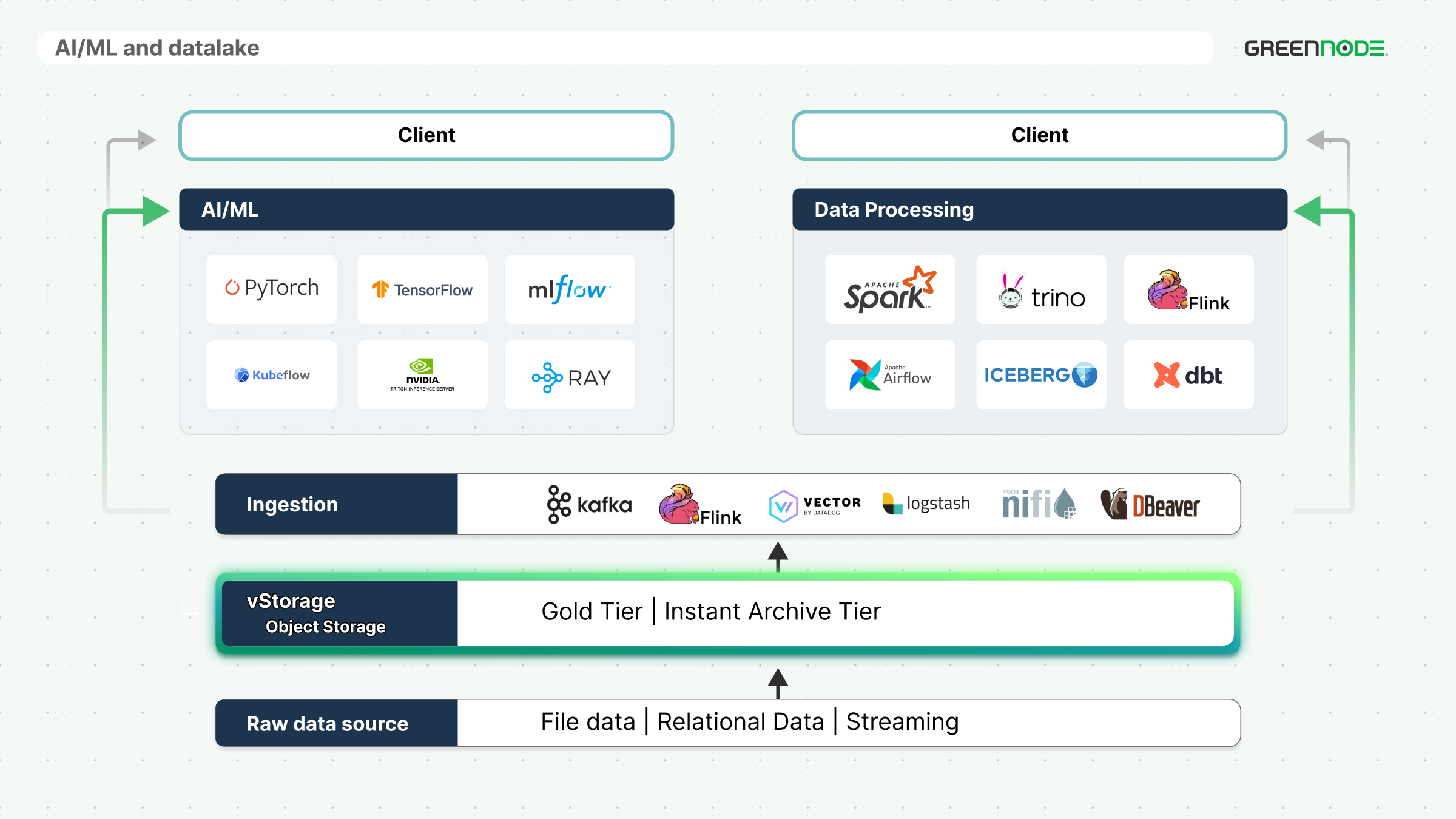
All three zones coexist within a single object storage bucket, differentiated by key prefix and metadata tags. No separate storage systems required — dramatically reducing operational complexity and total infrastructure cost.
4. The Hidden Cost Problem: Why Egress Fees Are a Budget Trap
This is the cost model most enterprises discover the hard way.
When training data is stored on AWS S3 or Google Cloud Storage in Singapore or Tokyo, the billing model extends far beyond storage capacity. Every time an AI pipeline reads data from storage back to a GPU cluster — if that cluster is located in Vietnam or a different region — the provider charges an egress fee. AWS bills approximately $0.09/GB for outbound data transfer. A pipeline consuming 10TB of training data per month incurs $900 in egress fees alone — before accounting for storage capacity costs.
Multiply that across multiple teams, multiple models, and year-over-year data growth — egress costs can exceed storage costs by 10–100x, as DigitalOcean’s research has documented.
The solution: co-locate storage and compute within the same data center, or select a provider with domestic infrastructure and transparent egress pricing. When object storage and GPU clusters both reside within GreenNode’s Vietnam infrastructure, data transfer operates at LAN speeds — zero cross-border latency, zero internal egress fees.
5. Data Sovereignty: The Regulatory Constraint AI Pipelines Cannot Ignore
If your AI pipeline processes customer data — behavioral analytics, electronic health records, or financial transaction data — you are operating under the binding requirements of Vietnam’s Cybersecurity Law 2018 and Decree 13/2023/ND-CP on Personal Data Protection.
In practical terms: personal data of Vietnamese users must be stored within Vietnamese territory. This directly constrains infrastructure decisions — training data containing user information cannot be arbitrarily placed on AWS ap-southeast-1 or Google Cloud asia-northeast1.
GreenNode’s object storage operates exclusively from Tier III-certified data centers located within Vietnam, achieving 100% compliance with these requirements — while delivering full S3 API compatibility so existing AI pipelines connect without modification.
6. Why GreenNode Is the Optimal Object Storage Choice for AI in Vietnam
When evaluating object storage infrastructure for Big Data and AI workloads, enterprises should apply a four-question framework:
Latency: Is storage-to-compute latency low enough to sustain AI pipeline throughput?
True TCO: Are egress fees hidden? What does the fully-loaded cost model look like?
Regulatory compliance: Is data physically stored within Vietnamese territory?
Integration: Is S3 API compatibility full-spectrum with the existing tech stack?
GreenNode Storage addresses all four dimensions: Tier III-certified data center infrastructure located in Vietnam, full S3 API compatibility, zero internal egress fees within the GreenNode ecosystem, and 100% compliance with the Cybersecurity Law.
With 1,000+ enterprises running production workloads on the GreenNode ecosystem, this is a battle-tested platform serving workloads from early-stage AI startups to large-scale enterprise systems.

Conclusion
Object storage is not merely a place to “park data.” With the right architecture, it becomes the data foundation for the entire AI infrastructure stack — from data ingestion and feature engineering through model training, serving, and monitoring.
Vietnamese enterprises are entering the era of real AI transformation — not proof-of-concept pilots, but production-grade workloads. At that stage, the choice of storage infrastructure made at the outset determines development velocity, operational cost trajectory, and long-term regulatory posture.
