

Key Takeaways
- OCR and Intelligent Document Processing (IDP) transform high-volume banking workflows by converting scanned IDs, loan files, contracts, bank statements, and financial reports into structured data. This can reduce KYC processing from roughly 45 minutes to under 5 minutes and financial-statement data entry from 2–3 hours to under 10 minutes per file.
- Vietnamese document accuracy requires a specialized pipeline, not raw OCR alone. Effective deployments combine image preprocessing, OCR and layout analysis, Vietnamese-specific entity extraction, confidence scoring, and human review for low-confidence fields—improving straight-through processing while preserving control over high-risk data.
- For Vietnamese banks, onshore data processing is central to both compliance and trust. GreenNode’s MaaS OCR/IDP offering is positioned to process sensitive KYC and financial data on infrastructure in Vietnam, with API or on-premise deployment options, audit logs, and custom model fine-tuning for each bank’s document templates.
A loan officer processes an average of 40–60 loan applications per day.
Each application file contains national ID cards (CCCD), contracts, bank statements, and collateral documents—all of which must be read manually, inputted into the system, and cross-referenced.
At the scale of a bank with thousands of branches, this is no longer a productivity issue; it is a strategic bottleneck hindering the speed of digital transformation.
OCR (Optical Character Recognition) and IDP (Intelligent Document Processing) have changed this equation.
However, for banks and financial institutions in Vietnam, the question is not just "which OCR is the best," but "which solution can process Vietnamese language documents with high enough accuracy while ensuring data does not leave the territory of Vietnam."
These are two problems that most foreign OCR solutions fail to solve simultaneously.
1. The Document Processing Challenge in the Vietnamese Financial Sector
Banks and financial institutions in Vietnam handle some of the largest volumes of documents in the economy—and the growth rate of credit along with the expansion of digital services is increasing that volume faster than manual processing capabilities can handle.
2. Types of Documents Requiring Automated Processing
- KYC and Customer Identification: National ID cards (CCCD), passports, and business registration certificates need to have their information extracted, cross-referenced with databases, and verified for validity. With eKYC, this speed directly impacts the customer experience when opening accounts or registering for services.
- Loan Applications: Bank statements, labor contracts, and collateral documents—each file can consist of 10–30 pages of documents in various formats. Loan officers currently input most of this information manually.
- Contracts and Legal Documents: Credit agreements, guarantee contracts, and service agreements need to have key clauses extracted, effective dates tracked, and expiration dates monitored, stored in a structured manner for retrieval.
- Corporate Financial Statements: Income statements, balance sheets, and cash flow statements—used for corporate credit underwriting, currently inputted manually by analysts from PDFs or scanned copies.
- Transaction Documents: Invoices, receipts, and payment orders need to be processed automatically for reconciliation and accounting.
3. Why Manual Processing Is No Longer Suitable
The issue is not just personnel costs. Manual processing creates three bottlenecks that directly impact competitiveness:
- Approval Speed: Retail customers increasingly compare their bank loan experience with fintech platforms that can approve loans within minutes. Every hour of manual processing is a competitive disadvantage.
- Error Rates: High-volume manual data entry under time pressure leads to errors—ranging from incorrectly entered account numbers to missing critical clauses in contracts.
- Auditability: When regulators request file audits, unstructured and inconsistent document storage slows down the process and increases compliance risks.
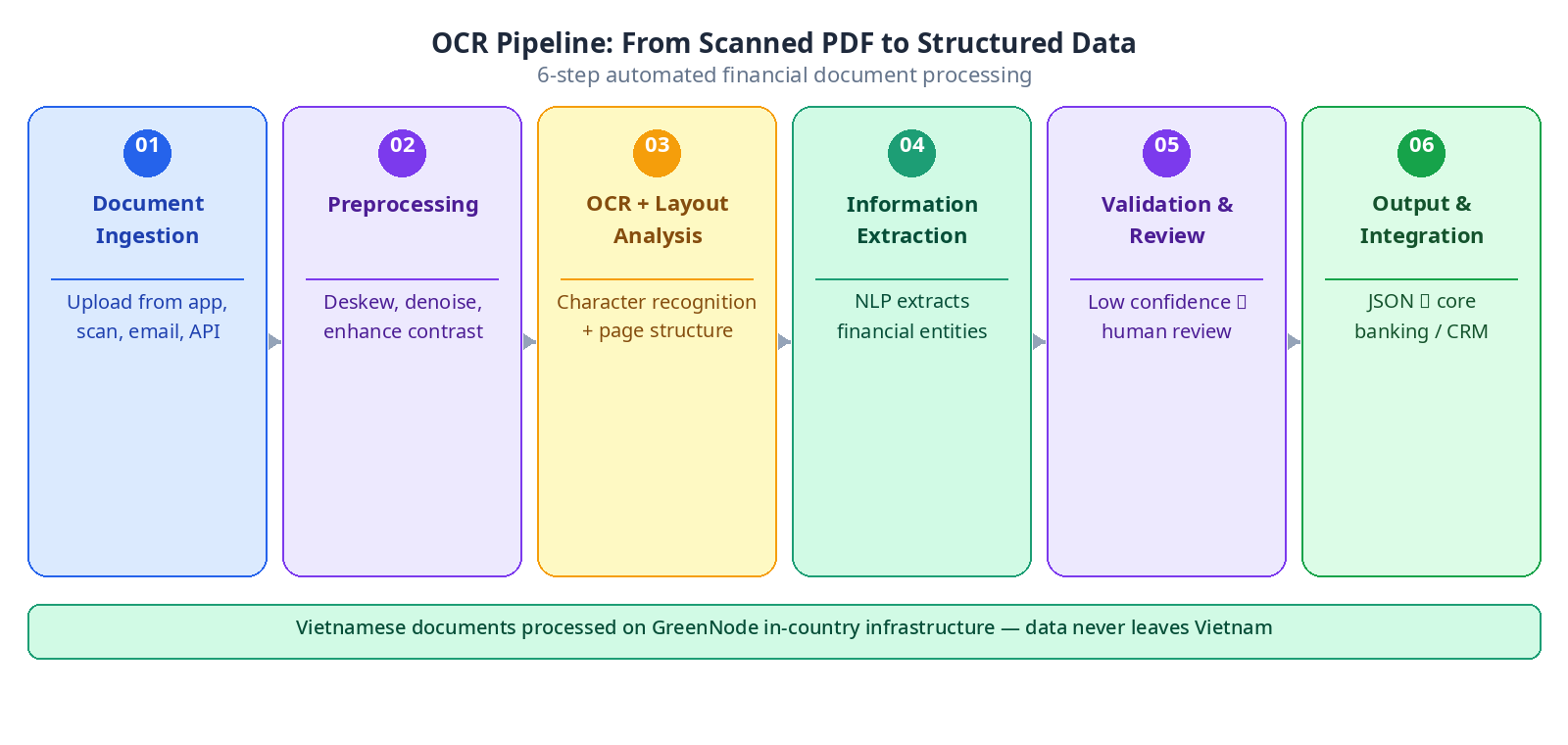
4. The OCR Pipeline: From Scanned PDF to Structured Data
A complete OCR workflow for banking is not just "reading characters from an image"; it is a processing chain from document ingestion to structured output ready to be fed into the core banking system.
Actual Steps in the Pipeline
Step 1 - Document Ingestion: Receive documents from multiple sources: uploads via mobile applications, scans at the counter, email attachments, or APIs from external systems. Standardize formats and resolutions to ensure input quality.
Step 2 - Preprocessing: Automatically process images before running OCR: deskew (adjust tilt angles), denoise (reduce noise), enhance contrast, and detect text orientation. This step directly impacts final accuracy, especially with low-quality scans from branches.
Step 3 - OCR and Layout Analysis: Recognize characters combined with layout analysis to understand the document structure: identifying tables, signatures, stamps, and specific data fields. For Vietnamese documents, this step distinguishes a great solution from an acceptable one.
Step 4 - Information Extraction: From the recognized text, extract specific entities: full names, ID numbers, dates of birth, addresses, account numbers, and transaction values. This utilizes Natural Language Processing (NLP) and Named Entity Recognition (NER) fine-tuned specifically for the Vietnamese financial sector.
Step 5 - Validation and Human Review: Fields with low confidence scores are flagged for human review instead of processing everything manually. The Straight-Through Processing (STP) rate—the percentage of files requiring no manual intervention—is the most critical KPI of the pipeline.
Step 6 - Output and Integration: Structured data is exported into formats suitable for core banking systems, CRMs, or workflow management software, such as JSON, XML, or direct API integration.
5. Accuracy with Vietnamese Documents: Benchmark Results
Note: The figures below are reference benchmark results from common OCR tools tested with Vietnamese financial documents. GreenNode provides specific benchmark data for each use case during the consultation process.
The Vietnamese language poses unique challenges for OCR technology that many solutions trained primarily on English data handle very poorly:
- Tone Marks and Diacritics: Vietnamese has 6 tones and multiple diacritics (ă, â, ơ, ư, đ...). OCR easily misidentifies "hạn" as "han" or "lãi" as "lai"—in a financial context, this error can lead to serious misunderstandings.
- Diverse Fonts in Legal Documents: Banking contracts use many different fonts and sizes, particularly in pre-printed templates combined with filled-in sections.
- Low-Quality Scanned Documents: Files from lower-level branches are often scanned using legacy equipment, producing noisy and skewed images—this is the real-world testing condition, not an ideal laboratory environment.
Typical Benchmark Results by Document Type:
Document Type | Good OCR Accuracy | Minimum Requirement for Production Environment |
| National ID (CCCD) / Passport (clear print) | >98% | >95% |
| Typed Contracts | >95% | >90% |
| Bank Statements | >97% | >93% |
| Financial Statement PDFs | >94% | >90% |
| Handwritten Documents | >85% | >80% |
Handwritten documents (handwriting) represent the greatest challenge—especially templates that feature both pre-printed parts and handwritten sections filled out by customers.
6. Integration into KYC, Contract, and Financial Statement Workflows
Automated Customer Identification (KYC) Workflow - From Minutes to Seconds
- Traditional KYC Workflow: Customer submits documents -> Officer manually inputs data -> Cross-references with CIC -> Approval. Time: 30–60 minutes at the counter, or 1–3 days with basic eKYC.
- With Integrated OCR Workflow: ID photos are uploaded -> Automatically extracts information within seconds -> Automatically cross-references with CIC and watchlists -> Results returned to the officer for verification. The Straight-Through Processing (STP) rate reaches 80–90% for standard applications. Real-world result: reduces KYC processing time from 45 minutes to under 5 minutes for the majority of files. Credit Underwriting - Structured Data from Financial Statements
- Corporate financial statements are usually submitted as scanned PDFs or scanned files from auditing firms. Analysts currently enter financial metrics manually into spreadsheets for calculation.
- OCR combined with table extraction can automatically recognize tables within financial statements, map correct row/column labels, and export structured data ready to be fed into credit scoring models. This reduces data entry time from 2–3 hours per file to under 10 minutes.
Contract Management - Automated Clause Tracking
With portfolios of millions of contracts, banks need to track maturity dates, penalty clauses, variable interest rates, and renewal conditions. Contracts are currently stored as unstructured PDFs, making specific information lookups time-consuming.
OCR combined with key-value extraction creates a searchable document index: all contracts maturing in the next 30 days, all contracts with floating interest rates, or all contracts linked to specific collateral.
7. Compliance: Processing Sensitive Data on Onshore Infrastructure
This is the most critical differentiator when banks in Vietnam select an OCR solution, and it is often overlooked until the legal department or the State Bank of Vietnam raises questions.
7.1 KYC and Financial Data Are "Important Data"
According to Data Law No. 91/2025/QH15 and Decree 356/2025/ND-CP, personal identification information (CCCD, biometrics) and financial information (accounts, transactions) are classified as important data. Processing this type of data on foreign cloud platforms without a Transfer Impact Assessment submitted to the Ministry of Public Security is a violation of the law.
This means: if your OCR pipeline sends ID images or bank statements to servers located in Singapore or the US for processing, you are in violation, even if the results are returned within seconds.
7.2 Requirements from the State Bank of Vietnam (SBV)
In addition to the Data Law, the State Bank of Vietnam has its own regulations regarding information security in banking operations. Credit institutions must ensure that customer data processing systems meet technical standards approved by the SBV, including requirements for system logging, audit trails, and inspection capabilities. Foreign cloud providers are typically unable to provide the level of audit trails and transparency required by the SBV during inspections.
7.3 Onshore Infrastructure Is a Mandatory Requirement, Not an Option
When KYC and financial data are processed on onshore infrastructure—servers located in Vietnam, operated by a Vietnamese company not subject to the US CLOUD Act—the entire pipeline automatically complies: data does not leave the territory, full audit logs are maintained, and it can be inspected by the SBV or regulatory authorities. This is something that foreign hyperscaler OCR solutions—even if they have a local zone in Singapore—cannot fully guarantee under the current Vietnamese legal framework.
8. GreenNode MaaS OCR + Onshore Infrastructure: Solving Both Problems
GreenNode provides OCR and Intelligent Document Processing solutions through its MaaS (Model as a Service) platform, running entirely on onshore infrastructure in Hanoi and Ho Chi Minh City.
8.1 Two Major Issues Solved Simultaneously
Accuracy with Vietnamese Documents: The OCR model is fine-tuned on data sets composed of Vietnamese financial documents (CCCD, contracts, bank statements, financial reports). This is not a generic OCR engine trained primarily on English and then converted to Vietnamese.
Local Compliance: The entire pipeline is processed on servers within Vietnam. GreenNode is a Vietnamese company, not subject to the CLOUD Act, and is not a local subsidiary of a foreign corporation. Data does not leave the territory, and complete audit logs are provided.
8.2 Integration Models
- API-First: The OCR pipeline is provided via REST APIs. The bank's engineering team can integrate it into existing workflows without changing core banking systems. The input is an image/PDF, and the output is a structured JSON format.
- On-Premise Deployment Option: For banks with the highest security requirements, GreenNode supports deploying the model directly on the bank's internal infrastructure—data completely remains within the internal network.
- Customization by Document Type: Each bank has its own document templates (contract forms, report formats, KYC layouts). GreenNode fine-tunes models according to the specific document types of each client.
Reference Case Study from ACB
ACB (Asia Commercial Bank) is one of the financial institutions in Vietnam that has deployed document processing automation solutions. To learn details about the solutions GreenNode provides for the financial sector, please contact the team to receive the full case study and specific consultation information.

9. Implementation Timeline and Cost Estimates
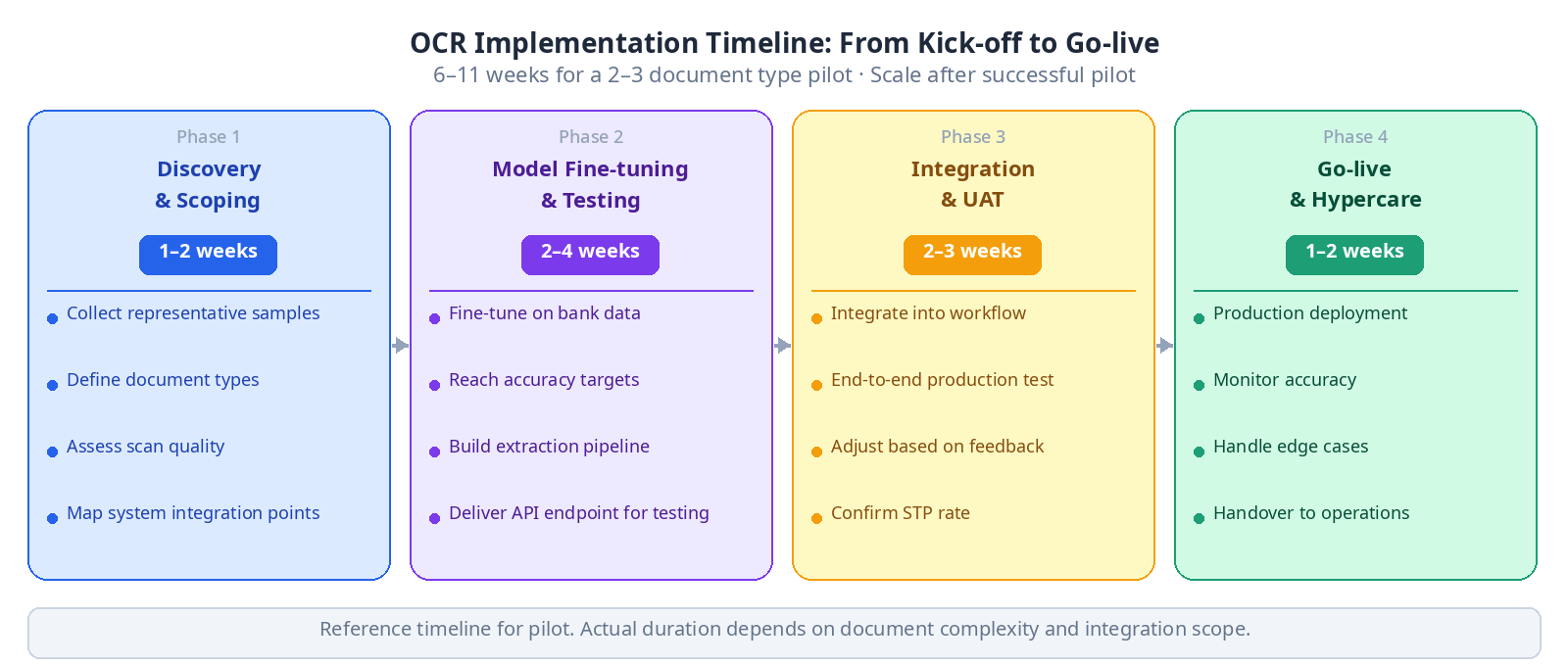
Typical Implementation Timeline
The time from kick-off to official go-live depends on three factors: the complexity of document types, the level of integration with existing systems, and customization requirements.
Phase 1 - Discovery and Scoping (1–2 weeks): Collect representative sample documents, identify document types to be processed, evaluate current scan quality, and define integration points with core banking systems.
Phase 2 - Model Fine-Tuning and Testing (2–4 weeks): Fine-tune the OCR model on the bank's sample documents, achieve accuracy targets on the test set, build extraction pipelines for each document type, and deliver API endpoints for the technical team to test.
Phase 3 - Integration and User Acceptance Testing (UAT) (2–3 weeks): Integrate APIs into existing workflows, perform end-to-end testing with anonymized real production data, and adjust based on feedback from business operations staff.
Phase 4 - Go-Live and Hypercare (1–2 weeks): Deploy to the live production environment, monitor accuracy and Straight-Through Processing (STP) rates, and handle any arising edge cases.
Total Time: 6–11 weeks for a pilot phase with 2–3 document types. Scaling up to full deployment occurs after a successful pilot phase.
10. Cost and Pricing Models
GreenNode prices according to models suited for various scales:
- Pay-per-use: Charged based on the number of pages processed—suitable for the pilot phase or when workload volumes are low.
- Subscription: Monthly/annual packages with volume commitments—lower per-unit costs, suitable when workloads have stabilized.
- Enterprise: Customized pricing policies for large-scale deployments (>100,000 pages/day) or on-premise deployments.
Specific costs depend on document types, volume, customization levels, and the deployment model. Contact GreenNode to receive a detailed quote based on your specific use case.
Frequently Asked Questions (FAQ) – From the Perspective of a Chief Digital Officer
Can the solution integrate with existing core banking systems?
Yes. GreenNode provides standard REST APIs, allowing the bank's engineering team to integrate at the backend level without modifying core banking systems. GreenNode also supports building custom connectors for common systems in Vietnam upon request.
What level of accuracy is required to deploy to a production environment?
This depends on the document type and risk tolerance. For CCCD and passports (critical data, high risk of error), accuracy typically needs to be >95% before enabling automated straight-through processing. For bank statements, a level of 90–93% is acceptable if there is an additional review layer for critical data fields. GreenNode will work with clients to define accuracy thresholds and target STP rates during the scoping phase.
What happens if the OCR system makes a misidentification?
The processing workflow includes a confidence scoring mechanism for each extracted information field. Any field with a score below the defined threshold will be flagged for manual human review instead of automatic processing by the system. Over time, human feedback from staff is utilized to continuously improve and enhance the model's accuracy during real-world usage.
Will our data be used to train models for other clients?
No. Each bank's data is processed within an isolated environment and is completely excluded from training models for other parties. This data governance principle is explicitly defined in contract documents.
How is compliance with PDPL 2026 and State Bank of Vietnam regulations guaranteed?
GreenNode provides comprehensive documentation for compliance audits: Data Processing Agreements (DPA), full audit logs, system architecture ensuring no cross-border data transfer behaviors, and assistance in preparing Transfer Impact Assessments if any processing element requires international transfer (which typically is not the case).

Conclusion: Two Requirements, One Solution
Banks and financial institutions in Vietnam require OCR and document processing solutions that satisfy two requirements simultaneously, a combination rarely solved at once in the current market: high accuracy for specific Vietnamese documents, and strict compliance with the Data Law 2025, PDPL 2026, and State Bank of Vietnam regulations on onshore data processing.
Foreign solutions typically meet the first requirement but create legal risks regarding the second. Conversely, domestic solutions usually ensure compliance but lack the necessary accuracy for production environments.
GreenNode MaaS on onshore infrastructure is designed to fully address both requirements—and this is why an increasing number of financial institutions in Vietnam are evaluating this solution as a key part of their digital transformation roadmap.
FAQs about OCR
1. What platform do I need to build an automated OCR system for millions of contracts a month?
You need a full Intelligent Document Processing (IDP) platform with five layers: multi-channel ingestion, classification & structured extraction, crosscheck & verification, output normalization, and no-code onboarding for new form templates — raw OCR alone isn't enough at this scale. GreenNode IDP covers all five layers in a single processing flow, reaching 99% accuracy on printed text and 94% on Vietnamese handwriting.
2. How much does it cost to build an automated OCR system for millions of contracts a month?
The real cost isn't raw OCR (around $1.50 per 1,000 pages on most APIs) — it's structured field extraction, where pricing can jump 20-45x depending on the vendor and feature combination. At a scale of hundreds of thousands to millions of pages a month, that gap plus engineering time to build and maintain the pipeline (typically 40-80 hours for the initial rollout) is what actually drives ROI — not the "per page" rate advertised on a vendor's homepage.
3. Should I build my own pipeline or buy a ready-made IDP platform for high-volume contracts?
If your volume is under a few tens of thousands of pages a month and you only need raw text, stitching together separate APIs can work for now. But once you need structured extraction, business-rule crosschecking, and output normalization at millions of pages a month, an all-in-one IDP platform is usually cheaper than building it yourself, since it bundles all five capability layers (ingestion, classification & extraction, crosscheck, normalization, template onboarding) instead of requiring your own team to maintain a separate pipeline for each one.
4. What compliance requirements apply to an OCR system processing contracts with personal data in Vietnam?
As of January 1, 2026, the governing framework is the Personal Data Protection Law (No. 91/2025/QH15) along with its implementing Decree 356/2025/NĐ-CP, which replaced the now-expired Decree 13/2023/NĐ-CP. Businesses need to review their processing purpose, retention period, and data subject rights against the new law, and consider whether the platform supports local data storage or on-premise deployment.
5. How long does it take to deploy an OCR/IDP system for millions of contracts a month?
With a managed platform that already has a library of pretrained models, businesses can start experiencing the system within 2-3 days, compared to weeks or months for a self-built pipeline stitched together from separate APIs with custom-trained models per contract type. Onboarding a new contract template on a platform with no-code template configuration can take under 30 minutes, instead of waiting for a vendor to retrain a model.
