What matters
- GreenNode IDP measures accuracy at the field level (99% printed, 94% handwritten), a stricter bar than the character-level accuracy some domestic rivals cite.
- Its OCR plus GenAI and LLM/VLM architecture lets teams self-configure new templates, while domestic solutions still need vendor involvement.
- Infrastructure sits in Vietnam and Thailand, certified under SISA, TVRA, and ISO 27701, with deployment in just 2 to 3 days.
When it comes to intelligent document processing in Vietnam, businesses have no shortage of "Made in Vietnam" options: FPT.AI with FPT AI Read and akaOCR, VNPT SmartReader, Viettel IDP, or VinBigdata (now part of VinIT) with SmartOCR. They all carry the OCR/IDP label, all handle Vietnamese "properly," and all have real-world deployments in banking, insurance, and public administration. The catch is that the demos tend to look fairly similar, while underneath, the core technology, customization capability, and deployment model differ significantly.
This article compares GreenNode IDP against domestic OCR/IDP solutions across 4 criteria that any Operations/Transformation Lead should ask before choosing a vendor: Vietnamese-language accuracy, core technology (pure OCR vs. LLM/VLM-powered), customization capability, and deployment/support model.
Vietnam's domestic OCR/IDP market: names worth knowing
Before getting into the detailed comparison, here's a quick look at the most talked-about domestic solutions:
- FPT.AI (FPT AI Read / FPT AI Reader): an OCR platform combining Deep Learning and NLP, supporting more than 30 document types. FPT positions it as the market leader in Vietnamese text recognition and digitization, with a published extraction accuracy of up to 98%. Within the same FPT ecosystem, the QAI unit (FPT Software) also offers akaOCR — an OCR + NLP platform focused on digitizing, storing, and integrating enterprise data.
- VNPT SmartReader: VNPT AI's OCR solution, which claims text digitization accuracy of up to 99.9% and includes a "KOCR Plus" feature that reconstructs editable DOCX/XLSX files while preserving table formatting.
- Viettel IDP (Viettel AI): an intelligent document processing solution that extracts information from scanned images in under 2 seconds per page — 60 to 80 times faster than manual entry — with a published accuracy of around 90%, helping cut approval time by 80%.
- VinBigdata SmartOCR (VizoneLens): positioned as a next-generation intelligent document processing solution with GenAI built in, combining a large language model (LLM) with traditional OCR technology rather than relying on plain character extraction. Note: as of September 2025, VinBigdata JSC merged into VinIT (Vingroup IT Solutions JSC) under a Vingroup board resolution, so the product now operates under VinIT rather than as an independent VinBigdata entity.
Broadly speaking, the tech/telecom giants have the edge in reach and infrastructure, while specialized AI companies like VinBigdata (now under VinIT) are moving quickly from plain OCR toward the fuller IDP concept. GreenNode IDP sits in the second group, but pushes considerably further on LLM/VLM integration and self-service capability for business users.
4 criteria for comparing GreenNode IDP with domestic solutions
1. Accuracy on Vietnamese documents: printed text, handwriting, and tables
GreenNode IDP reports 99% field-level accuracy on printed Vietnamese forms and 94% on handwritten Vietnamese forms, with processing time under 3 seconds per page. By comparison, FPT AI Read reports 98%, VNPT SmartReader claims up to 99.9%, and Viettel IDP sits around 90%.
One important caveat: these numbers aren't measured on the same scale. VNPT SmartReader measures general character recognition/text digitization, while GreenNode and Viettel IDP report accuracy at the field level — a much harder bar to clear, since it requires getting the position, meaning, and formatting of each data field right, not just the characters. So when comparing vendors, don't just look at the headline number — ask for a benchmark run directly on the documents you actually process (invoices, contracts, handwritten forms, and so on).
2. Core technology: pure OCR, or LLM/VLM-powered context understanding?
This is the biggest differentiator among these solutions. GreenNode IDP combines three technology layers — traditional OCR, GenAI, and a large language model (LLM) — letting the system not just recognize characters but also understand meaning, validate, and classify documents automatically. This is what makes "self-service templates" possible: users simply upload a sample and tag the fields, with no fine-tuning or retraining required, even when the document layout changes.
VinBigdata SmartOCR (now under VinIT) is heading in a similar direction, having publicly repositioned itself around LLM + OCR rather than plain character extraction. Most FPT AI Read/akaOCR, VNPT SmartReader, and Viettel IDP marketing, by contrast, still leans on the phrase "OCR + Deep Learning + NLP" rather than LLM/VLM-level understanding of full document context — meaning that when an unfamiliar form or a layout change shows up, there's a good chance you'll need to reconfigure the template or wait on vendor support, rather than have the system adapt on its own.
3. Customization: adding new templates, workflows, and rule logic on your own
For Operations/Transformation Leads, the practical question usually comes down to: "When a new form or business rule comes up, can my team handle it ourselves, or do we have to wait on the vendor?"
GreenNode IDP provides a visual workflow builder for configuring multi-step processing pipelines — data sources, model selection, normalization, validation rules, output destinations — all in one interface, plus a rule engine for defining cross-document reconciliation logic, routing exceptions, and triggering approval workflows, none of which requires deep technical intervention.
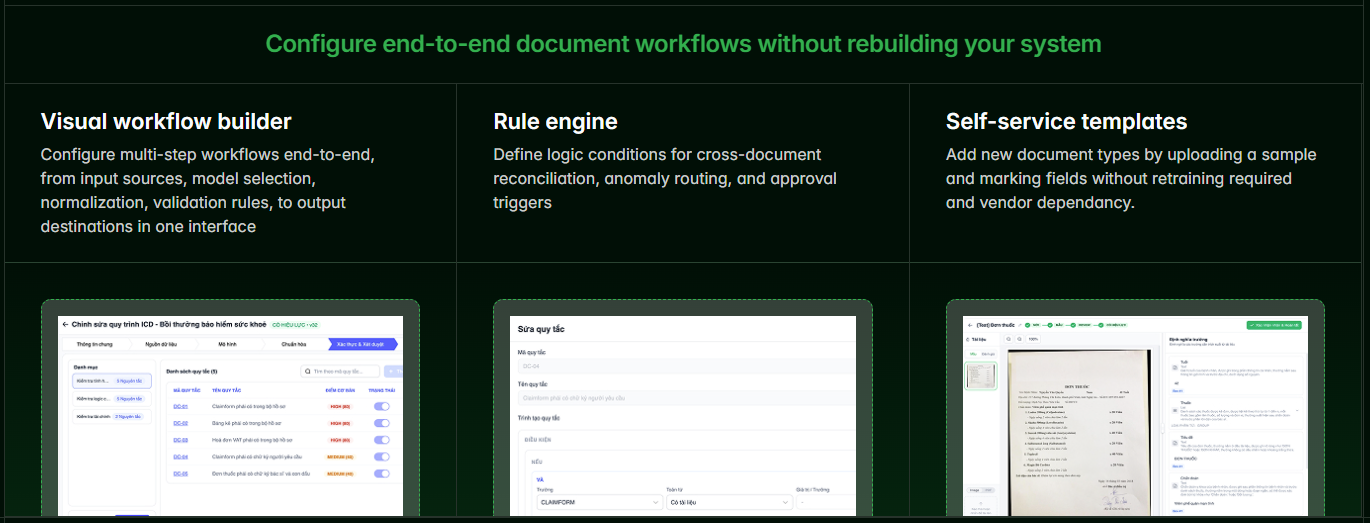
Domestic solutions like FPT AI Reader and VNPT SmartReader typically run on pre-built template libraries organized by industry (personal ID documents, government, BFSI, and so on); extending to a completely new document type or a complex business rule will likely require coordinating with the vendor's technical team, stretching out deployment time compared with a self-service model.
4. Data sovereignty, security certifications, and deployment model
This criterion matters more and more for finance, insurance, and the public sector. GreenNode IDP runs on sovereign infrastructure spanning 6 availability zones in Vietnam (Hanoi, Ho Chi Minh City) and Thailand, meaning data never leaves Southeast Asia — businesses retain full control over where workloads run and who can access them, backed by SISA, TVRA, and ISO 27701 certifications. Published deployment time is just 2–3 days, since no initial fine-tuning is required.
Domestic giants like FPT, VNPT, and Viettel also have the advantage of Vietnam-based infrastructure and a large customer base across banking and government, but publicly available detail on security certifications specific to each OCR/IDP product tends to be thinner. With any vendor — GreenNode included — businesses should request certification documentation and confirm the deployment model (SaaS, on-premise, or hybrid) fits their industry's compliance requirements before signing a contract.
This is also where GreenNode IDP differs most sharply from international platforms like Amazon Textract, Azure AI Document Intelligence, and Google Document AI — strong on global infrastructure, but not specifically optimized for Vietnamese and lacking on-premise deployment or in-country data storage, a factor that matters more than ever now that Vietnam's 2025 Personal Data Protection Law is in effect. For a deeper look at this group of platforms, see our comparison of GreenNode IDP against international data-processing solutions.
Quick comparison table
| Solution | Core technology | Published accuracy | New template customization | Deployment model |
|---|---|---|---|---|
| GreenNode IDP | OCR + GenAI + LLM/VLM | 99% (printed) / 94% (handwritten), field-level | Self-service templates, no fine-tuning/retraining required | SaaS + on-premise, sovereign infrastructure in Vietnam & Thailand, 2–3 day go-live |
| FPT AI Read / akaOCR | OCR + Deep Learning + NLP | ~98% (text digitization) | Pre-built template library (30+ document types), extended via FPT's team | Cloud/API via Console.fpt.ai |
| VNPT SmartReader | OCR + NLP | Up to 99.9% (text digitization) | Industry-specific template library (GOV, BFSI) | Cloud/on-premise on VNPT infrastructure |
| Viettel IDP | AI/OCR | ~90% (field-level), <2s/page | Handled per project alongside Viettel | Integrated internally with banking systems/partners |
| VinBigdata SmartOCR (now under VinIT) | LLM + OCR (GenAI) | No specific field-level figures published | Expanding toward GenAI | SaaS/on-premise |
The accuracy figures in this table are self-reported by each vendor, measured on different datasets and criteria — treat them as an initial reference point only, not a substitute for running a real benchmark on your own documents.
So which solution should Vietnamese businesses choose?
The answer depends on the scale and complexity of the document-processing problem your business is facing:
- For workflows that stop at OCR-ing ID documents for a single eKYC flow, the differences between solutions on the market tend to be minor. But the moment a business needs to expand into more complex business documents — loan files, insurance claim files, financial reports, import/export paperwork — where templates change frequently and the operations team wants to add new document types on their own without waiting on the vendor to retrain a model, the gap between a "pure" OCR tool and GreenNode IDP's LLM/VLM-plus-self-service-template approach becomes obvious, significantly shortening both deployment time and the ongoing operating cycle compared with a model that depends on the vendor's technical team.
- If your industry (finance, insurance, healthcare) places heavy weight on keeping data within the region and needs clear security certifications, GreenNode IDP runs on sovereign infrastructure in Vietnam and Thailand with SISA, TVRA, and ISO 27701 certifications — one of the few domestic IDP platforms to disclose this level of detail publicly. Whichever vendor you choose, ask for specific certification documentation before signing a contract.
In practice, GreenNode IDP is already used by numerous banks and insurance companies in Vietnam to automate large-scale processes, from credit file processing and KYC to hundreds of thousands of insurance claims a year, showing that the platform is mature enough to run at enterprise scale, not just as a demo or a small pilot.
The fastest way to judge the real fit is to run a pilot on your own actual documents. With a deployment time of just 2–3 days and no upfront fine-tuning required, the GreenNode team can help you see the difference in accuracy, processing speed, and self-customization directly on your real data, rather than relying solely on the figures published on the product page.