

When choosing an AI inference platform, speed and API price are usually the first things teams compare. But for product teams in Vietnam and Southeast Asia, those two numbers are not enough to make a decision.
A model can post impressive speeds on a benchmark, yet the real experience still depends on the distance between your users and the GPU. An API may connect to hundreds of models, but which systems does your request pass through before it is processed? And if your application handles customer data, do you know exactly where that data is processed? These are the questions to ask when choosing an AI inference platform for the Asia-Pacific (APAC) market.
This article helps you tell inference providers apart from API routers and managed AI services, compares 7 platforms using public information, and shows how to choose a solution that fits your workload, budget and data governance requirements.
What is an AI inference provider, and how is it different from an API router?
An AI inference provider directly operates or controls the infrastructure that runs the model, while an API router acts as an intermediary that forwards requests to different providers.
To find out where your data is actually processed, ask every platform one question: whose GPU runs my prompt? The answer tells you who can access your data, who directly affects latency, and which contract protects your data.
- Direct inference provider: owns or controls the infrastructure that runs the model, including GPUs, batching and caching. Some providers use leased GPUs or multi-cloud infrastructure instead of owning all of their hardware. Examples: Together AI, Fireworks AI, Groq, DeepInfra, Baseten.
- API router or gateway: provides one common interface for sending requests to many different inference providers. Instead of integrating each API separately, developers use a single API key and choose models from multiple sources. Example: OpenRouter.
- Managed AI platform: a cloud platform, often sold as Model as a Service (MaaS), that serves some models on its own infrastructure and resells others from model vendors under contract. Examples: Amazon Bedrock, GreenNode MaaS. Within the same platform, the answer to "whose GPU?" can differ from model to model.
The trade-offs are fairly clear. A router adds a network hop, so it cannot make median latency faster, although it can improve reliability by switching away from a slow upstream. And a router's zero-retention commitment covers the router itself, not necessarily every upstream it sends your data to (Fireworks). For regulated data, fewer hops and a direct contract with whoever runs the GPU is the safer choice.
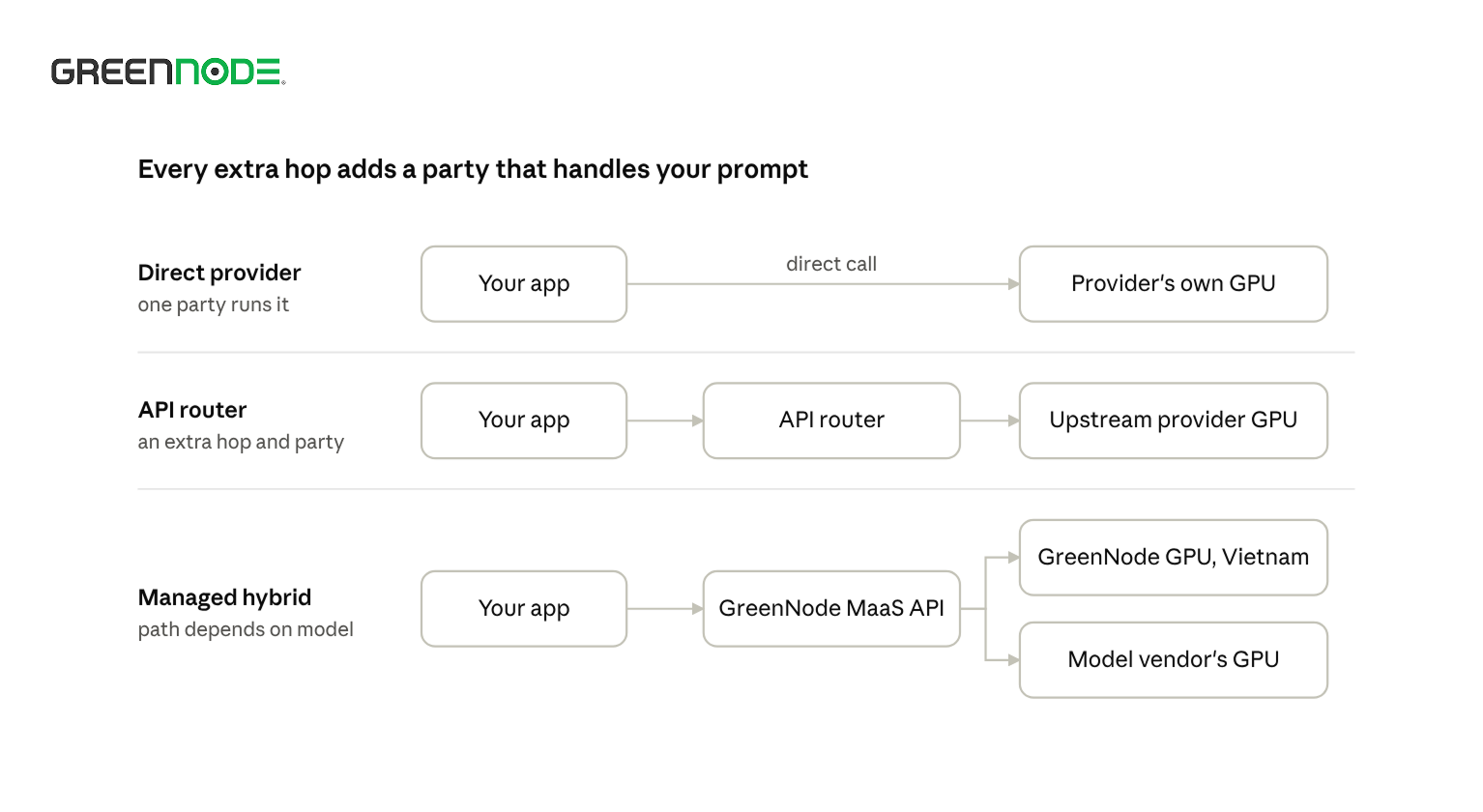 On a managed hybrid platform such as GreenNode MaaS, self-hosted models run on the platform's own GPUs, while partner models take one more hop to the model vendor.
Six criteria to compare AI inference platforms from an APAC perspective
Judge every platform on six points: execution control, latency from your region, data governance, model catalog, pricing model, and support. US comparisons usually look at speed and price first. For APAC teams, the first three criteria decide whether a platform is usable at all.
| Criterion | What to ask the provider | Why it matters in APAC |
|---|---|---|
| 1. Execution control | Do you run this model on your own GPUs, or forward it to another party? | Decides who sees your data and whom you can hold accountable |
| 2. Latency from your region | Which region are your GPUs in? | Tokens/sec figures are measured close to the GPU; every user request also adds a trip across the Pacific |
| 3. Data governance and sub-processors | Do you store prompts? Is zero retention on by default? Who are your sub-processors, and in which countries? | Cross-border data transfer rules (e.g. Vietnam's Personal Data Protection Law) apply to every hop, not just the first one |
| 4. Model catalog | Which open-weight and closed-weight models are available? How often are new models added? | Deployment location and processing terms can differ between models on the same platform |
| 5. Pricing model | Do you charge per token, per GPU-hour, or per dedicated endpoint? Is there a minimum usage commitment? | Real cost also depends on traffic, caching, context length and resource usage |
| 6. SLA and support | Is there an uptime SLA? Do support hours overlap with your time zone? | A ticket queue on US hours means an overnight wait when something breaks in Asia |
Still, don't rely only on benchmarks published by providers. Measure latency from where your users are. You can send the same prompt 100 times from a VM in your region, then compare median and p95 time-to-first-token (TTFT) across platforms. For a fuller checklist beyond these six points, see our guide to evaluating Model-as-a-Service vendors.
Top AI inference platforms in 2026, compared
No single platform is the best fit for every workload. Groq stands out for speed on the models it supports; Fireworks AI offers dedicated deployments in several APAC locations; Amazon Bedrock has broad APAC region coverage; and GreenNode MaaS has GPU infrastructure in Vietnam, according to its public documentation. The table below summarizes information published by each provider. It is not an independent benchmark: real latency needs to be measured from your own region and workload.
| Platform | Type | APAC presence (public) | Data retention (public default) | Pricing model | Best for |
|---|---|---|---|---|---|
| Together AI | Direct provider | No public APAC region list; private/VPC dedicated endpoints on request | Zero retention is opt-in, set per organization | Per-token serverless + dedicated endpoints | Broad open-model catalog, fine-tuning |
| Fireworks AI | Direct provider | Dedicated deployments in Tokyo, Taiwan, Malaysia and New South Wales (quota on request) | Zero retention by default for open models | Per-token serverless from $0.10/1M; on-demand GPUs from $7/GPU-hr | Fast open models, dedicated deployments in APAC |
| GreenNode MaaS | Managed AI service, hybrid | Availability zones in Hanoi, Ho Chi Minh City and Bangkok | Self-hosted models run on GreenNode GPUs; partner models are forwarded to the vendor under contract | Per-token (input, cache, output), prepaid or postpaid | Vietnam and Southeast Asia teams that need data to stay in-country |
| Groq | Direct provider (LPU chips) | 4.5 MW site in Sydney with Equinix, launched Nov 2025 | Inference not retained by default; abuse logs kept up to 30 days unless ZDR is on; stored data in US GCP | Per-token, free tier | Lowest latency on supported open models |
| DeepInfra | Direct provider | No public APAC region | Inputs held in memory only, not logged; Google and Anthropic models forwarded to those vendors | Per-token, low list prices | Cheapest access to popular open models |
| Baseten | Direct provider, multi-cloud | Pools 10+ clouds; region-locked, self-hosted and hybrid options | States it never stores inputs or outputs; SOC 2 Type II, HIPAA | Dedicated GPU per minute + Model APIs | Custom and fine-tuned models in production |
| Amazon Bedrock | Managed AI service | Runtime in 13 APAC regions incl. Singapore, Jakarta, Malaysia, Thailand, Tokyo, Sydney; no Vietnam region | Model vendors have no access to prompts or completions | Per-token + provisioned throughput | Teams already on AWS |
Three things most comparisons leave out:
- "APAC region" does not mean infrastructure in your own market. A GPU in Sydney or Tokyo is still 4,000–7,000 km from Ho Chi Minh City. Closer than Virginia, but not in-country. If you need infrastructure inside Vietnam, compare the top cloud providers in Vietnam.
- Dedicated is not serverless. Fireworks' APAC regions are for dedicated deployments with granted quota. A serverless call may still run elsewhere.
- Assess how a provider is changing, not just how it performs today. Changes in technology, strategy or corporate structure can affect a product roadmap. If you plan a long-term contract, review the roadmap, SLA, contract terms and your options for switching to another provider.
GreenNode MaaS Model Catalog: self-hosted and partner models
GreenNode MaaS offers two groups of models: self-hosted models that run on GreenNode GPUs in Vietnam, and third-party models that are processed on the respective vendor's infrastructure under a service agreement.
That means where your data is processed depends on the model and endpoint you choose, not just on the platform's name.
| Self-hosted models | Third-party models | |
|---|---|---|
| Examples today | GLM-5.2 | Kimi K2.7 Code, Kimi 2.6, Qwen 3.7 Plus, MiniMax M3, Gemma 4 31B; Claude and GPT models |
| Whose GPU | GreenNode's, in GreenNode availability zones | The model vendor's |
| Where the prompt goes | Stays on GreenNode infrastructure | Forwarded to the vendor under an official contract |
| Good for | Workloads with personal or regulated data that must stay in Vietnam | Tasks without personal data that need frontier or specialist models |
Model list from GreenNode MaaS available models, October 2026.
How should you apply this?
- For tightly regulated data: consider a dedicated endpoint running self-hosted models in Vietnam. When the endpoint reaches its load limit, requests are rejected rather than automatically rerouted to an outside provider.
- Route by sensitivity. Send customer records, contracts or medical notes to self-hosted models. Use partner models for public content, coding help or tasks with no personal data.
- Check the label before you build. Every model on the platform is labeled GreenNode self-host or third-party. Make that label part of your design review, the same way you check a library's license.
This matters even more since Vietnam's Personal Data Protection Law took effect on January 1, 2026: cross-border transfer violations can be fined up to 5% of the previous year's revenue (see why it matters where AI processes your data). A platform that tells you exactly where each model runs turns that risk into something you can manage.
How to choose an inference platform by workload
Sort each workload by two questions: how sensitive is the data, and how many different models do you need? The answer puts you in one of four boxes, and each box points to a different kind of platform. Most teams have workloads in more than one box, which is why a single provider rarely fits everything.
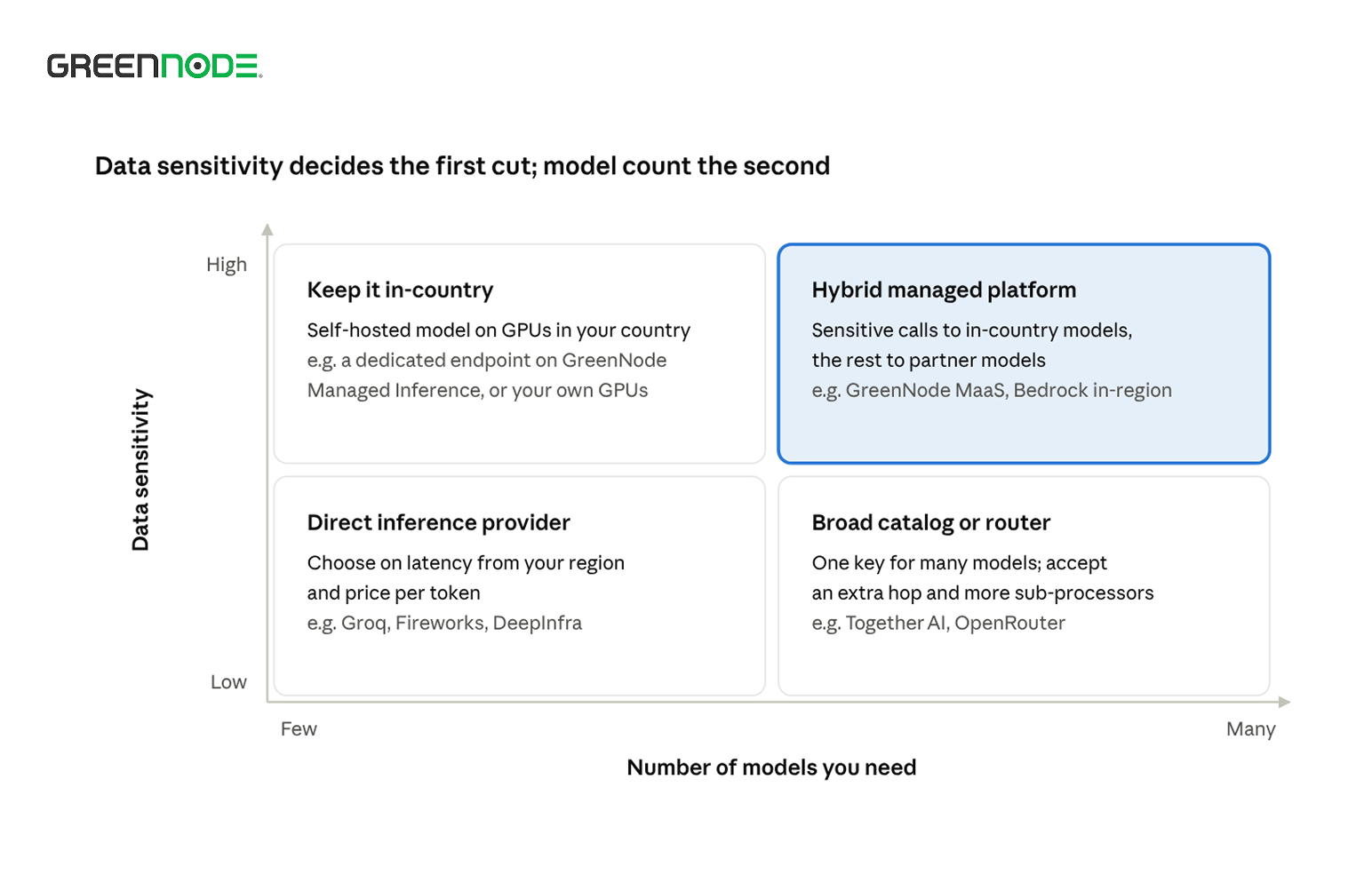
- Sensitive data, few models: keep inference in-country. A self-hosted model on local GPUs, or a dedicated endpoint, gives you a short, auditable data path. If the model also needs to know your domain, read how SEA enterprises move from generic LLMs to domain-specific AI.
- Sensitive data, many models: use a managed platform that labels where each model runs, so you can route sensitive calls locally and the rest to partner models. This is where most APAC enterprises end up.
- Low sensitivity, few models: pick the direct provider with the best latency from your region and the best price for that model.
- Low sensitivity, many models: a broad catalog or a router is more convenient. Accept the extra hop and check the sub-processor list once.
FAQ
What are the top AI inference platforms in 2026?
The most widely used are Together AI, Fireworks AI, Groq, DeepInfra and Baseten among direct inference providers, and Amazon Bedrock among managed AI services. For teams in Vietnam and Southeast Asia, GreenNode MaaS adds GPUs in Hanoi, Ho Chi Minh City and Bangkok.
What is the fastest LLM inference provider?
On published benchmarks, providers using specialized chips such as Groq and Cerebras lead on tokens per second for supported open models. From APAC, network distance to the GPU can outweigh that lead, so measure time-to-first-token from your own region.
Are there free inference providers?
Groq offers a free tier, and several providers give starter credits. Free tiers have tight rate limits and are meant for testing, not production.
What is the difference between an inference provider and an API router?
An inference provider runs the model on GPUs it controls. An API router forwards your request to one of several providers, adding a network hop and another party that handles your data.
How do I keep AI inference data inside Vietnam?
Choose a model that runs on GPUs located in Vietnam, such as a self-hosted model on GreenNode MaaS, and confirm the provider's sub-processor list. A model served from Singapore, Tokyo or the US counts as a cross-border transfer.
Next step: Try models on the GreenNode MaaS Playground, or contact sales to discuss a dedicated endpoint.
