As businesses dive deeper into the AI-Native era, the sheer volume of data generated by IoT devices, smart applications, and machine learning models is staggering. For Chief Information Officers (CIOs) and IT leaders, managing this data efficiently is no longer just a technical challenge; it is a financial and strategic imperative.
When designing a robust IT infrastructure, you will inevitably face a critical architectural decision: Edge Computing vs Cloud Computing. What is the difference between these two paradigms, and which one is the right fit for your enterprise?
This guide will break down their core differences (MOFU) and reveal how the most successful organizations are combining both to achieve ultimate performance and cost-efficiency (BOFU).
1. What is Cloud Computing?
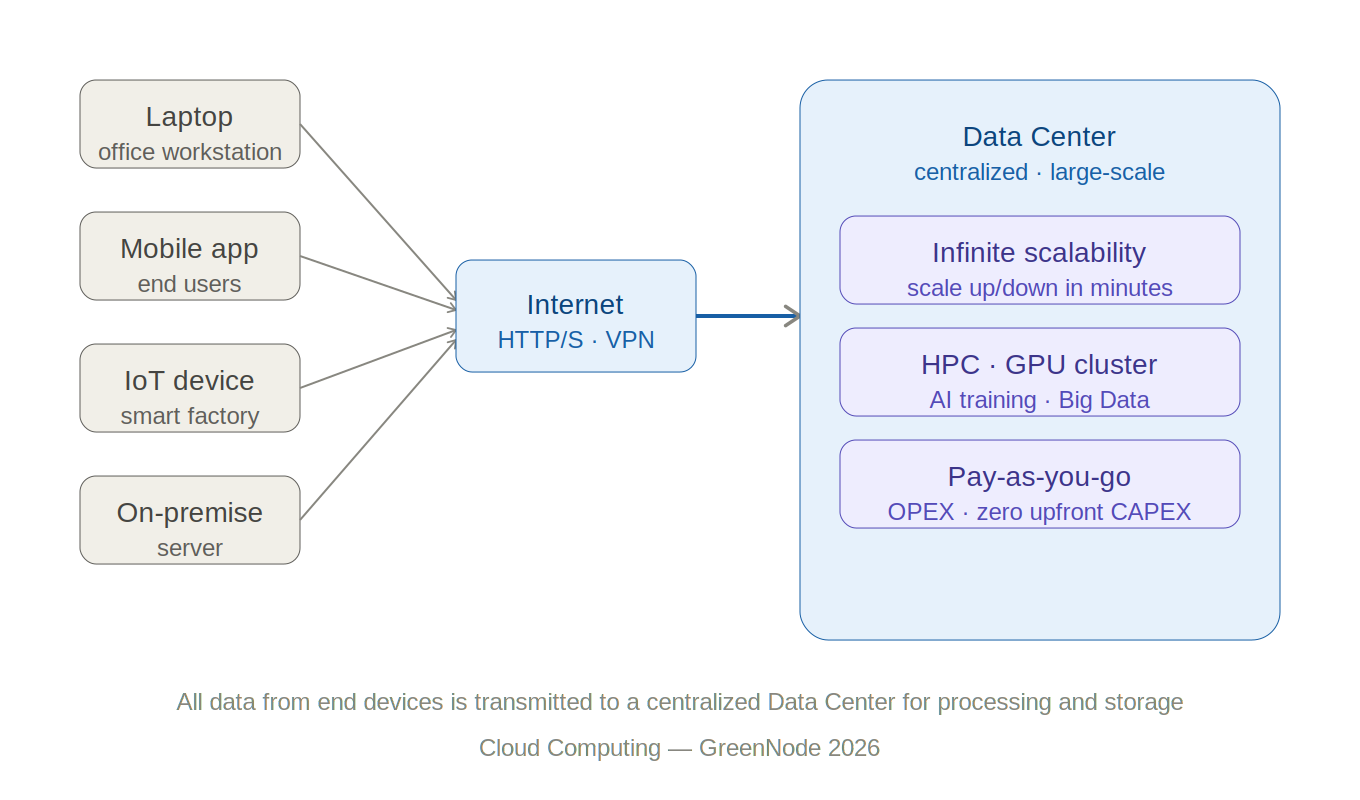
Cloud Computing refers to the delivery of computing services—including servers, storage, databases, networking, and software—over the Internet. In this model, data is transmitted from end-user devices to massive, centralized Data Centers for processing and storage.
Key Strengths of Cloud Computing:
- Infinite Scalability: You can scale resources up or down in minutes, easily handling unexpected traffic spikes.
- Massive Processing Power: Cloud environments are home to High-Performance Computing (HPC) and powerful GPU clusters, making them the only viable environment for heavy-lifting tasks like Large Language Model (LLM) training and Big Data analytics.
- Cost-Efficiency (FinOps): Operating on a Pay-as-you-go model eliminates the need for massive upfront hardware investments (CAPEX).
2. What is Edge Computing? (The Frontline Processor)
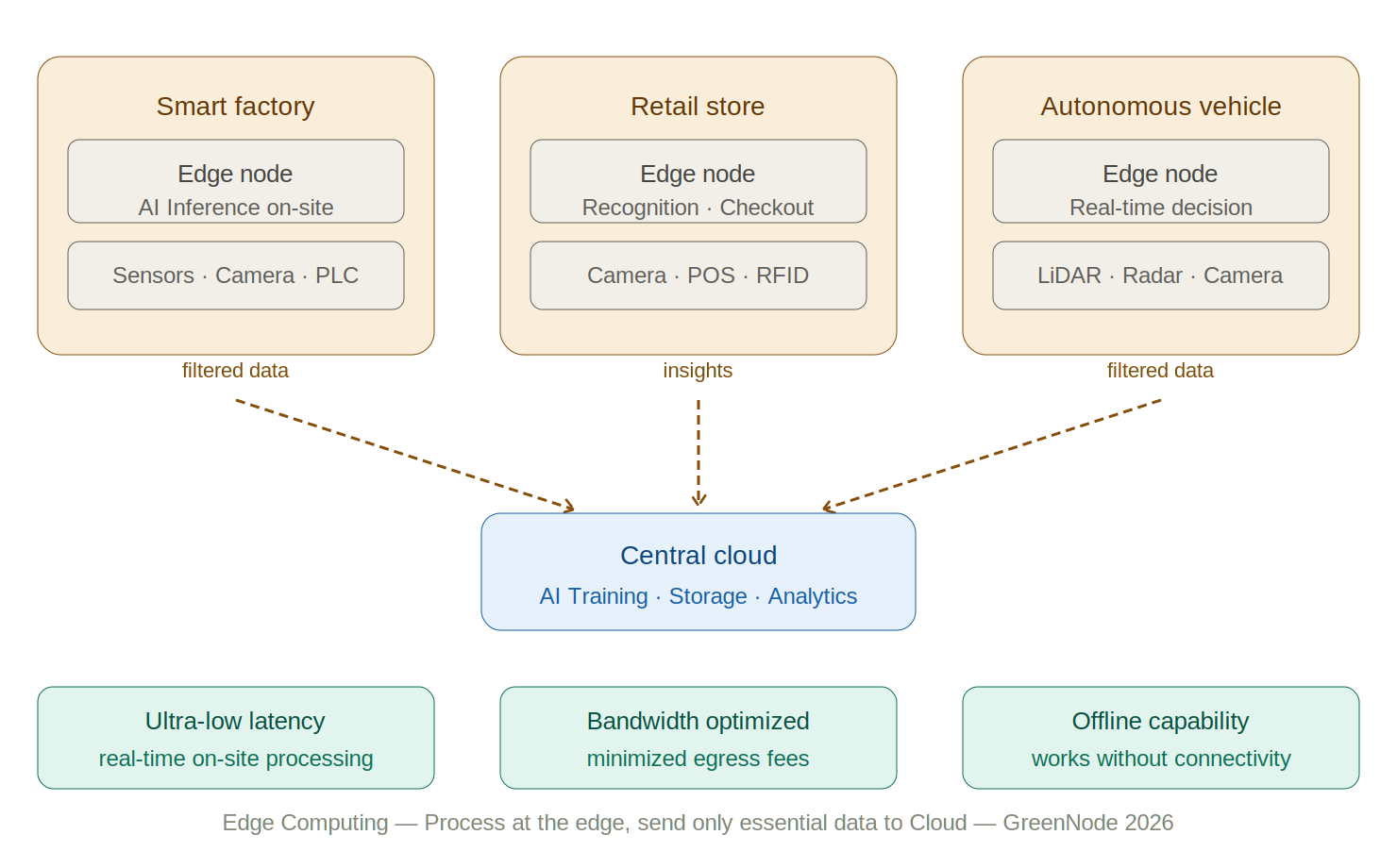
While the Cloud is a centralized brain, Edge Computing acts as the decentralized nervous system. Instead of sending all data back to a distant Data Center, Edge Computing brings computation and data storage closer to the "edge" of the network—right where the data is being generated (e.g., inside a smart factory, a retail store, or an autonomous vehicle).
Key Strengths of Edge Computing:
- Ultra-Low Latency: By processing data locally, Edge Computing delivers real-time or near-real-time responses, crucial for time-sensitive applications like remote surgery or automated manufacturing.
- Bandwidth Optimization: Sending petabytes of raw data to the Cloud is expensive. Edge devices filter and process data locally, sending only the essential insights to the Cloud, drastically reducing Egress fees.
- Offline Functionality: Edge systems can continue to operate and process critical tasks even if the connection to the central Cloud is temporarily lost.
3. The Core Differences: Edge Computing vs Cloud Computing
To help you make an informed decision, here is a direct comparison based on enterprise operational criteria:
Feature | Cloud Computing | Edge Computing |
Location | Centralized in large-scale Data Centers. | Decentralized, located near the data source. |
Latency | Medium to High (Depends on geographical distance and network routing). | Extremely Low (Real-time processing). |
Bandwidth Usage | High (Requires continuous data transmission). | Low (Filters out irrelevant data before transmitting). |
Compute Power | Virtually limitless. Ideal for AI Training and 3D rendering. | Limited by local hardware. Ideal for AI Inference and basic analytics. |
Security & Privacy | Centralized security protocols. Requires compliance with Data Sovereignty laws. | Reduces the risk of mass data breaches in transit, but physical devices can be harder to secure. |
4. The 2026 Strategy: Why Choose One When You Can Have a Hybrid?
The debate of Edge Computing vs Cloud Computing is not a zero-sum game. The most successful digital transformation strategies in 2026 do not choose one over the other; they adopt a Hybrid Architecture.
In a modern AI pipeline:
- The Cloud is used to train complex Machine Learning models using vast historical datasets.
- The Edge is used to deploy those trained models (AI Inference) for real-time decision-making in the field.
However, to make this Hybrid model work flawlessly, you need a Cloud infrastructure provider that guarantees high bandwidth, robust security, and zero-latency connectivity. This is where international hyperscalers often fall short due to cross-border routing issues and exorbitant bandwidth costs.
5. GreenNode: Your Ultimate Infrastructure Partner
If your enterprise is looking to build a high-performance backend to support your Edge devices, GreenNode provides the ultimate domestic ecosystem designed for the AI era.
By partnering with GreenNode, you unlock unparalleled advantages:
- Tier III Domestic Data Centers: Eliminate international bandwidth bottlenecks. GreenNode ensures that data traveling from your Edge devices to the Cloud experiences the lowest possible latency.
- Powerful Compute for AI: Leverage GreenNode GPU Cloud equipped with state-of-the-art NVIDIA H100 and L40S clusters to train your AI models faster than ever before.
- Seamless Integration: Host your centralized databases and management applications on high-availability GreenNode Cloud Servers, providing a stable anchor for your decentralized Edge network.
- Strict Data Sovereignty: Ensure 100% compliance with local cybersecurity laws by keeping your most sensitive data within domestic borders.