

The information provided in this article is for reference purposes only and should not be construed as legal advice or legal representation
If asked: "How many AI systems is all customer data flowing through, and who is keeping the logs for each of those systems?" could you answer within 5 minutes?
For most organizations that have deployed AI on a project-by-project basis a document lookup chatbot last quarter, a profile scoring tool this month, a call summarization assistant next week the answer is usually no. It is not due to a lack of caution. For every project deployed, the right questions were asked: "Is the data stored in Vietnam?" and "Is the provider reputable?" And every time, the answer was yes.
But "every tool is fine" does not mean "the entire system is controlled." Those are two different questions, and the gap between them is where risk silently accumulates: vector data from one tool, query logs from another, backups of a fine-tuned model from a third all scattered, with no one having the full picture, until there is an audit, a major client request, or an incident that forces an exact answer about where the data resides.
This is why data sovereignty in AI operations cannot be assessed at the individual tool level. It is an attribute of the overall architecture how the infrastructure, data, models, and application layers are designed to operate together under a consistent control mechanism, rather than a mere accumulation of isolated "seems fine" decisions.
This article shares an architectural perspective: the layers that make up an AI platform, who is responsible at each layer, and the questions infrastructure managers should ask to get that full picture before having to answer it in a much more urgent situation.
1. Architecture: The Deciding Factor for Data Sovereignty
Returning to the scenario above: if forced to answer right now, "Where is customer data residing within our entire AI system?", many organizations would realize the answer is not as simple as when evaluating each tool individually. This is because an AI system operates across multiple layers—compute infrastructure, data platform, model serving layer, and application layer—and each layer might be operated by different parties, in different jurisdictions, even if the primary infrastructure is located domestically.
An often-overlooked point: even if the data (data plane) is hosted domestically, if the control and monitoring layer management console, operational dashboards, metadata systems is operated by a foreign entity, the organization's actual control capacity remains limited. This is why evaluating data sovereignty requires looking at the entire architecture—every layer, every component rather than just asking a single question about location.
In other words: good architecture creates true sovereignty; infrastructure location is just one variable within that architecture. This is also why the following sections dive deep into each layer comprising an AI platform, giving infrastructure managers a more complete map when evaluating current systems or designing new ones.
2. The Layers Constituting an AI Platform
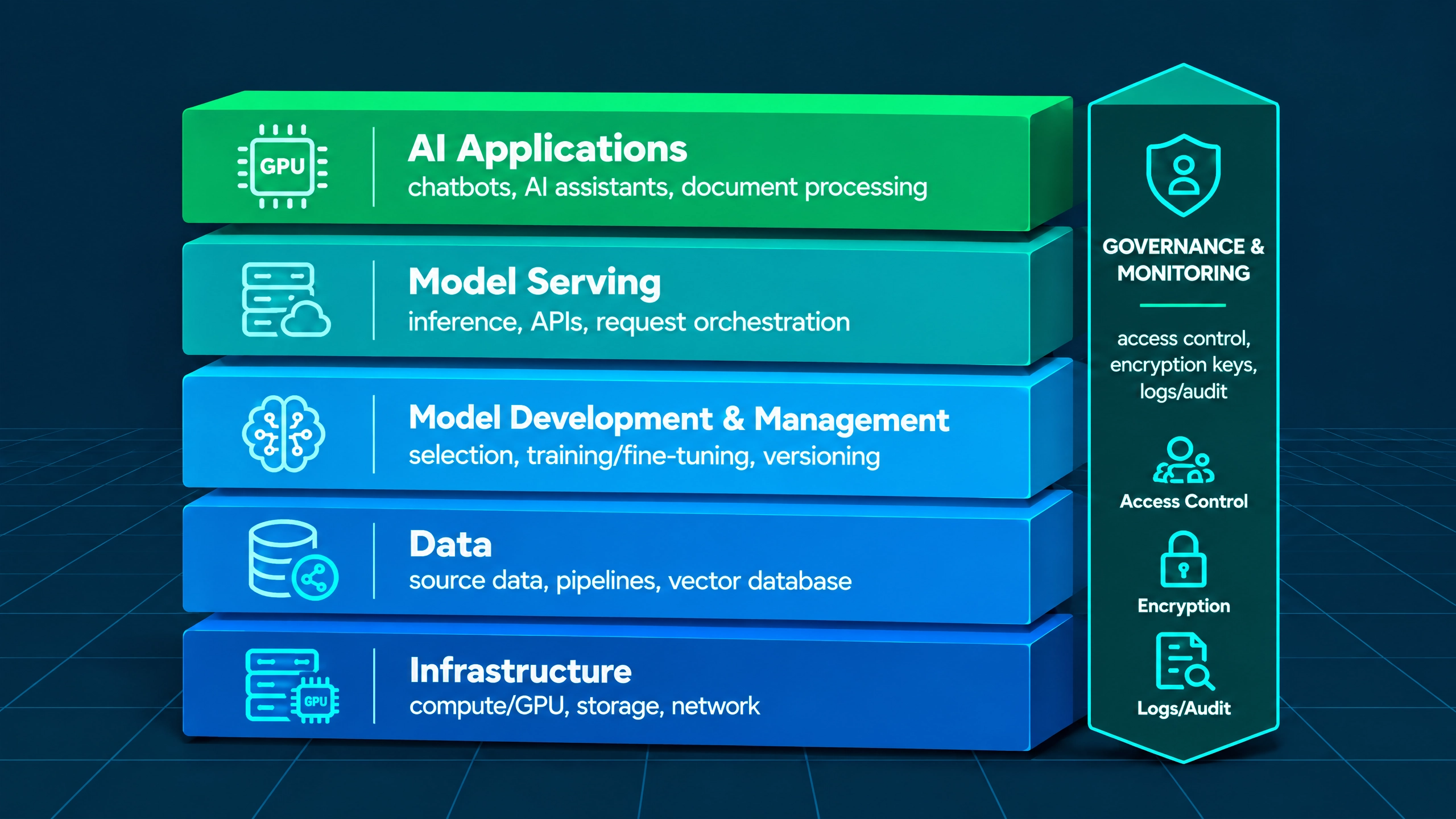
According to the standard stratification in the AI infrastructure industry, a fully operational AI platform consists of five technical layers stacked from the bottom up, plus a monitoring and governance layer that runs through all five:
- Infrastructure Layer: Compute (GPU/CPU), physical storage, and network. This is the foundation providing processing and storage capacity for everything above it, determining performance, scalability, and resource location.
- Data Layer: Where data is collected, stored (databases, data lakes), cleaned, and standardized before being fed into models. For AI systems with retrieval, this is also where vector data is stored.
- Model Development Layer: Where models are selected, trained, or fine-tuned on the organization's data. This layer dictates who truly controls the model: whether the organization has access to the weights, the training pipeline, and the data used for fine-tuning, or if this entirely belongs to an external model provider.
- Model Deployment Layer: Where the completed model is packaged and serves actual inference requests, typically via APIs or microservices.
- Application Layer: Where the model is integrated into actual business systems: chatbots, credit scoring tools, document processing assistants. This is the layer end-users interact with directly.
A crucial point to note: The model development layer and model deployment layer pose two different questions, though they are often lumped together during infrastructure evaluations. An organization might self-host model serving (inference) entirely domestically meeting location requirements at the deployment layer but if the underlying model is a product of a foreign provider where the organization has no access to weights or the fine-tuning process, the core "cognitive" capability of the AI system still depends entirely on external parties at the development layer. This is a form of data sovereignty leakage that is easily missed because it lies not in the question "where is the data?" but rather "who owns the model?".
3. The Singular Governance Layer: Consistent Control Across 5 Technical Layers
Unlike the five technical layers above, there is one layer that does not sit "inside" the architecture but runs across the entire system: the observability & governance layer. From a data sovereignty perspective, the three core components of this layer are:
Identity and Access Management (IAM): Who has access to which resources, at what level, and how those permissions are granted or revoked.
Encryption Key Management: Who holds the data encryption keys, and whether key management authority is segregated from data access permissions.
Logging and Monitoring: Whether every access action, configuration change, or data processing event is fully recorded and retrievable when needed.
When this governance layer is well-designed and uniformly applied across all five technical layers, the organization gains a system that is both easy to operate since all permissions and activities are clear and trackable and ready to answer how data is being processed at any time. This forms the foundation that enables smoother AI scaling, as the operations team doesn't have to rebuild the control mechanism every time a new AI application is deployed.
4. Components Retaining Data the Longest but Often Excluded from Evaluation
When evaluating an AI system, the most attention is usually given to the input data and the core model. However, there are four other components that also retain data sometimes for much longer periods yet are easily left out of the evaluation scope:
Logs: Query logs and system logs are often stored by default for months or years for operational purposes, but are rarely reviewed for sensitive content that might appear within them.
Backups: Data in backups usually exists longer than the original data and may reside in a different storage location, making it easy to overlook during data location audits.
Vector Databases: Data converted into embeddings for retrieval tasks (e.g., internal document lookup chatbots) can still contain information that could be inferred from the original content.
Fine-tuned Models: If a model is additionally trained on the organization's proprietary data, the model itself becomes a form of data storage, even if not visually apparent like a standard data file.
Including all four of these components in the infrastructure evaluation scope alongside the original data and core model helps organizations gain a more complete picture of where data truly "lives" across the entire system, thereby enabling the design of appropriate control mechanisms and retention lifecycles for each component.
5. Delineation of Responsibilities Between the Enterprise and the Provider
Under the new legal framework for Personal Data Protection (Law No. 91/2025/QH15 and Decree 356/2025/ND-CP effective January 1, 2026), the boundaries of legal responsibility between the Data Controller and Data Processor are clearly defined according to each technical service model.
| No. | Usage scenario | GreenNode’s role | Enterprise’s role |
| 1 | The enterprise deploys and operates its own application on GreenNode infrastructure, including vServer, vStorage, vDB, and VKS | Data Processor provides technical infrastructure for data storage, transmission, and operation according to configurations established by the enterprise; does not determine processing purposes | Data Controller - determines the purpose, scope, data categories, and retention period; configures the service and issues processing instructions |
| 2 | The enterprise calls a prebuilt model API through the MaaS Sovereign Lane | Data Processor for the model-processing activity, performing inference on submitted data according to the enterprise’s instructions and purposes | Data Controller - responsible for determining which data is used for which purposes and how model outputs are applied in business decisions |
| 3 | The enterprise accesses international models through the MaaS Gateway Lane | Data Processor for transmission, routing, logging, and control; the model provider is a disclosed sub-processor | Data Controller - determines which data may use this lane and records cross-border data flows as required by law |
| 4 | The enterprise trains or fine-tunes its own model on the AI Platform | Data Processor - provides compute, dataset storage, and model-lifecycle tooling within the enterprise’s tenant; does not access datasets beyond the technical scope needed for operations | Data Controller - responsible for the lawful basis and consent for training data, including mechanisms for consent withdrawal |
| 5 | The enterprise uses AgentBase to connect agents to internal systems | Data Processor - provides runtime, identity, memory, gateway, and policy controls; access boundaries are declared by the enterprise through Policy Group | Data Controller - determines which agents may access which systems and data, and which thresholds require human review |
| 6 | GreenNode acts as a subcontractor for a partner | Sub-processor - processes data only under valid authorization from the primary processor and does not receive instructions directly from the end customer | As defined by the agreement between the enterprise and the primary processor |
Properly identifying which model you are in and how responsibilities are divided within that model helps infrastructure teams avoid a common pitfall: assuming the provider "takes full responsibility" when in reality, a critical portion (e.g., data usage purpose, application-tier access configuration) still rests with the enterprise.
6. How GreenNode Builds This Architecture: Three Deployment Models and Provider Portability
In reality, there is no single "standard" architecture suitable for every enterprise you must choose a deployment model aligned with current contracts, data scale, and readiness for transition. GreenNode currently supports three collaboration models, varying by infrastructure location and the legal entity responsible for operations:
Model 1: Data is stored and processed entirely in Vietnam; no data is transferred abroad.
Model 2: Data is processed by a regional legal entity, accompanied by appropriate cross-border data transfer impact assessments prior to deployment.
Model 3: A multi-layered model where a domestic partner acts as the primary focal point, and GreenNode participates in a technical support role under authorization.
The common thread across all three models is that provider portability (exit & portability) is built-in from the start. Enterprises can export data, migrate workloads, or change collaboration models as needs evolve, without having to rebuild the entire governance mechanism from scratch. This is one of the most practical values of designing a sovereign architecture from the beginning: the organization always retains the right to choose, rather than being locked into a single vendor.
7. The 9 Criteria for Evaluating a Sovereign AI Cloud and Checklist for Infrastructure Managers
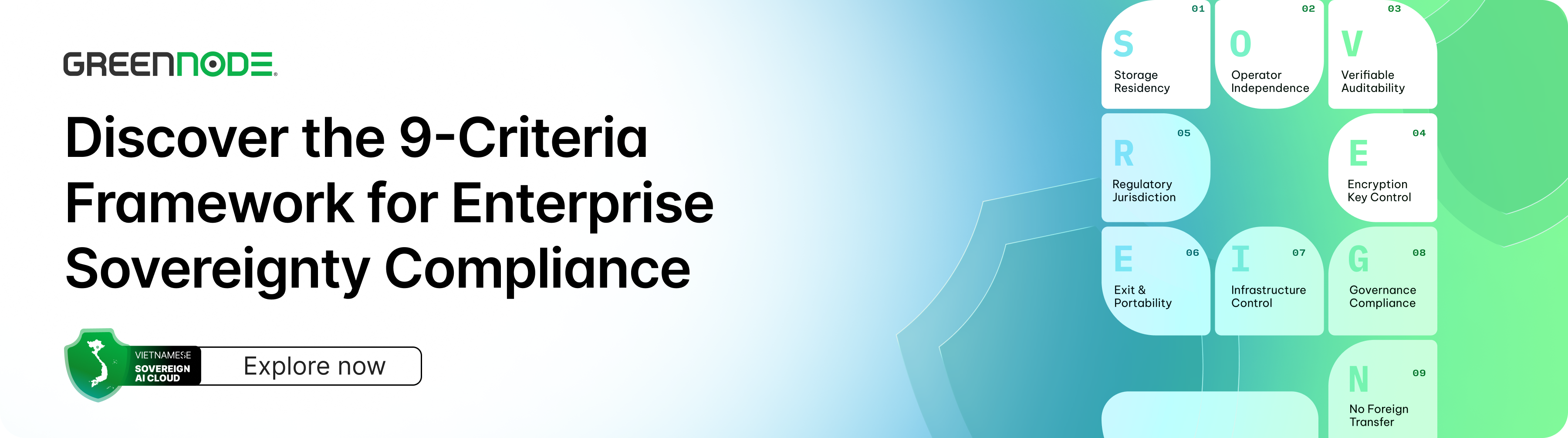
To help IT Infrastructure Managers and Chief Information Security Officers (CISOs) establish a basis for assessing the actual capabilities of Cloud/AI providers, below is the Sovereign AI Cloud control criteria set comprising 9 core indicators:
- Storage Residency: Source data, backup data, and metadata are accurately stored and processed within the committed geographic scope.
- Operator Independence: The enterprise has full autonomy to operate workloads on the platform; the provider has no right to intervene in business data beyond the agreed scope.
- Encryption Key Control: Customers hold and manage encryption keys (KMS); data access permissions are completely segregated from key management authority.
- Infrastructure Control: Data Center locations are transparent; only properly authorized personnel in Vietnam have the authority to operate the system.
- Regulatory Jurisdiction: Data and infrastructure fully comply with the Vietnamese legal system and are not subject to interference by foreign jurisdictions.
- Verifiable Auditability: The system maintains detailed trail logs (who accessed, when, from where) ready for generating compliance audit reports.
- Exit & Portability: Provides standardized tools to extract data and models, along with secure data wiping mechanisms upon service termination.
- Governance Compliance: Meets international information security certifications and industry-specific regulations (ISO 27001, SOC 2, SBV Circular 09/12).
- No Foreign Transfer: No automatic transmission or storage of data to infrastructure zones outside Vietnam without formal written approval.
Checklist: 3 Questions Infrastructure Managers Must Clarify Before Signing a Contract
- Verify the Control Plane: "Where is the service's control layer (console, metadata, logging) located, and which legal entity directly operates it?"
- Responsibility Boundaries per Service Model: "To what extent is the provider responsible for securing models and access logs for AIaaS / Managed AI services?"
- Exit Strategy: "When the contract needs to be terminated, how does the process of extracting all vector embeddings, log data, and model weights take place, and how is the commitment to Data Wiping verified?"
Conclusion
Data sovereignty in the AI era cannot be achieved by accumulating individual tool approval decisions. It requires a standardized architectural blueprintfrom physical infrastructure, data processing layers, and model training/serving layers, to an overarching governance framework.
GreenNode Sovereign AI Cloud ecosystem is built to give enterprises the ability to accelerate AI deployment while maintaining substantial control over their data assets and ensuring full compliance with Vietnam's legal framework.
FAQs about Sovereign AI Cloud architecture
1. Which cloud platform is suitable for Vietnamese enterprises that must comply with domestic data regulations?
Vietnamese enterprises that must comply with domestic data regulations should choose a Sovereign Cloud platform. The platform should store and process data in Vietnam and be run by a Vietnamese legal entity. The enterprise should control its own encryption keys and access rights, the system should be auditable, and there should be a built-in path to switch providers. No data should be transferred abroad without approval. These criteria follow the Personal Data Protection Law No. 91/2025/QH15 and Decree 356/2025/ND-CP. GreenNode, VNG's Sovereign AI Cloud platform, meets them through three deployment models. The first stores and processes data entirely in Vietnam. The second processes data through a regional legal entity, with a cross-border transfer impact assessment before deployment. The third has a domestic partner as the main point of contact, with GreenNode providing technical support under authorization.
2. Does using foreign AI APIs like ChatGPT violate Vietnam's data laws?
Using a foreign AI API is not automatically a violation. However, when prompts, documents or personal data are sent to servers abroad, the enterprise is transferring data across borders. Under Law No. 91/2025/QH15 and Decree 356/2025/ND-CP, the enterprise must then define whether it is the data controller or processor, document the data flow, and disclose the model provider as a sub-processor. On GreenNode, international models are accessed through a MaaS Gateway where the model provider is clearly disclosed. Enterprises that need to keep data entirely in Vietnam can choose a deployment model that stores and processes data locally.
3. How can an enterprise verify that its AI data actually stays in the country?
An enterprise needs to check all five layers of its AI system, not just where the servers are. AI data goes beyond source data. It includes prompts, embeddings in vector databases, fine-tuned model weights, inference outputs and access logs, and each can sit in a different system. Three points are often missed: where the service's control layer (console, metadata, logs) is located, who holds the encryption keys, and where access logs are stored. A quick test: can the enterprise say within five minutes how many AI systems its customer data flows through, and who keeps the logs for each one?
4. When using AI cloud, who is responsible for protecting personal data: the enterprise or the provider?
Responsibility depends on the usage scenario. Under Law No. 91/2025/QH15 and Decree 356/2025/ND-CP, the controller and processor roles must be defined for each case: enterprise-operated applications, prebuilt model APIs, international model access, model training or fine-tuning, agent connections, and provider subcontracting. Typically, the enterprise is the data controller and the cloud provider is the processor, and each party's scope of responsibility should be stated clearly in the contract.
5. What should enterprises ask an AI cloud provider before signing a contract?
Before signing, an enterprise should ask the provider three questions. The first is where the service's control layer (console, metadata, logs) is located. The second is how far the provider's responsibility goes for securing models and access logs. The third is how the enterprise will retrieve all vector embeddings, log data and model weights when the contract ends. The third question determines whether the enterprise gets locked in to one provider. GreenNode builds exit and portability in from the start, so enterprises always keep control of their data and models.
