

What matters
- Claims processing time drops from ~30 minutes to under 5; the core value case is speed, driven by automating classification, extraction, and cross-checking in one pipeline instead of manual sorting across document formats.
- Accuracy holds even on handwriting: 99% on printed text, 94% on handwritten Vietnamese, which matters because prescriptions and lab results are frequently handwritten or scanned photos, not clean digital files.
- Labor cost drops 70–80% on document handling, with throughput over 320 pages/minute. This is a volume-and-cost argument as much as a speed one.
- The system also does fraud/consistency checking, not just extraction, cross-referencing data across documents (card, prescription, invoice) to flag inconsistencies before routing to auto-approval or manual review.
In the health insurance industry, the speed and accuracy of claims processing directly shape both customer experience and operating costs. A typical claim file includes dozens of different documents — hospital invoices, prescriptions, discharge papers, lab results — submitted through multiple channels and with no consistent format. This is exactly the problem that Intelligent Document Processing (IDP) was built to solve.
The bottlenecks of traditional claims processing
At most insurance companies and Third Party Administrators (TPAs), claims processing still relies heavily on manual work:
- Claims arrive through multiple channels (email, fax, in person) with no automated way to sort them.
- Staff have to manually classify each document, which leads to errors and missed files.
- Manual data entry slows down processing and introduces mistakes.
- There's no automated way to cross-check data across documents within the same claim file.
As a result, average processing time per claim runs 25–35 minutes, operating costs stay high, and scaling up becomes difficult whenever claim volumes spike — especially for TPAs handling claims for multiple insurers at once, each with its own document formats.
Four core capabilities that automate the entire claims lifecycle
GreenNode IDP combines traditional OCR with large language models (LLM) and large vision-language models (VLM) to solve this problem through four capabilities:
1. Automatic document classification
The system automatically identifies and classifies the document types specific to health insurance claims: health insurance cards, discharge papers, prescriptions, imaging results, lab results, cost breakdowns, medical summaries, VAT invoices, and more. Input can be PDFs, photos, or ZIP files containing multiple documents; the system automatically splits them apart, names them according to a set convention, and removes blank or redundant pages.
2. Accurate data extraction — including handwritten Vietnamese
This is the single biggest differentiator when applying IDP to health insurance in Vietnam. Many medical documents — prescriptions, accident reports, doctors' notes — are handwritten in free-form styles with no fixed template. Thanks to a model trained specifically on handwritten Vietnamese (tonal marks, fast handwriting strokes), GreenNode IDP achieves field-level extraction accuracy of 99% for printed text and 94% for handwriting, handling structured, semi-structured, and free-form text equally well.
3. Cross-checking and validation for risk scoring
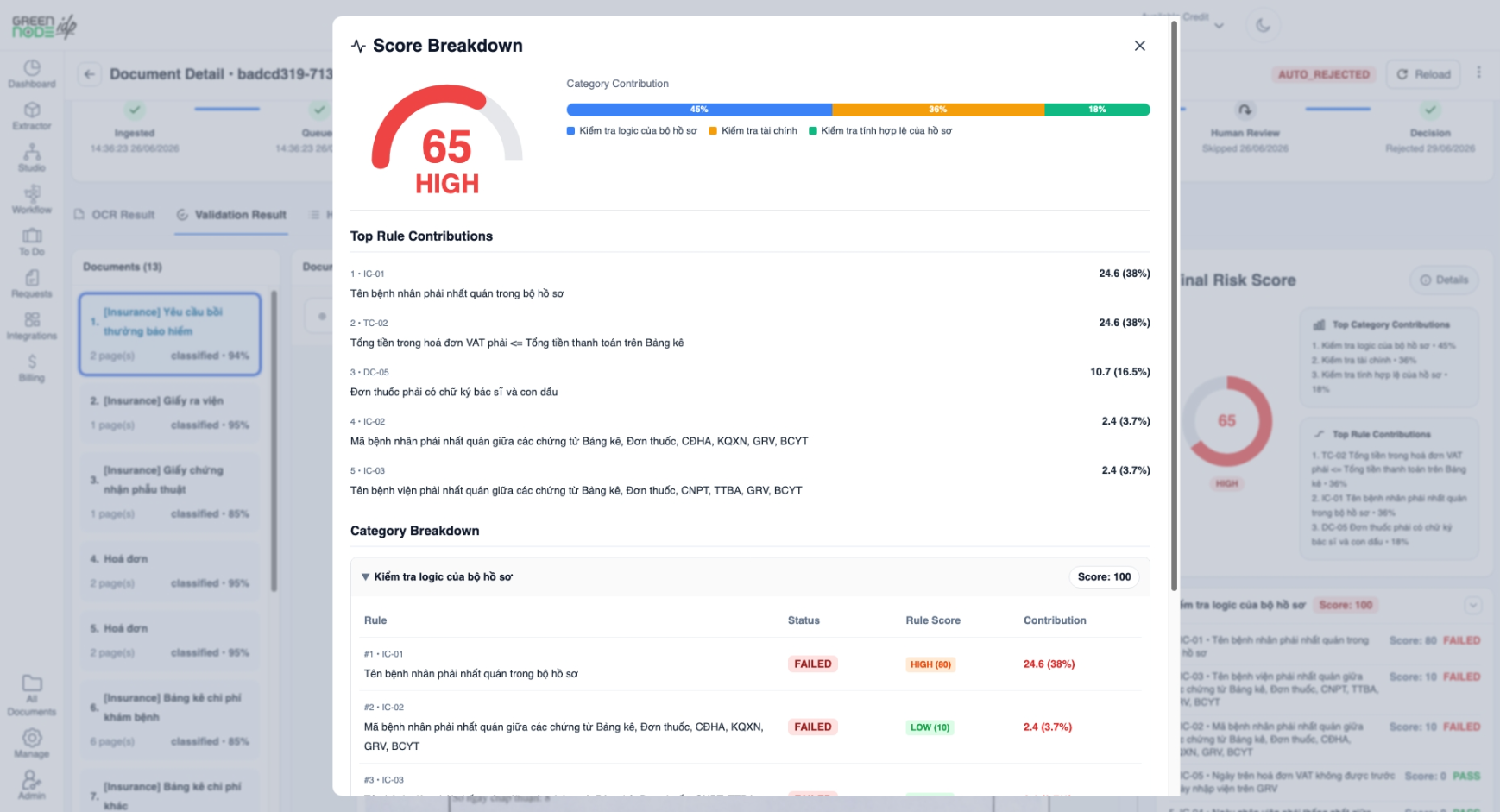
The system automatically cross-references information across documents within the same claim file (dates, amounts, names, and so on), and compares the data against ICD disease codes and policy benefit rules to suggest an appropriate payout amount. At the same time, its tampering and forgery detection models — built on pixel-level structure analysis, metadata analysis, and information-logic checks — flag suspicious signals early, before a claim is approved, reducing fraud risk during the reimbursement process.
4. Smart routing and output standardization
Based on the calculated risk score, claims are automatically routed: either approved automatically or sent to human review. Extracted data is standardized (date formats, currency amounts, special characters) and exported in a JSON/XML/flat schema tailored to each business, ready for direct integration into core systems via REST API, Webhook, Message Queue, S3, or email.
Real-world results: processing claims six times faster
These aren't just theoretical figures. At one TPA (Third Party Administrator) currently using GreenNode IDP to process claims for dozens of insurers at once, processing time per claim dropped from roughly 30 minutes to under 5 minutes, with extraction accuracy reaching 99% and document-handling labor costs down 70–80%. On throughput, the parallel batch-processing architecture lets the system handle more than 320 pages of documents in a single minute, keeping speed stable even during sudden spikes in claim volume — a critical factor in helping this partner meet its claims-settlement SLA commitments to customers.
At the infrastructure level, these numbers are backed by the model's real-world processing performance: under 2.5 seconds per page on an RTX 4090 GPU, and under 1 second per page when deployed on an NVIDIA H100 GPU.
Extraction accuracy has also been verified at the field level — 99% for printed forms and 94% for handwritten ones — rather than measured only at the document level. Thanks to a rich library of pre-trained models, insurance companies can start experiencing the solution in as little as 2–3 days, without a separate fine-tuning phase for each new form.
Handling forms from multiple sources without reconfiguration
In practice, health insurance claims often come from multiple sources — insurers, hospitals, pharmacies — each using its own form, mixing printed text with free-form handwriting. GreenNode IDP adapts to new forms on its own, without needing to be reconfigured for each one, allowing it to process claims from multiple sources simultaneously on a single platform.
When a completely new form needs to be onboarded, the business team can do it themselves in GreenNode IDP Studio in four steps:
- Upload a sample file
- Label the data fields
- Test with real data
- Publish it for immediate use in the workflow
The entire process takes under 30 minutes, with no need to restart the system or wait for the vendor to retrain a model.
The value IDP brings to insurance businesses
Applying IDP to the health insurance claims process delivers three clear categories of benefit for insurers and TPA partners:
- Speed: cuts claims processing time from tens of minutes down to under 5 minutes, helping meet claims-settlement SLAs with customers and partners.
- Accuracy: reduces manual data-entry errors and catches signs of fraud or document tampering early.
- Scalability: processes large volumes in parallel and adapts to new forms from multiple sources without further investment in models or process redesign.
Implementation roadmap
To transform their claims processing workflow, insurance businesses can follow a three-step path:
- Register for a solution consultation: GreenNode's team analyzes the specific context and bottlenecks in your claims process, then proposes a suitable implementation plan.
- Run a pilot: deploy a proof of concept on one claim type to measure results before scaling up.
- Go live: full system rollout within 4–6 weeks.
Beyond extracting and cross-checking claims data, GreenNode IDP also provides an in-depth verification layer — authenticating and matching signatures and stamps, and detecting tampered or forged documents — helping insurance businesses control fraud risk from the moment a claim is received.
