What matters
- AgentBase is infrastructure, not another framework. You keep your existing stack (LangGraph, CrewAI, LlamaIndex, or plain Python), no rewrites, and just deploy it as a Docker container exposing an HTTP endpoint.
- Governance sits outside the framework, not inside it. RBAC, budget alerts, memory persistence, and observability apply the same way regardless of which framework built the agent.
- Each framework gets a specific value-add: LangGraph gets a native memory bridge for its checkpointing, CrewAI gets agent isolation and budget tracking for its multi-agent roles, LlamaIndex gets private VPC protection for RAG data.
- Real examples back the claim: a Python-based meeting-transcription agent (Mee Agent) and a RAG documentation crawler (vllm-wiki Agent, using Firecrawl + Gemma) both run on the same platform layer.
When evaluating a platform to run AI agents, most developers don't start with features, they start with their stack: "We're already on LangGraph, do we have to switch?" Or: "We're building with CrewAI, will that still work?"
With GreenNode AgentBase, the short answer: you don't have to change a thing.
AgentBase isn't a new framework that asks you to relearn how to build agents. It's where you run them, regardless of what they're written in. LangGraph, CrewAI, LlamaIndex, and plain Python, all of it ships to AgentBase without touching a single line of your business logic.
What frameworks does AgentBase support — and why doesn't it force you to switch?
AgentBase Runtime is container-based. You package your agent as a Docker image, deploy it to the Runtime, and expose an HTTP endpoint. Inside that container, you're completely in control, any framework, any version, any dependency you want.
The governance and infrastructure layer, from RBAC, Private VPC, MCP Gateway, Memory Service to Budget Alert, all operate outside the container. AgentBase doesn't touch your code, doesn't inject middleware, and doesn't require you to use a proprietary SDK.
Put simply: you keep the stack you know, AgentBase handles the rest.
| Framework | Strengths | Best for | What AgentBase adds |
|---|---|---|---|
| LangGraph | Stateful graph, explicit flow control, human-in-the-loop | Multi-step approval workflows, production agents that need audit trails | Native memory bridge (AgentBaseMemoryEvents), per-node RBAC, observability |
| CrewAI | Role-based multi-agent, fast to prototype, intuitive mental model | Workflows with clear role division: research, drafting, review | Agent isolation, per-crew budget tracking, Private VPC |
| LlamaIndex | RAG and knowledge retrieval, rich data connectors | Internal knowledge agents, document Q&A, enterprise search | Private VPC keeps data inside your network, MCP Gateway logs retrieval |
| AutoGPT / MetaGPT | Autonomous agents, code generation, automatic task decomposition | R&D agents, complex automation pipelines | Runtime isolation, memory persistence, budget control |
| Plain Python | Full control, no external dependencies | Any use case that needs completely custom logic | The full platform layer — AgentBase wraps the outside, your code stays untouched |
LangGraph: can you deploy to AgentBase without losing native checkpointing?
LangGraph is currently the most popular choice for production agents — especially when workflows span multiple steps, require precise state control, or involve human-in-the-loop checkpoints. Its graph-based architecture maps naturally to complex enterprise processes: multi-level approvals, conditional routing, retry logic.
AgentBase ships a built-in AgentBaseMemoryEvents that works as a LangGraph CheckpointSaver — meaning LangGraph's conversation state is persisted to AgentBase Memory Service without needing to build a custom bridge. Deploy a LangGraph agent to AgentBase and you get long-term memory, RBAC, and observability with almost no code changes.
Does CrewAI multi-agent work on AgentBase?
CrewAI is the right fit when you want to organize agents by role — a Research Agent handles search, a Writer Agent handles drafting, a QA Agent handles review. The mental model is intuitive, prototyping is fast, and it's easy to explain to non-technical stakeholders.
Shipping a CrewAI crew to AgentBase means your agents run with full isolation between them, budget tracking per crew, and the option to attach a Private VPC if the crew needs to access internal data. The CrewAI side stays exactly as-is — AgentBase handles the infrastructure.
LlamaIndex and RAG pipelines: does your data actually stay inside the network?
LlamaIndex is where RAG-heavy use cases shine: agents that need to read, index, and query internal documents — knowledge bases, technical documentation, internal databases. If your team is building an internal knowledge agent or document Q&A system, LlamaIndex is a solid foundation.
When you deploy a LlamaIndex agent on AgentBase with Private VPC, the entire pipeline — from indexing to retrieval — runs inside your organization's private network. Sensitive documents never leave to be processed. This is often the deciding factor for teams in fintech and healthcare.
Has anyone actually built and deployed with this?
A couple of examples from what's already been built and deployed on AgentBase:
- Mee Agent — real-time meeting transcription and automated minutes. The agent listens to a live meeting, transcribes it, and generates a minutes-of-meeting document automatically. Written in plain Python, deployed to AgentBase Runtime, and shared across the entire team through a single endpoint — no one needs to install anything locally. No complex framework needed here: just Python, a few model calls, and AgentBase handling the serving and scaling.
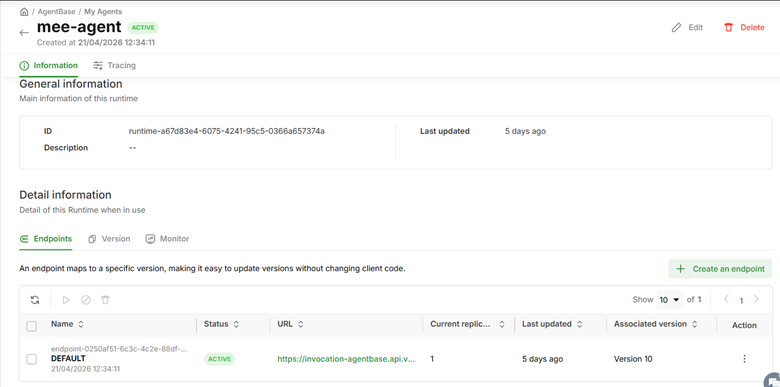
Full tutorial at Build and Deploy Mee Agent for AI Meeting Notes.
- vllm-wiki Agent — a knowledge base that stays current from your docs. The agent uses Firecrawl to crawl documentation, indexes and queries it with Gemma 4-31B running directly on GreenNode MaaS, and returns answers with citations. A straightforward RAG agent — running entirely on AgentBase without needing to set up a separate vector store infrastructure.
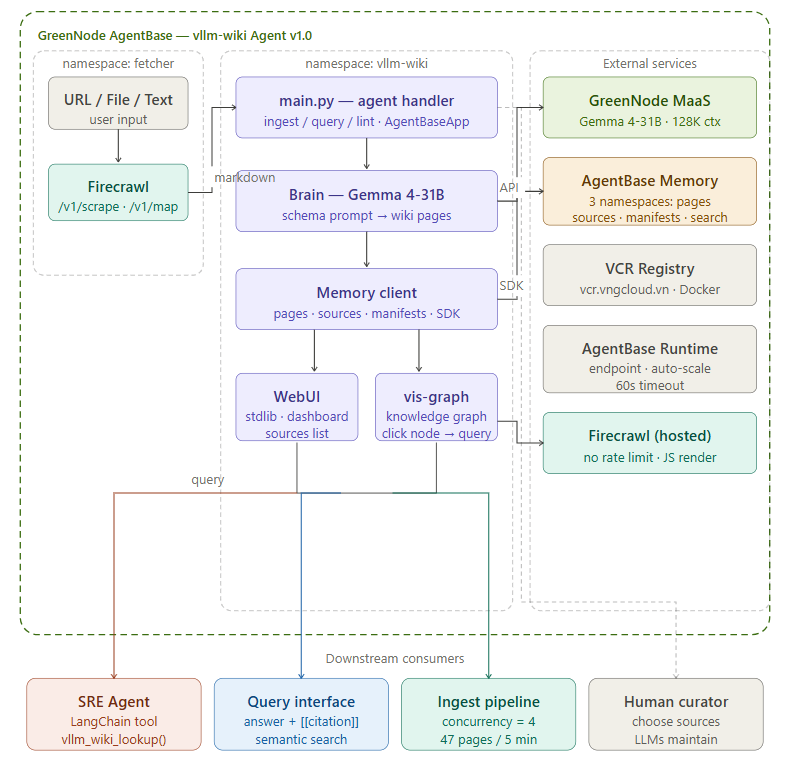
- Full tutorial at From Docs to Wiki: Build a Living Knowledge Agent.
Two completely different use cases, two different approaches — same place to deploy.
You pick the framework. GreenNode AgentBase handles the infrastructure
Framework-agnostic isn't just about technical compatibility. The more important point is this: whichever framework you choose, you still get AgentBase's full governance layer — RBAC for team-level access control, Private VPC to keep data inside your network, MCP Gateway for centralized tool connection management, Memory Service for long-term memory, and Budget Alert for cost tracking.
You don't have to choose between "using the framework your team knows" and "having production-grade infrastructure." AgentBase gives you both.
And if your team later decides to move from CrewAI to LangGraph, your existing RBAC config, VPC setup, memory stores, and budget settings all carry over. Nothing needs to be rebuilt.