

What matters
- GreenNode sells an integrated lifecycle, not just cheap compute: notebook, network volume, model tuning, model registry, and inference are built to connect natively, aimed at teams that don't want to stitch together separate vendors (the same "integration glue" problem flagged in GreenNode's own SEA-platform article).
- Vietnam-only data residency is the core differentiator, not price, it targets financial services, healthcare, and government-adjacent organizations bound by local compliance, at the cost of no multi-region failover (single region: Ho Chi Minh City, though infra also exists in Bangkok).
- Pricing is consumption-based but opaque: prepaid, postpaid, and hold-credit options exist, but actual rates aren't published, they're set via custom assessment based on model size, GPU tier, and traffic, which makes upfront cost comparison hard.
- GPU tiers cap around 14B-parameter models, and there's no independent third-party benchmark or public uptime SLA. This is a real gap for teams needing frontier-scale models or verified performance guarantees.
- Best fit is narrow and specific: ML engineers wanting notebook-to-API deployment without DevOps overhead, and orgs needing SEA-language optimization (Vietnamese, Thai, Bahasa), teams needing AutoML, native CI/CD, or multi-region redundancy should look elsewhere (e.g., AWS SageMaker).
If you've made it far enough into your AI infrastructure search that "GreenNode AI Platform" is now on your shortlist, you're probably past the "what is this" stage and into the "should we actually use this" stage. This review is written for that stage, no fluff, no generic explainer, just what the platform does, where it's strong, where it falls short, and how it stacks up against AWS SageMaker, RunPod, and building it yourself.
What Is GreenNode AI Platform?
GreenNode AI Platform is GreenNode's managed environment for the full AI model lifecycle from writing training code, to fine-tuning, to serving models as production APIs, built on infrastructure hosted in Vietnam. Instead of stitching together a notebook provider, a storage layer, a model registry, and an inference service from three or four different vendors, GreenNode packages all four into one connected workflow: Notebook → Network Volume → Model Registry → Inference.
The pitch isn't "more compute." Compute is a commodity at this point, any hyperscaler or neo-cloud can rent you a GPU. GreenNode's actual differentiator is that the entire model lifecycle, including where your training data physically sits, stays inside a single Vietnam-based environment with project-level access control. For teams where "where does our data live" is a compliance question and not just a technical preference, that matters more than shaving a few cents off GPU-hour pricing.
Key Features
Notebook Instance
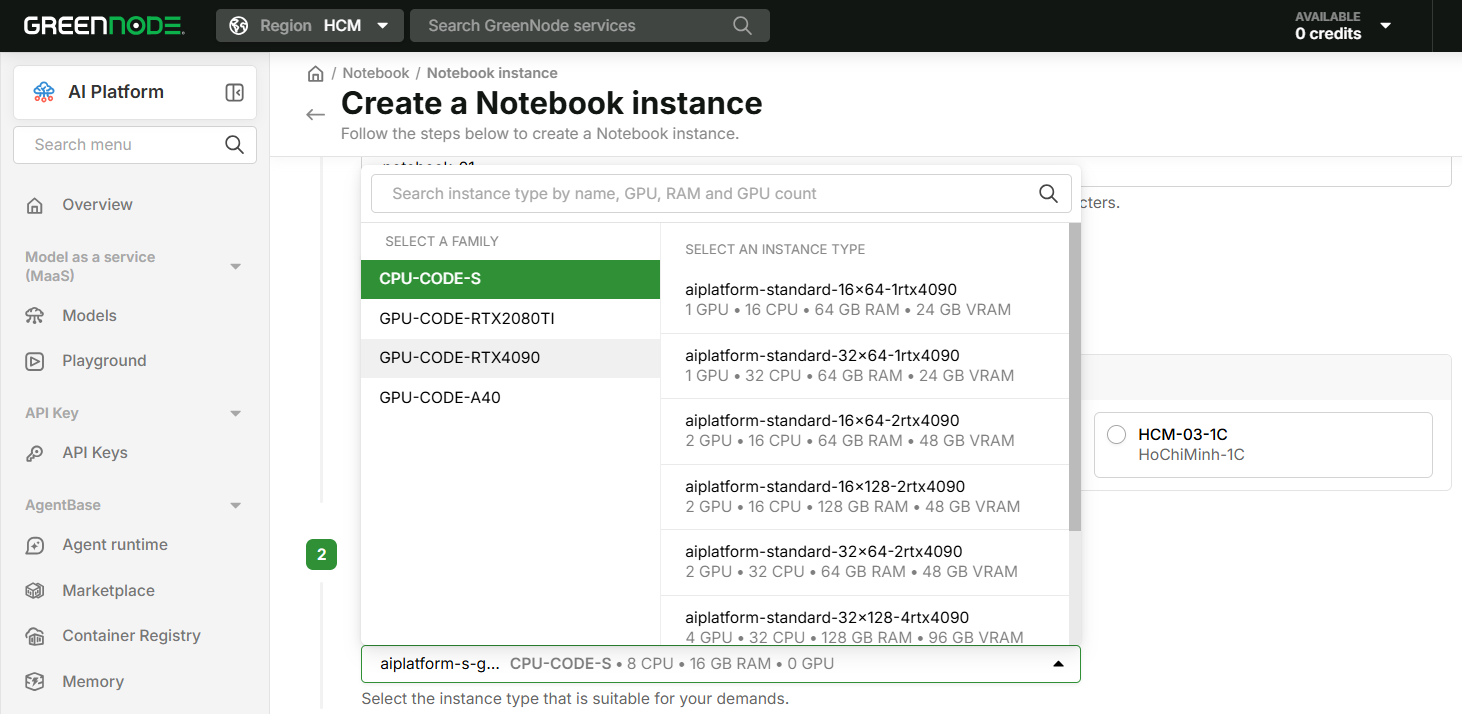
An interactive AI programming environment that lets AI Engineers write code, experiment, and train models directly on the cloud. It supports Jupyter Notebook, a familiar environment for most of the AI/ML community; comes with GPU integration for fast model training (RTX 2080 Ti, RTX 4090, or A40, depending on the instance group you pick); and includes code version management that stores and tracks revision history so notebooks can be shared across a team.
Typical use cases: writing AI code, experimenting with models, data preprocessing, and running inference tests. One thing worth flagging up front: notebook instances don't get a public IP, and local block storage is wiped when the instance stops — more on why that matters in the Limitations section.
Network Volume
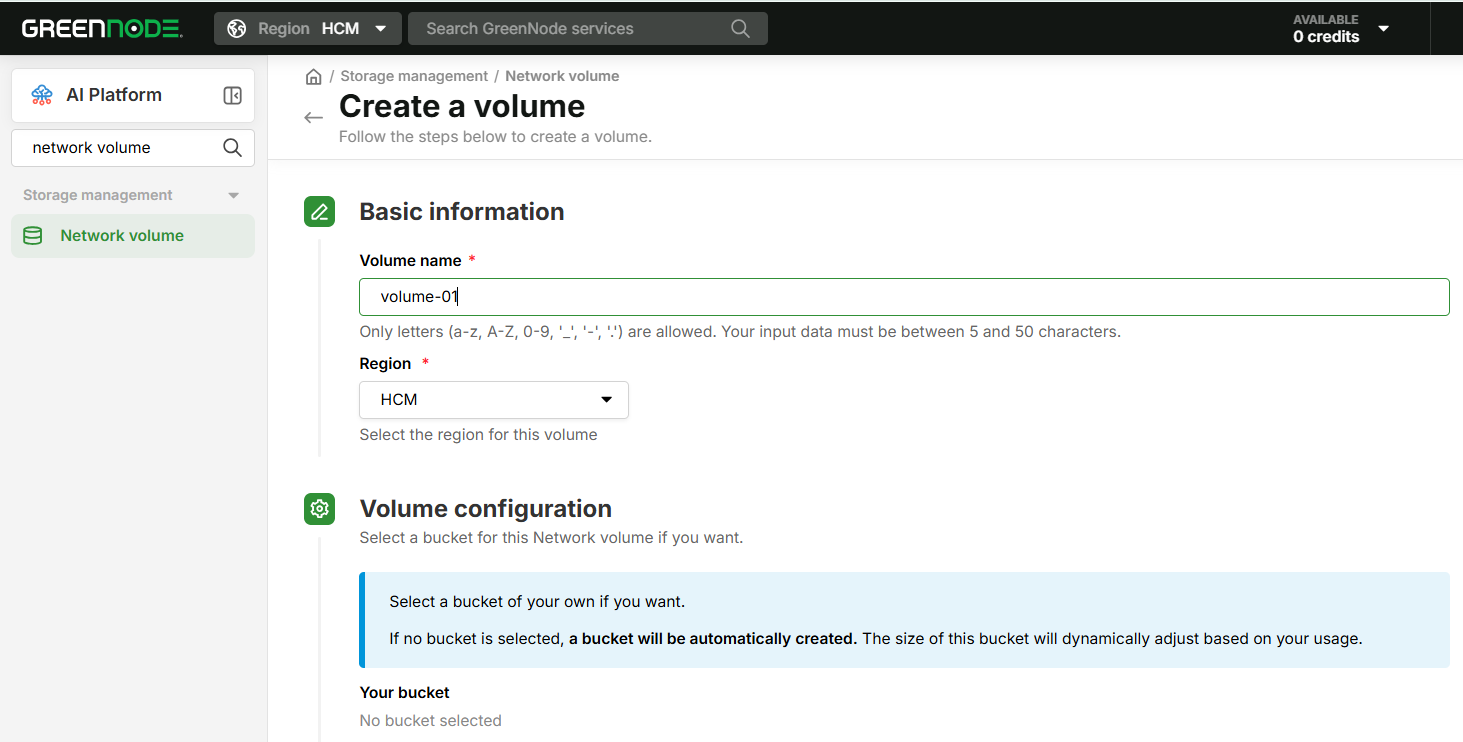
A distributed storage system that lets AI Engineers share data, models, and training results across notebooks and servers without manual transfer. It offers flexible, scalable capacity suited to large-scale data processing, fast read/write access across multiple sessions, and integrated security with access control by user or project group.
Typical use cases: storing datasets, models, training results, and log files. In practice, this is the connective tissue of the whole platform — Notebook, Model Registry, and Inference can all mount it, so datasets and model files don't need to be re-uploaded at every stage. Data auto-syncs into a notebook's local storage on start and syncs back out on stop, and you can also push/pull data directly via the aiplatform-util CLI or standard S3-compatible tools like s3cmd. For teams that have lost work to a crashed notebook with no persistent backing store, this is the feature that actually solves that problem — not a nice-to-have.
Model Tuning
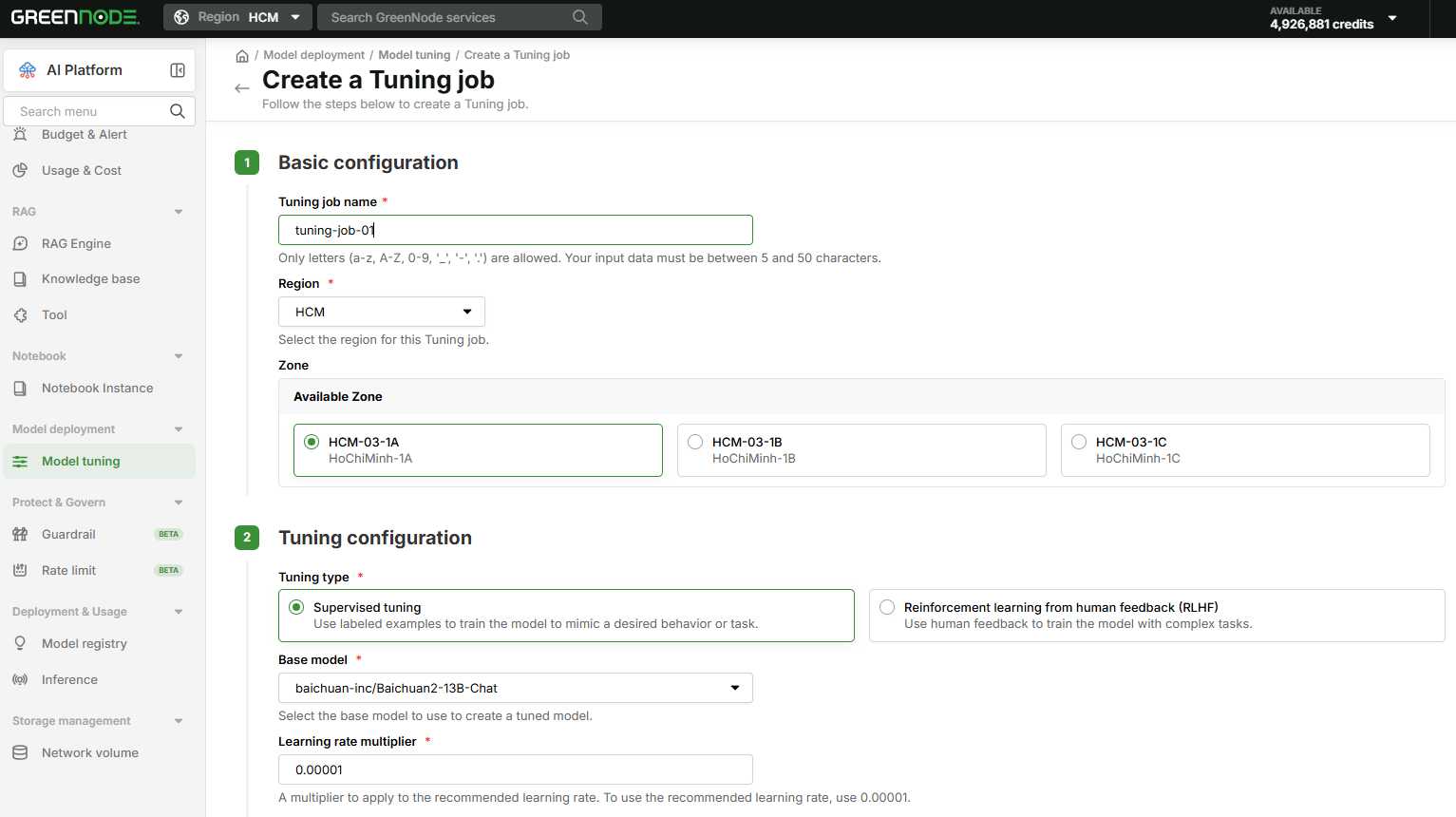
Lets AI Engineers fine-tune model parameters (hyperparameter tuning) to reach optimal performance. It automates parameter experimentation by running multiple training versions in parallel, supports optimization algorithms, and records results while suggesting the most accurate model.
Typical use cases: optimizing models for image recognition, natural language processing, and predictive analytics.
Model Registry
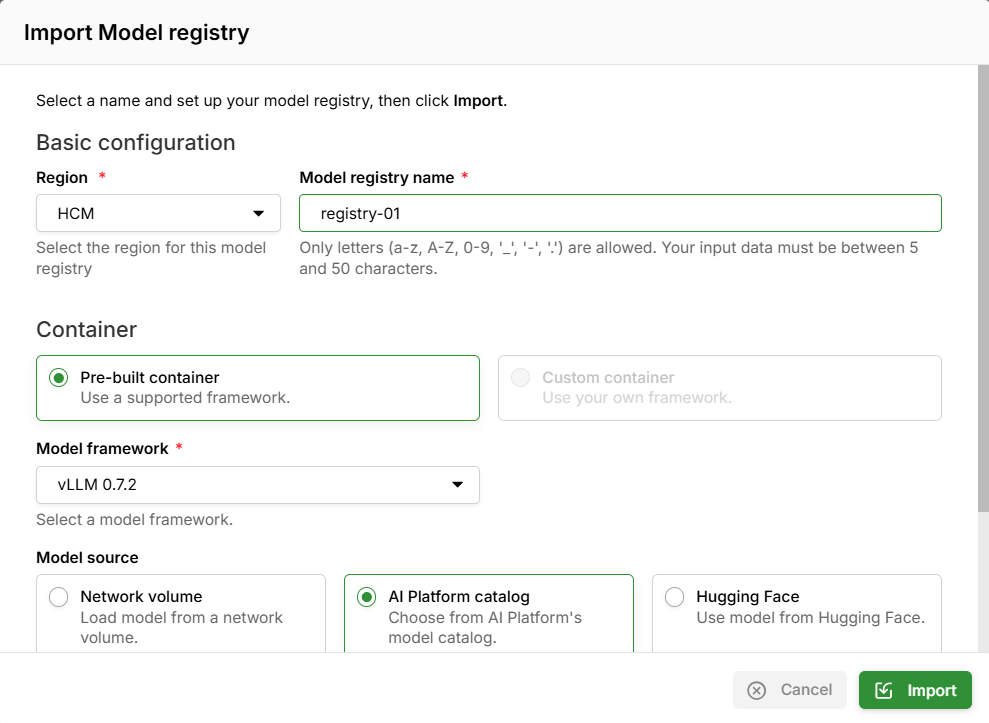
A centralized place to version, store, and govern trained models before deployment. It supports three import paths depending on how your model is packaged: Triton-format models (ONNX, TensorFlow SavedModel, TorchScript, TensorRT, OpenVINO) from a Network Volume, vLLM-served models (from Network Volume, the AI Platform Catalog, or directly from Hugging Face), or a fully custom container with your own image, ports, and health checks. That range covers most real-world deployment scenarios without forcing you into one serving framework.
Inference
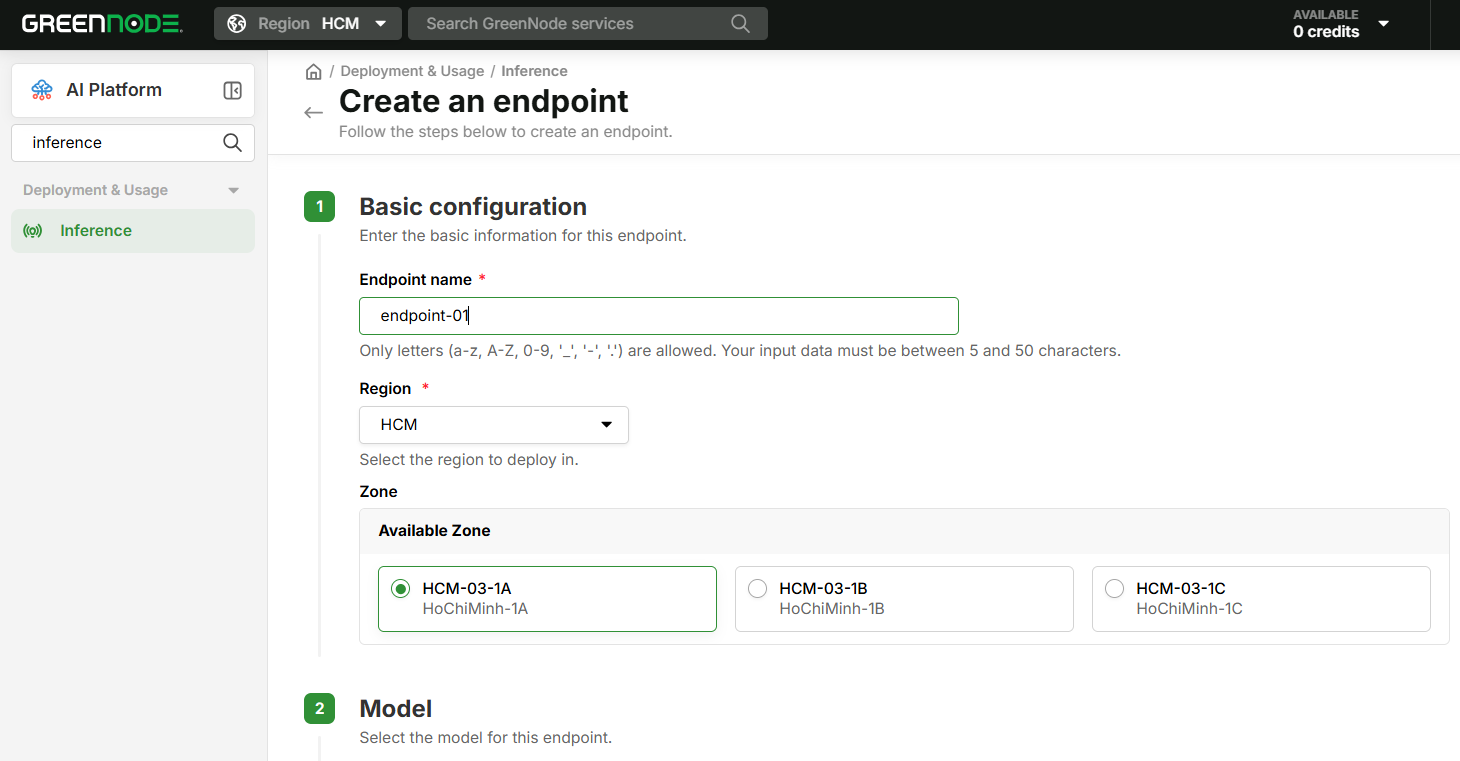
Lets businesses deploy AI models and convert them into APIs for real-world applications: deploy as RESTful APIs for easy integration into web, mobile, and chatbot applications, with optimized low-latency inference for fast response times and model version management to safely upgrade and control performance.
Typical use cases: AI chatbots, image/video analysis, and recommendation systems. Configurable replica counts also allow for autoscaling — this is the layer that closes the gap between "the model works in a notebook" and "the product team has an endpoint to call."
A quick scope note: you may see AI Gateway — a unified access layer for routing to multiple LLM providers like OpenAI, Google, and DeepSeek — mentioned alongside AI Platform in GreenNode's marketing. Structurally, it's a separate product within GreenNode's broader AI Stack rather than a bundled feature of AI Platform itself. In practice, though, the two are designed to work together under the same account and console, GreenNode's Model-as-a-Service, for instance, routes its requests through AI Gateway so if you need multi-provider LLM routing on top of models you've fine-tuned in AI Platform, it's an easy add rather than a separate vendor relationship to manage.
Pricing
GreenNode AI Platform is priced on consumption, and how that consumption is calculated differs by resource:
- Notebook Instance: priced by compute flavor (the combination of CPU, RAM, and GPU you select) plus the size of the Local Block Storage attached to the instance.
- Inference Endpoint: priced by compute flavor (CPU/RAM/GPU) used to run the model. If autoscaling is enabled, cost scales with however many replica instances are actually running at a given time, not a flat per-endpoint rate.
- Network Volume: priced by actual storage used (GB), so you pay only for what you store rather than a fixed allocation.
On top of that, GreenNode offers three payment models across the AI Stack:
- Prepaid: charged upfront when a resource (Notebook, endpoint) is created; unused balance is refunded automatically if you delete the resource early.
- Postpaid: use first, get billed at the end of the cycle based on actual consumption.
- Hold Credit: used specifically for Network Volume: the system reserves a portion of your credit and deducts from it gradually as storage is consumed.
Because the final cost depends on model size, GPU tier (RTX 2080 Ti, RTX 4090, or A40), and inference volume, two teams on the same platform can land on very different bills which is exactly why we work with each customer to size the right configuration rather than pushing a one-size-fits-all rate.
In practice, this means we'll walk through your setup with you, model size, expected traffic, GPU tier, and scope a quote around that, rather than handing you a generic rate card that doesn't reflect your actual workload. If you want to get a head start before that conversation, the Model Catalog's hardware requirements table is a good way to gauge which GPU tier your model needs.
Real-World Performance
Here's where we'll be direct: GreenNode doesn't publish independent, third-party-verified benchmark reports on inference latency, uptime SLA percentages, or GPU availability rates, so we won't invent numbers that aren't publicly documented. What we can say based on the architecture:
- Region: AI Platform's documented Notebook and Network Volume region is HCM (Ho Chi Minh City) only. Worth noting: GreenNode as a company already operates a large-scale AI Cloud data center in Bangkok, Thailand (STT BKK1), so the underlying infrastructure footprint extends beyond Vietnam — but that Bangkok capacity isn't yet exposed through the AI Platform product itself. For workloads serving users in Vietnam, HCM hosting is a latency advantage over hyperscaler regions that route through Singapore. For workloads serving Thailand, Indonesia, or the Philippines today, you're trading a single-region AI Platform setup for data-residency benefits — worth confirming with sales whether Bangkok support is on the roadmap if that matters for your use case.
- GPU tiers: The available cards in AI Platform's Model Catalog (RTX 2080 Ti, RTX 4090, A40) are solid mid-range options for models up to roughly 14B parameters based on the documented hardware requirements. GreenNode does offer H100 GPU clusters at the broader infrastructure level for large-scale distributed training, but that's a separate offering from the managed AI Platform layer — worth confirming with sales whether H100 access can be provisioned within Notebook/Inference or only as dedicated bare-metal infrastructure.
- Uptime: No public SLA percentage is listed on the documentation reviewed for this article. If uptime guarantees are a procurement requirement, get the SLA terms in writing during the sales conversation rather than assuming a number.
Who It's For
- ML Engineers who want to go from notebook to production API without filing a ticket to a separate infra or DevOps team.
- CTOs / IT Architects at companies where "our AI infrastructure vendor is inside Vietnam" is a real requirement, not a preference — particularly under Vietnam's AI Law (effective March 2026) and the PDP Law.
- BFSI and Healthcare teams handling data (KYC records, medical records) that legally can't leave the country, and who need training and inference to happen inside the same governed environment rather than bouncing between vendors.
- Teams fine-tuning for local language accuracy — companies in Vietnam, Thailand, and Indonesia that need a model to actually perform in the local language, not just tolerate it. Generic LLMs trained mostly on English text tend to lose accuracy on Vietnamese, Thai, or Bahasa Indonesia, especially in domain-specific text like contracts, medical records, or customer support transcripts. Rather than fine-tuning from scratch, teams can start from Model Catalog options like SeaLLMs or Qwen — models already better adapted to SEA languages — and fine-tune from there using Notebook and Network Volume. This is a meaningfully different starting point than pulling a generic English-first model off Hugging Face and hoping fine-tuning closes the gap on its own.
It's a weaker fit if you specifically need frontier-scale H100/A100 clusters within the self-service AI Platform layer (Notebook/Inference) rather than as separate bare-metal infrastructure, or if you need a platform with mature AutoML and governance tooling out of the box.
Read more: Revolutionizing Music Creation with AI application: A Practical Use Case from SongGen.AI
Limitations
To be fair to readers evaluating this seriously:
- Single region at the product level. AI Platform itself runs out of HCM only — there's no multi-region failover or Thailand/Indonesia/Singapore presence exposed through the product yet, even though GreenNode's broader infrastructure already has a data center in Bangkok.
- No AutoML layer. Model Tuning covers hyperparameter search, but there's nothing equivalent to SageMaker Autopilot's fully automated model selection.
- No published CI/CD pipeline orchestration. If your team wants native pipeline-as-code (à la SageMaker Pipelines), you'll need to build that layer yourself on top of the API.
- Notebook storage is ephemeral by design. Local block storage is wiped on stop; anything not synced to Network Volume before stopping an instance is gone. This is a workflow discipline requirement, not a bug, but it catches new users.
Alternatives Compared
| GreenNode AI Platform | AWS SageMaker | RunPod | Self-Hosted | |
|---|---|---|---|---|
| Data residency | Vietnam (HCM) only, by design | Global regions incl. Singapore; no VN region | 30+ regions globally; no VN-specific residency guarantee | Wherever you build it - your call, your responsibility |
| Lifecycle coverage | Notebook → Storage → Registry → Inference, natively connected | Full lifecycle but split across many separately-billed sub-services, with costs accumulating across whichever services a team uses | GPU compute + storage only. No built-in registry, notebook UX, or gateway | Everything as you assemble and maintain the full stack |
| Pricing model | Consumption-based, not publicly listed | Pay-as-you-go, component-billed; ml.-prefixed instances typically run 20–40% above equivalent raw EC2 pricing for the managed convenience | Published per-second GPU rates, roughly $0.12/hr to over $7/hr depending on GPU tier | Capex-heavy (hardware) or raw cloud GPU rental, plus your own ops overhead |
| Ease of use | Managed UI across full lifecycle, minimal DevOps needed | Powerful but carries a steep learning curve for teams outside the AWS ecosystem | Simple for GPU rental; DIY for everything above the compute layer | Full control, full complexity but you needs a dedicated platform/DevOps team |
| Regional language support | Curated SEA-language models in Model Catalog (SeaLLMs, Qwen) ready to fine-tune out of the box | No SEA-specific model catalog; teams source and adapt base models themselves | No curated model catalog; you bring your own base model and fine-tuning pipeline | Fully DIY — you source, adapt, and validate SEA-language base models yourself |
| Best fit | VN/SEA teams needing data sovereignty + full lifecycle in one place | AWS-native orgs with committed spend and compliance needs already met by AWS | Startups optimizing for cheap, flexible GPU compute without lifecycle tooling | Large orgs with existing infra teams and specific compliance/control requirements |
Verdict
Choose GreenNode AI Platform if your primary constraint is data residency in Vietnam and you want notebook-to-API in one governed environment without hiring a platform team to glue services together. It's a genuinely strong fit for BFSI, healthcare, and government-adjacent teams in Vietnam, and for ML engineers who'd rather not wait on DevOps to expose a model as an endpoint. It's also a strong starting point specifically for teams fine-tuning for Vietnamese, Thai, or Bahasa Indonesia accuracy, the Model Catalog's SeaLLMs and Qwen options give you a better base model than a generic English-first LLM, which neither SageMaker nor RunPod offer out of the box.
Skip it, at least for now, if you need multi-region redundancy across Southeast Asia, H100/Aai100-class GPUs provisioned inside the self-service AI Platform layer itself (rather than as separate dedicated infrastructure), a mature AutoML layer, or public self-serve pricing you can benchmark without a sales call. In those cases, AWS SageMaker's broader (if pricier) ecosystem, or RunPod's cheaper raw compute, may be the better starting point, with the tradeoff that you'll be assembling more of the lifecycle yourself.
Next step: if data sovereignty and an integrated Notebook → Moai_platform_reviewdel Registry → Inference workflow matter more to you than shaving compute costs, contact us to get pricing scoped to your actual model and traffic volume.
FAQS
Are there any comprehensive platforms for deploying and optimizing machine learning models?
Yes — platforms like GreenNode AI Platform, AWS SageMaker, and RunPod are built to cover the full ML lifecycle in one place. GreenNode AI Platform, for instance, connects Notebook (development), Model Tuning (hyperparameter optimization), Model Registry (versioning), and Inference (deployment) into a single workflow, so teams don't have to stitch together separate tools for training, optimizing, and serving models.
What are the best platforms for deploying and managing AI inference at scale in 2026?
The right platform depends on your priorities. AWS SageMaker offers the broadest ecosystem and autoscaling tools for large enterprises already on AWS. RunPod is a strong option for teams that want cheap, flexible GPU compute and are comfortable managing the rest of the stack themselves. GreenNode AI Platform is built for teams that need inference endpoints with autoscaling replica management inside Vietnam, particularly where data residency is a requirement alongside deployment scale.
Which Southeast Asian cloud platforms support LLM fine-tuning without needing to manage your own infrastructure?
GreenNode AI Platform is one of the few Southeast Asia-based options — it lets teams fine-tune models (including SEA-optimized options like SeaLLMs and Qwen from the Model Catalog) using a managed Notebook and Model Tuning environment, without provisioning or maintaining GPU servers directly. This is particularly relevant for Vietnam, Thailand, and Indonesia-based teams that need fine-tuning to happen within a locally hosted environment for data-residency reasons.
