

There is a problem most engineering teams run into when scaling from a single agent to a multiagent system: the agents start "forgetting" each other. Agent A collects customer data, agent B processes orders, agent C writes reports — but no one shares context. The result is a pipeline that produces fragmented, inconsistent outputs.
This is not a model problem. It is a memory architecture problem — specifically, a group memory problem.
If you are not yet familiar with the basic memory layers of a single agent (working, episodic, semantic, procedural), the article How to Stop Your AI Agents From Forgetting is a good starting point. This piece assumes you already have that foundation and goes straight to the harder question: when multiple agents run side by side, how should memory be shared, scoped, and governed so that the whole system can actually coordinate.
A recent analysis from O'Reilly Media (February 2026) argues that group memory is not an add-on feature once an agent system is running — it is a foundational layer that enables agents to coordinate in the first place.
Why single-agent memory is not enough for multiagent systems
For a single agent, persistent memory solves the problem of "remembering across sessions." Once you have five agents running in parallel, each keeping its own memory, three very different issues appear:
- Context drift: Agent A and B read two different versions of the same event.
- Duplicated work: Agent C repeats work agent A already completed because it is unaware the result exists.
- Incoherent outputs: The orchestrator tries to combine outputs from agents that do not share the same "truth."
An arXiv paper on "Governed Memory" (March 2026) shows that most multiagent systems fail in production not because their models are weak, but because they lack a shared memory layer with proper governance. This is a distributed systems problem, not a prompt engineering problem.
The blackboard pattern: a shared "board" for agents
The blackboard pattern is one of the most common and battle-tested architectures for shared context in multiagent systems. The core idea: instead of agents talking directly to each other, they all read from and write to a shared space — the "blackboard."
In practice, it works like this:
- The orchestrator initializes a task and writes the initial state to the blackboard.
- Specialized agents watch the blackboard and act as soon as they see input that matches their capabilities.
- Each agent writes its results back to the blackboard with metadata: agent ID, timestamp, confidence score.
- The orchestrator reads from the blackboard to assemble the final result.
The blackboard pattern solves coupling: an agent does not need to know which other agents exist, only the schema of the blackboard. This makes it easy to plug new agents into the system.
However, the pattern has one critical weakness: concurrent writes. When two agents write to the same entry at the same time, you need a clear conflict resolution mechanism — we will come back to this later.
Memory scoping: not every agent should see everything
A common architectural mistake is to implement shared memory as one flat database where every agent can read everything. This leads to two major problems: degraded performance due to retrieval noise, and security risk when agents handling sensitive data can see unrelated context.
Production systems in 2026 have converged on a pattern often called memory scoping or a "scope chain":
- Global scope: Semantic memory, business rules, shared facts — readable by all agents, writable only by privileged processes.
- Workflow scope: Episodic memory for a specific task or workflow — readable only by agents participating in that workflow.
- Agent scope: Local working state of each agent — not shared, typically stored in context or in keys (e.g., Redis) namespaced by agent ID.
The simplest way to implement this is to organize namespaces in the vector DB as {workflow_id}/{agent_id} and define a permission matrix that specifies which agents may read which namespaces. This is not a luxury feature — it is a baseline requirement for any system running on real customer data.
Teams building production-ready architecture for AI agents usually implement memory scoping from the start rather than trying to refactor it in once the system has scaled.
Conflict resolution: when two agents disagree
Memory conflicts in multiagent systems show up in two main forms: write conflicts and semantic conflicts.
For write conflicts (two agents writing to the same entry), familiar distributed systems techniques apply: optimistic locking with version vectors, or last-write-wins with timestamps for low-stakes data. For high-stakes data, such as financial decisions or order state, you need compare-and-swap style atomic operations.
For semantic conflicts (agents holding contradictory information about the same entity), things get more complex. An arXiv paper (January 2026) proposes a "Team of Rivals" architecture: instead of majority voting, you use a hierarchy with veto authority. A Planner agent proposes, an Executor agent acts, and a Critic agent can veto and force re-planning when it detects conflicts with semantic memory. This forces the system to converge on consensus rather than always picking the strongest agent's answer.
One practical rule that works well: do not put an LLM on the read path. When agents retrieve memory, do not use another LLM to "filter" results; it adds latency and a new point of failure. Retrieval should be deterministic and fast — vector similarity plus metadata filters. LLMs should only enter at the synthesis stage, after context has been assembled.
Coordinated forgetting: memory needs to expire
Group memory also needs clear deletion policies. Without them, semantic memory accumulates stale data and episodic memory grows unchecked, causing retrieval precision to degrade over time.
There are three main triggers for memory deletion:
- TTL-based: Working state deletes itself after N minutes or hours.
- Event-triggered: When a workflow ends, workflow-scope memory is kept for X days and then removed.
- Importance scoring: Entries are ranked using a combination of recency × relevance × importance score, and those below a threshold are deleted.
Frameworks like Mem0 implement this scoring function to automatically consolidate episodic memory into semantic facts once confidence is high enough — effectively providing a controlled "learning" mechanism for multiagent systems.
The key point for multiagent systems is that coordinated forgetting must be consistent. If agent A deletes a fact from its working memory but agent B keeps a copy in workflow-scope memory, the system can continue to make decisions based on outdated data. Expiration policies must be enforced at the memory layer, not at individual agents.
The right infrastructure for multiagent workloads
Group memory design is not just a software architecture topic; it drives specific requirements for the underlying infrastructure.
Typical infrastructure needs include:
- Low-latency reads: Retrieval should stay under 50 ms P95 to avoid blocking agent pipelines, which means optimized vector indexes and compute placed close to the data store.
- Concurrent write throughput: A system with 10 agents writing in parallel needs a backend that can handle concurrent writes with consistent ordering.
- Horizontal scalability: Adding new agents should not turn the memory layer into the bottleneck.
This is why engineering teams in Vietnam and Southeast Asia are increasingly choosing AI cloud platforms with integrated GPUs and low-latency regional deployments. GreenNode, for example, provides an environment tailored to these workloads through its AI Platform: GPU Cloud optimized for inference, managed Kubernetes (VKS) for container orchestration, and vDB for database operations — all deployed across six availability zones in Hanoi, Ho Chi Minh City, and Bangkok to keep latency between agents and the memory store within production-ready bounds.
Teams running multiagent workflows on self-managed infrastructure and feeling that complexity is getting out of hand often find that shifting to managed infrastructure is the right move at the right time.
Group memory deployment checklist
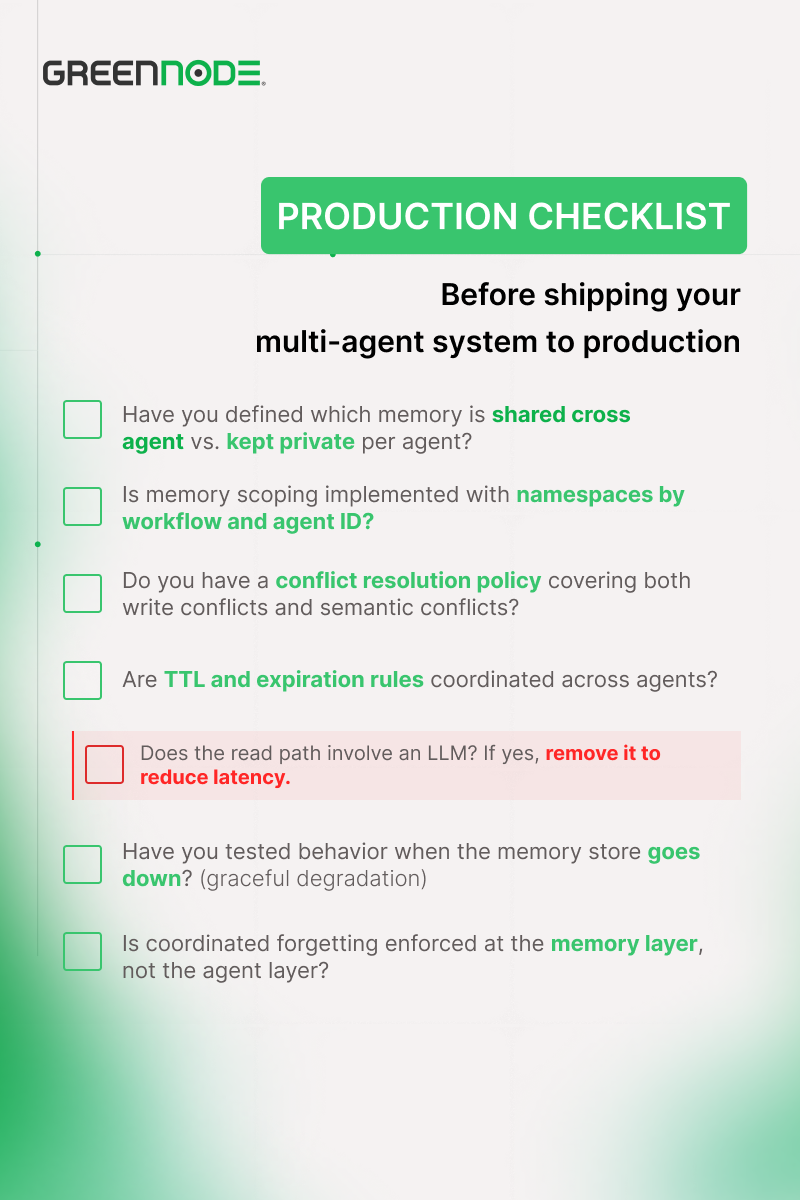
Before pushing a multiagent system to production, it is worth checking the following points:
- Have you clearly identified which memories need to be shared across agents and which should remain local?
- Is memory scoping implemented with namespaces by workflow and agent ID?
- Do you have conflict resolution policies for both write conflicts and semantic conflicts?
- Are TTL and expiration rules coordinated across agents?
- Is there an LLM on the read path? If so, can you remove it to reduce latency?
- Have you tested system behavior when the memory store goes down (graceful degradation)?
- Is coordinated forgetting enforced at the memory layer, not only inside individual agents?
Multiagent systems that look solid on paper often fall apart in production because they miss one or more of these points. Group memory design is therefore not an afterthought — it determines whether the agents in your system truly coordinate or just run in parallel without knowing about each other.
If you are building an agentic RAG architecture for low-latency environments or want to see how AgentBase handles memory and orchestration for multiagent workflows in production, those resources are good starting points for taking your system from prototype to a production-grade deployment.
